Are Outdoor Christmas Lights Waterproof, and What Do the Ratings Mean?
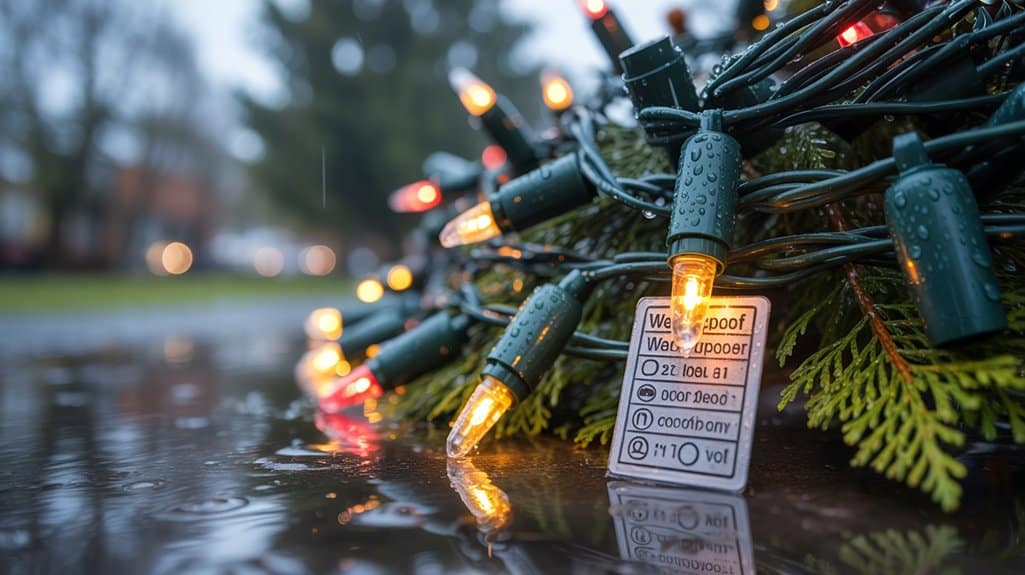
Water-Resistant, Not Waterproof
Outdoor Christmas lights carry a water-resistant rating, not a waterproof one, and no product in this category is listed for continuous submersion under roofline or ground-mounted installation conditions. That resistance is valid only when connectors, enclosures, and receptacles are installed according to manufacturer instructions, as required under NEC 110.3(B). UL 588 defines the listing framework that separates indoor-only strings from those approved for outdoor use.
What the Listings and Ratings Say
Three distinct listing regimes govern what an outdoor Christmas light product can claim about water resistance: UL 588 for the light string itself, UL 817 for cord sets, and UL 62 for flexible cord, where the W in a designation such as SJTW signals suitability for wet locations and outdoor exposure. Controllers, transformers, and junction enclosures carry either a NEMA Type designation under ANSI/NEMA 250-2020 or an IP code under IEC 60529, and substituting one system for the other discards meaningful information – NEMA types include corrosion, icing, and oil criteria that IP codes do not address. What a product is rated to withstand matters far less than whether it is installed in a configuration that preserves that rating, since NEC 110.3(B) ties a listing’s validity directly to compliance with the manufacturer’s instructions.
Outdoor product classes and the W in a cord designation
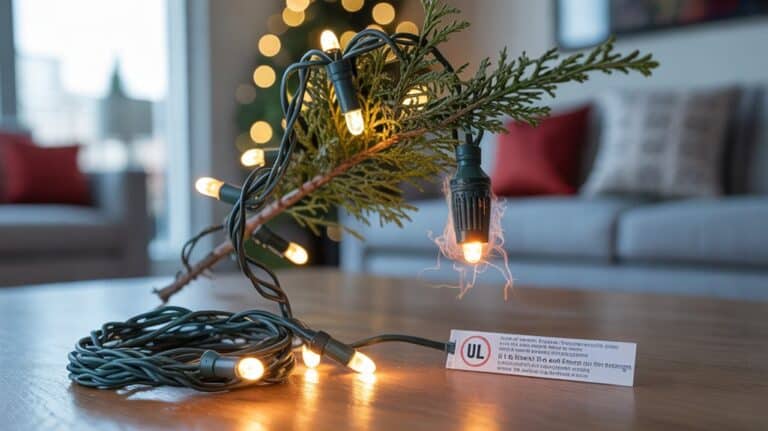
UL 588 distinguishes indoor-only Christmas lights from indoor-outdoor products by the specific tests each must pass, making the listing the definitive indicator of whether a string has any claim to water resistance. A product that carries only an indoor listing has no rated protection against rain, dew, or surface moisture, regardless of how it is marketed or packaged. The letter W in a flexible cord designation – such as SJTW – indicates suitability for wet locations and outdoor use under UL 62, and its presence on the cord jacket is a verifiable marker of outdoor-rated construction. Together, UL 588 and UL 62 define the product class before any enclosure rating or IP code enters the evaluation.
NEMA types, IP codes and why they are not interchangeable
ANSI/NEMA 250-2020 defines outdoor enclosure types including 3, 3R, 3S, 4, 4X, 6, and 6P, each with distinct criteria for rain, sleet, ice formation, hose-down exposure, and submersion, criteria that IEC 60529 IP codes do not replicate. An IP code carries two digits addressing solid-particle ingress and water ingress only, omitting the corrosion resistance, icing, and oil-exclusion provisions embedded in NEMA type designations. Because the two systems evaluate different properties, substituting an IP number for a NEMA type discards meaningful installation information rather than translating it. Under NEC 110.3(B), a rating applies only when the enclosure is installed in strict accordance with the manufacturer’s instructions, so an enclosure mounted upside down, fitted with an open knockout, or positioned outside its listed orientation carries no valid rating at all.
Where Water Actually Gets In
Ratings on the box describe the product’s tested limits, but water finds its way in at points the lamp string itself does not govern. The receptacle is the most consequential vulnerability: a flat flip cover that cannot close over an inserted plug leaves the connection exposed to direct rainfall, and a display that trips a GFCI when it rains almost always traces back to leakage current at a wet connector rather than a faulty device. Unused female ends left open, connectors resting at grade or in gutters, and any joint positioned at the low point of a cord run collect moisture the same way, feeding it toward the internal rectifier or driver where LED failures originate.
The receptacle cover and the GFCI that trips in rain
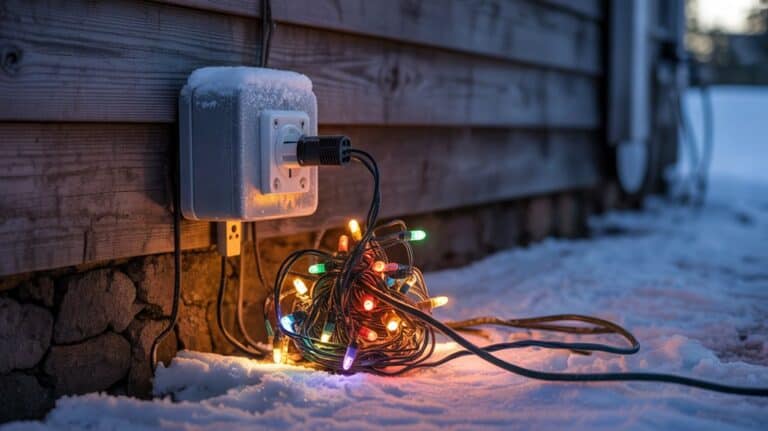
NEC Section 210.8 and IRC 2021 Section E3902 require outdoor receptacles to be ground-fault protected, and NEC 406.9(B) with IRC E4002 requires wet-location receptacles to be housed in enclosures that remain weatherproof with a plug inserted, mandating an in-use, or bubble-style, cover that closes over the plugged-in cord. The flat flip cover, which cannot accommodate an energized cord and still seal, is the most common water entry point in a holiday lighting installation. When moisture reaches a connection, leakage current develops; a Class A GFCI listed under UL 943 trips at roughly 4 to 6 milliamperes, so a display that loses power during rain has a wet connection rather than a malfunctioning protective device. Unused female plug ends left open, connectors resting at low points in a cord run, and cracked socket collars on C7 and C9 cord are the remaining primary infiltration paths.
Connectors, open ends and the low point in the run
Series connectors between cord runs, unused female plug ends left open, and cord joints resting at the low point of a run are the primary water infiltration paths in a Christmas lights installation. When a connector lies on a surface – a gutter channel, a roofline valley, or grade – standing water migrates into the joint by capillary action and produces the leakage current that trips a Class A GFCI, listed under UL 943, at roughly 4 to 6 milliamperes. Moisture inside an LED rectifier or driver, reached through an unsealed connector, is the characteristic failure path for LED strings. Unused female ends left uncapped present an open cavity that collects water directly, while a cord routed without attention to drainage concentrates water at every joint that sits below the adjacent run.
What a Weather-Ready Installation Looks Like
A weather-ready holiday lighting installation treats connection integrity and drainage geometry as the primary design criteria, not afterthoughts. Connectors elevated off grade, oriented with openings facing down, and sealed with purpose-made covers or dielectric-grade wrap stay dry because geometry and sealing work together; a connector sitting at the low point of a cord run will admit water regardless of its listed rating. Ice loading adds a separate failure path, where freeze expansion cracks socket collars and stiffens polymer clips, making cold-rated cord jackets and UV-stabilized clip stock more consequential to long-term performance than any waterproof claim on the packaging.
Elevating, sealing and orienting connections
Connector orientation and elevation above grade and gutter surfaces are primary installation controls that determine whether moisture enters a holiday light circuit at every series joint. When a connector hangs at a low point in a cord run, water migrates by gravity and capillary action into the socket collar, where leakage current accumulates until the Class A GFCI required under NEC 210.8 trips at its 4-to-6-milliampere threshold. Orienting connector openings downward and elevating joints above standing-water surfaces removes that collection point before it becomes a fault path. Unused female ends left uncapped present an equivalent risk and require purpose-made covers or dielectric-grade sealing wrap to maintain the water-resistance claim the product carries under UL 588.
Ice, cold and the ratings that matter more than waterproof
Ice expansion and freeze-thaw cycling crack C7 and C9 socket collars and lens housings in ways that no water-resistance rating under UL 588 addresses. Where temperatures drop below freezing, polymer clips and cord jackets stiffen, reducing flexibility and increasing the likelihood of cracking at connection points under mechanical load. ASTM G154 and G155 weathering test methods evaluate UV and thermal cycling resistance in cord jackets and clip stock, and products tested to those methods retain dimensional stability and flexibility under cold stress that untested materials do not. Ice accumulation also imposes structural load governed by ASCE 7, an independent failure mode that operates alongside, not in place of, the water-resistance criteria the installation already carries.
Frequently Asked Questions
A few questions surface repeatedly once a holiday display meets its first storm. Outdoor Christmas lights can get wet without immediate failure, but that tolerance depends entirely on rated connections, properly capped unused ends, and a GFCI circuit – because a display tripping in rain signals a compromised joint, not a defective protective device. IP44, snow loads, and freeze-expansion each introduce distinct failure paths that a rating printed on a package addresses only partially, with the installation itself carrying the remaining burden.
Can outdoor Christmas lights get wet?
Outdoor Christmas lights rated for outdoor use under UL 588 can get wet but are water-resistant, not waterproof. Resistance applies only when connectors are properly oriented, unused ends are capped, and the product is installed per manufacturer instructions under NEC 110.3(B). A GFCI trip during rain signals a wet connection, not a faulty device.
Why do my Christmas lights trip the GFCI when it rains?
A GFCI trip in rain means water has reached a connector, an open plug end, or a cord joint and is creating leakage current to ground. A Class A GFCI listed under UL 943 trips at roughly 4 to 6 milliamperes, a threshold easily reached by moisture bridging an exposed connection. The fault lies with the wet connection, not the protective device.
What does IP44 mean on Christmas lights?
IP44 under IEC 60529 indicates protection against solid objects larger than one millimeter and water splashing from any direction. NEMA enclosure types carry additional criteria – corrosion resistance, icing, and oil exposure – that an IP code does not address, making the two systems non-interchangeable. Installers should verify that the product’s listed standard, UL 588 for light strings, governs the actual installation conditions.
Can Christmas lights stay out in snow and ice?
Outdoor-rated Christmas lights can remain through snow and ice only when listed under UL 588 for indoor-outdoor use. Ice weight and freeze expansion crack socket collars and lenses, while cold-stiffened polymer clips lose holding strength. UV-stabilized cord jackets and clip stock rated for cold temperatures matter more than any waterproof claim.
Weather-Ready Christmas Lighting by Backyard Paradiso
Residential installations subject to sustained rain exposure, freeze-thaw cycling that stresses polymer socket collars, wet-location receptacle requirements under NEC 210.8, and ground-fault protection thresholds enforced by the governing jurisdiction present a layered set of conditions that determine whether a holiday lighting system performs reliably or fails at the first significant weather event. Backyard Paradiso works within this technical environment, applying familiarity with UL 588 outdoor product classifications, NEMA enclosure types, and connection-point water ingress to professional Christmas light installation across residential properties. Consultations are available by appointment for homeowners evaluating display scope, enclosure mounting compliance, or connector routing that eliminates low-point water collection. A display specified and installed this way avoids the repeated failures, GFCI nuisance tripping, and premature driver replacement that follow from treating a water-resistant product as a waterproof one.