When Should Christmas Lights Go Up and Come Down?
Three Clocks on a Holiday Display
Three separate clocks govern a holiday lighting display: the product standard window, the weather, and any applicable community or municipal calendar rules. Each clock imposes independent constraints, and the tightest one on any given installation controls the schedule. A holiday lighting display is a temporary decorative system installed on a residential structure for a defined season and removed before the product class limit expires.
The Product Clock
The listing standards governing Christmas lights and their associated cord sets and control devices define temporary use as an installation period not exceeding 90 days, and a display that remains beyond that window crosses into luminaire installation territory under a different product class entirely. That boundary has practical weight: professional installers book removal at the time of installation, not because the calendar demands it, but because the 90-day limit is fixed and removal carries the same fall and ladder risk as installation. Scheduling both ends of the display window before the first clip goes on the roofline is how that limit stays enforceable rather than aspirational.
The 90-day temporary-use window and what lies beyond it
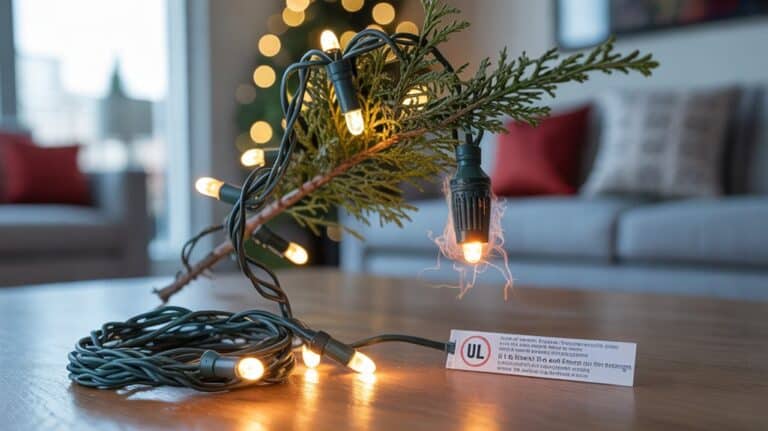
UL 588, the listing standard for seasonal decorative lighting products, defines temporary use as a period of installation and operation not exceeding 90 days. A display that remains in place beyond that window, or that is connected directly to a branch circuit rather than a cord set, has crossed out of the temporary product class and into the luminaire installation category governed by UL 1598 and the locally adopted electrical code. That boundary carries practical consequences: the hardware evaluated for temporary service was not tested to the thermal cycling, UV exposure, or mechanical fatigue that a longer installation accumulates. Installers who book both installation and removal dates at the outset – treating 90 days as a firm design window rather than a soft guideline – keep the display within the product class for which the equipment was listed and evaluated.
Why removal is booked at installation
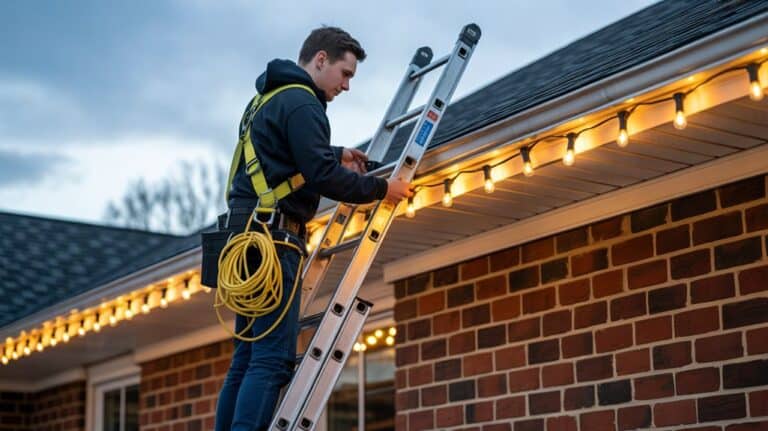
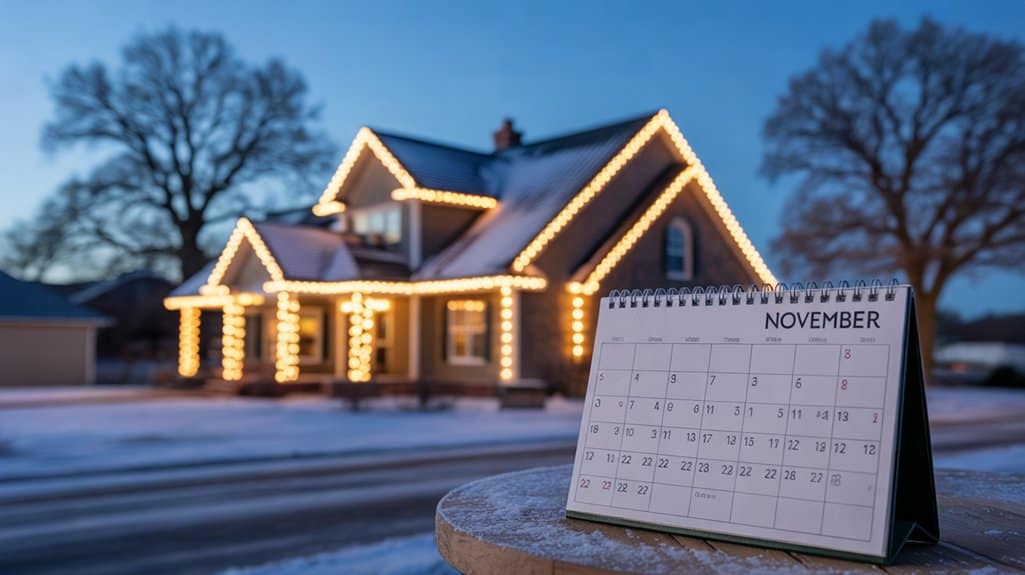
Professional installers book the removal appointment on the same day the installation contract is signed, treating the UL 588 90-day temporary-use limit as the scheduling boundary rather than a post-season afterthought. Removal carries the same fall and ladder hazards as installation – hazards governed for crews by OSHA 29 CFR 1926.501 and 1926.1053 – and available dates on a crew’s calendar compress quickly as the season closes. Booking removal at installation also disciplines the display timeline: a job installed in early-to-mid November that holds to the 90-day window must come down before the window closes, regardless of whether the homeowner has lost interest in the schedule. The 90-day boundary is not an administrative formality; it reflects the thermal cycling, UV exposure, and mechanical fatigue limits to which temporary-class products were evaluated.
The Weather Clock
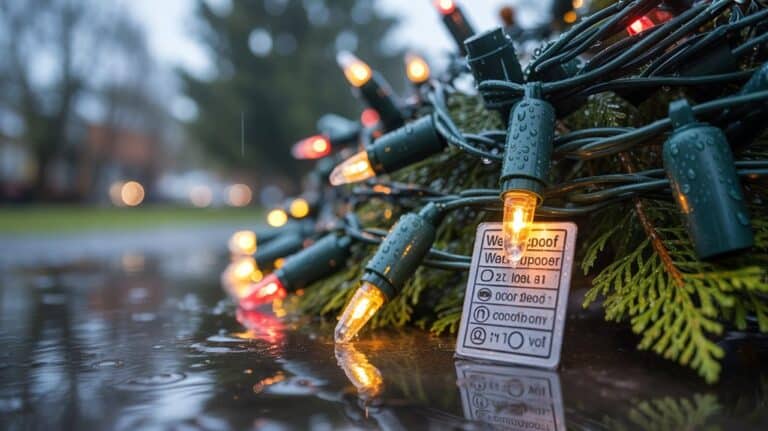
The weather clock runs independently of the product calendar, and it carries more immediate consequence – a wet or frosted roof surface, ice at the gutter line, or wind sufficient to displace a ladder are stop conditions regardless of where the date falls. Installation schedules in most residential contexts target the dry, daylight window that precedes the first hard freeze, because cord jackets and polymer clips stiffen and crack more readily when handled in sustained cold, compressing the margin for a clean layout. UV-stabilized clip stock is specified precisely because the material will carry a full season of solar exposure once installed, and that durability advantage is forfeited when clips are stressed during cold-weather handling before they have been set.
Dry roofs, daylight and wind as scheduling conditions
Wet or frosted roofing surfaces, inadequate daylight, and wind speeds sufficient to displace a ladder are stop conditions for crews working under OSHA 29 CFR 1926.501 and 1926.1053, which govern fall protection and ladder use, including the prohibition on using ladders on slippery surfaces without securing them. Christmas lights installation is fundamentally roof and ladder work, and those physical conditions determine whether the work proceeds or is rescheduled. Cord jackets and the UV-stabilized polymer clip stock evaluated under ASTM G154 and G155 weathering methods stiffen and crack more readily when handled in cold temperatures, making material condition an additional scheduling variable. The practical scheduling window that satisfies all three constraints – dry surfaces, adequate daylight, and manageable wind – typically closes as the first hard freeze approaches and the shortest days compress available working hours.
Cold, cord jackets and clips
Cord jacket materials and UV-stabilized polymer clip stock evaluated under ASTM G154 and G155 weathering methods become brittle and crack-prone when handled at low temperatures, making cold itself a material-handling hazard independent of surface or wind conditions. Clips that are forced around gutter stock or fascia edge in near-freezing temperatures are more likely to fail mid-season, compromising both the layout geometry and the mechanical retention that keeps cord sets away from sharp edges. The same polymer stock that resists seasonal UV degradation during the display window does so with properties calibrated to installation at reasonable ambient temperatures. Removal introduces a secondary inspection obligation: clips that have experienced a full season of wind loading may have migrated from their original placement and require assessment before the cord sets are stripped from the roofline.
The Calendar Clock
The calendar clock runs on two separate tracks: private covenants and public ordinance. Homeowner associations and design-review boards commonly set explicit display windows with defined lights-out dates, and those contractual obligations govern regardless of product standards or weather conditions. Municipal illumination or duration limits are less common in residential contexts but do exist in some jurisdictions, making it prudent to confirm local rules before installation – a step that also informs the timer schedule that a listed outdoor photocontrol or countdown timer will enforce through the duration of the display.
Association windows, local rules and timers
Homeowner associations and design-review covenants establish binding display windows and lights-out dates that govern Christmas light installations as private contractual obligations, independent of any municipal electrical code. These covenant windows vary by community and are not standardized across jurisdictions, so installers must obtain the specific association rules before scheduling either installation or removal. Municipal illumination or duration limits, where they exist, follow a parallel but separate authority; both mechanisms operate alongside the product-class 90-day boundary defined under UL 588 and matched by the 90-day holiday lighting allowance in NEC Article 590. A listed outdoor timer or photocontrol manages daily energized hours, limiting heat accumulation at connectors and reducing light trespass in line with the outdoor lighting zone principles in IES recommended practice.
When a permanent system is the better answer
A year-round roofline installation is classified as a luminaire system under UL 1598, with drivers evaluated under UL 8750, placing it outside the 90-day temporary-use boundary that governs Christmas light products under UL 588. That product-class distinction removes the removal-date constraint entirely, making a permanent system the appropriate answer when a homeowner requires lighting availability beyond any single holiday window, and it is the option most often chosen when roofline lighting is planned as part of an integrated outdoor living design rather than as a seasonal add-on. Because the system is treated as a fixed luminaire installation rather than temporary wiring, it is subject to the full requirements of the adopted electrical code rather than NEC Article 590. The fall and ladder hazards that define the scheduling logic for temporary displays – and that OSHA 29 CFR 1926.501 and 1926.1053 govern for professional crews – are addressed at installation alone, with no seasonal removal cycle to manage.
Frequently Asked Questions
Three questions surface consistently when homeowners and installers plan a holiday lighting project: when installation should begin, how long the display may remain up, and whether cold temperatures affect the process. The 90-day product window defined by UL 588 and NEC Article 590 anchors the first two answers, setting a hard boundary that shapes both the installation date and the removal date. Cold installation is permissible under those same standards but carries material consequences, as cord jackets and polymer clips stiffen at low temperatures and are more prone to cracking during handling and attachment.
When is the best time to put up outdoor Christmas lights?
The best installation window falls in the weeks before the first hard freeze, when surfaces are dry, daylight is adequate, and cord jackets remain pliable. UL 588 defines temporary decorative lighting use as a period not exceeding 90 days, so the installation date determines the latest permissible removal date. Homeowner association covenants may further narrow that window.
How long can Christmas lights stay up?
UL 588 defines temporary use as a period not exceeding 90 days, and NEC Article 590 allows holiday decorative lighting for the same 90-day period. A display that remains beyond that window, or is hard-wired to a branch circuit, exits the temporary product class and falls under luminaire installation standards. HOA covenants may impose shorter windows.
When should Christmas lights be taken down?
Christmas lights should come down before the 90-day installation window defined by UL 588 and NEC Article 590 expires. Weather conditions – specifically dry surfaces, calm wind, and above-freezing temperatures – govern the precise removal date more than the calendar. HOA covenants may impose an earlier lights-out deadline.
Can Christmas lights be installed in the cold?
Christmas lights can be installed in cold weather, but cold temperatures introduce meaningful material risk. Cord jackets and polymer clips stiffen and crack more readily when installed in freezing conditions, reducing long-term reliability. UV-stabilized clip stock, the material class addressed by ASTM G154 and G155 weathering standards, is specified precisely because components must endure a full season of environmental stress.
Christmas Light Installation and Removal by Backyard Paradiso
Residential Christmas light installation operates under intersecting clocks: the 90-day temporary-use window defined in UL 588 and NEC Article 590; the ladder and fall-protection requirements of OSHA 29 CFR 1926.501 and 1926.1053; and any private covenant or municipal illumination limits set by the local authority having jurisdiction. Backyard Paradiso’s Christmas light installation and removal crews work within all three frameworks, treating the 90-day product window and removal scheduling as engineered constraints rather than administrative afterthoughts. Consultations are available by appointment for homeowners evaluating installation timing, timer integration, or the boundary between temporary holiday lighting and a permanent UL 1598 roofline system. A crew that books removal at installation, accounts for weather stop conditions, and understands where the temporary product class ends protects both the display and the roof and gutter attachments that support it.