Can Pavers Be Laid Directly on Dirt or Grass?
Why Pavers Need a Base Instead of Bare Soil
Pavers require a compacted aggregate base beneath them because bare soil cannot carry load, drain water, or hold units level across seasons. In freezing climates, frost-susceptible soils heave and drop units cyclically, while organic topsoil decomposes and leaves voids regardless of climate. A compacted aggregate base transfers surface loads to stable ground and provides the drainage and dimensional stability a paver system depends on to function.
What Happens on Dirt or Grass
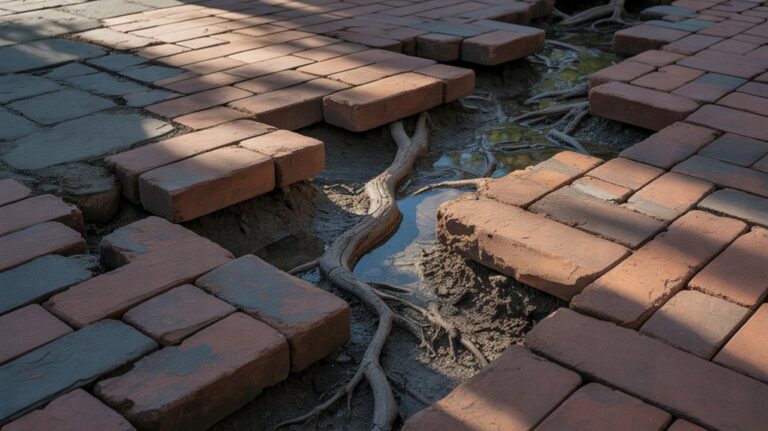
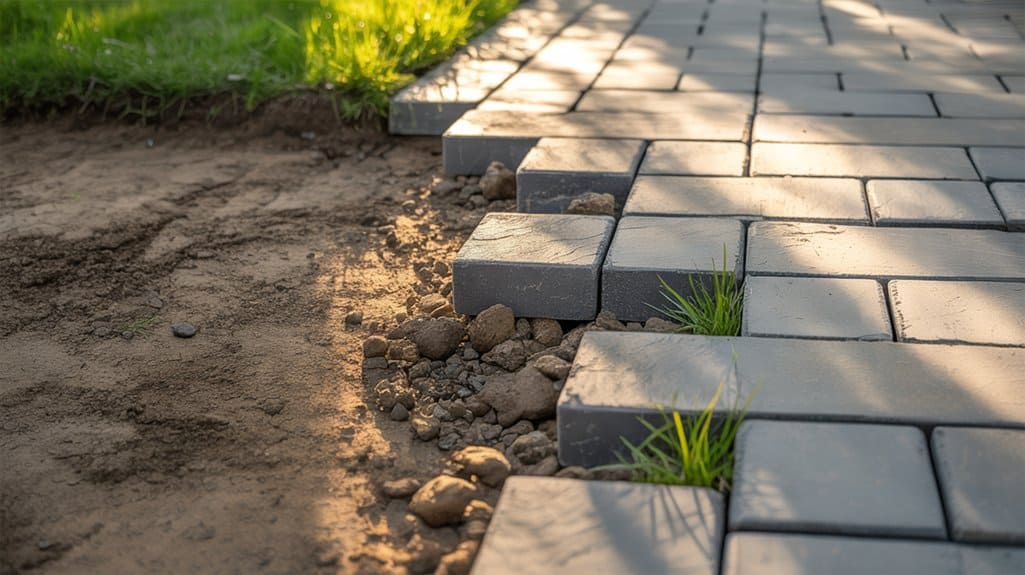
Topsoil fails as a subgrade because its organic content decomposes, leaving voids that allow individual units to settle unevenly and rock under load within a single season. Clay and silt soils hold water beneath the paver surface, enabling fine particles to migrate upward into the joints while saturated ground tips units out of plane; in frost-susceptible soils, that same retained moisture drives heave cycles that lift and drop the surface with each freeze-thaw event, a condition governed by site-specific frost depth rather than any single national threshold. Grass and roots beneath a closed paver field die, rot, and compound the settlement problem, and the unprotected joint sand that rests directly on native soil becomes a weed bed the moment airborne seed reaches it.
Settlement, rocking and the organic layer
Topsoil contains organic matter that decomposes over time, leaving voids beneath a paver surface that cause individual units to settle unevenly and rock under foot traffic within a single season. As vegetation and root material beneath the pavers die and rot, the loss of mass creates inconsistent support across the installation. Native soils compound this problem by compacting unevenly under repeated load, accelerating differential settlement. The Concrete Masonry and Hardscapes Association technical guideline PAV-TEC-002 requires that organic topsoil be stripped entirely before base preparation begins, a requirement that reflects how fundamentally incompatible living or decomposing material is with a stable paver surface.
Water, fines, frost and weeds
Fine-grained soils, including clays and silts, retain water beneath a paver surface and cause units to tip and migrate as saturated ground shifts under load. As water accumulates, fine soil particles migrate upward into joint spaces, disrupting interlock and accelerating surface instability. In freezing conditions, the consequences intensify: the U.S. Army Corps of Engineers EM 1110-3-138 identifies frost-susceptible soils – silts, silty sands, and low-plasticity clays – as materials that heave under freeze cycles and drop upon thaw, leaving the surface displaced each spring. Weeds compound the problem further, rooting upward through joints from undisturbed soil below, widening gaps and undermining edge restraint over successive growing seasons.
What a Base Does
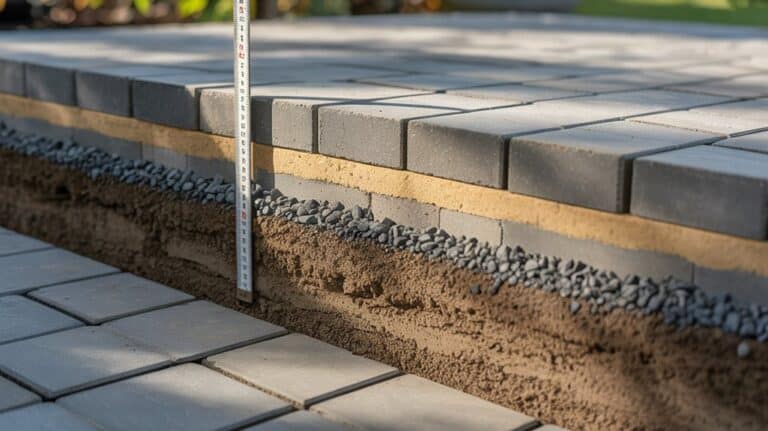
A properly built paver system is a layered structure, and each layer earns its place. The Concrete Masonry and Hardscapes Association’s guideline PAV-TEC-002 sequences the work from the bottom up: subgrade stripped of organic material and compacted to at least 98 percent of standard Proctor density per ASTM D698, a geotextile separator on fine-grained or weak soils to prevent fines from migrating into the aggregate, a compacted graded aggregate base in lifts to a minimum of four inches on well-drained soil, a one-inch screeded bedding course of ASTM C33 sand, and edge restraints on every free edge. Without that sequence, the paver surface has no mechanism for carrying load, draining water, or staying flat.
Subgrade, separator and compacted aggregate
The Concrete Masonry and Hardscapes Association technical guideline PAV-TEC-002 specifies that the subgrade beneath a segmental concrete pavement must be compacted to at least 98 percent of standard Proctor density as defined by ASTM D698, with proof-rolling performed to identify soft spots before any aggregate is placed. On fine-grained or weak soils, an AASHTO M288 geotextile separator is installed between the subgrade and the aggregate base to prevent fines from migrating upward and degrading the base over time. The compacted aggregate base itself must conform to ASTM D2940 and be installed in lifts to a minimum depth of four inches for patios on well-drained soil, with greater depth required on weaker or wetter subgrades. A one-inch bedding course of ASTM C33 sand, screeded to a uniform plane, completes the structural assembly beneath the paver units.
Bedding, restraint and drainage slope
The International Residential Code Section R401.3 requires a minimum two-percent slope away from a structure to direct surface water away from the foundation, a standard that governs how the finished plane of a paver patio must be graded. The compacted aggregate base is what makes that slope achievable and permanent; bare soil settles unevenly and cannot hold a drainage grade through seasonal loading. Edge restraints, installed on every free edge of the pavement, resist lateral spreading that would otherwise open joints, displace units, and destroy the screeded bedding plane beneath them. Together, the graded base, the ASTM C33 sand bedding course, and the mechanically fastened restraints form the structural system that keeps units interlocked, water moving outward, and the surface flat across years of use.
The Exceptions People Have in Mind
Two situations come up most often when someone questions whether a base is truly necessary: stepping stones set loosely in a lawn, and native soil that appears firm and well-drained enough to carry a patio on its own. These are not false comparisons – they describe real conditions that the standards actually address. What they do not describe, in either case, is a patio of edge-to-edge pavers on unmodified ground with sand as the only intermediary layer.
Stepping stones in a lawn
Stepping stones set individually in a lawn with turf between them constitute a path, not a pavement, and the two are not held to the same structural standard. Because each slab carries load independently and tolerates minor movement, the system is forgiving in ways that an edge-to-edge paver patio cannot be. Even so, a stepping stone placed directly on undisturbed soil will sink unevenly as organic matter beneath it decomposes; a few inches of compacted aggregate and a sand leveling layer under each individual slab resist that settlement. The distinction matters because homeowners frequently cite stepping stones as evidence that pavers can be installed on bare soil, an inference that does not transfer to continuous paved surfaces.
When native soil can carry a patio, and why sand alone cannot
The Concrete Masonry and Hardscapes Association’s design guidance PAV-TEC-004 establishes a soaked California Bearing Ratio of approximately 3 as the minimum threshold below which subgrade stabilization is required before any paved surface can be constructed. Native soil meeting that threshold and exhibiting well-drained granular characteristics may serve as a subgrade without full aggregate base augmentation, but the bedding course, edge restraints, and surface drainage slope remain mandatory regardless. Sand alone does not satisfy the base requirement under any soil condition; it migrates into fine-grained subgrades, holds water against the paver undersides, and shifts laterally without confinement. The finished surface must still drain at a minimum two-percent slope away from any structure, a grade that bare or lightly amended soil cannot reliably hold under traffic and seasonal moisture cycling.
Frequently Asked Questions
The questions homeowners ask most often share a common thread: whether some part of the base system can be skipped without consequence. Soil alone, grass beneath the units, sand as a substitute for compacted aggregate – each of these shortcuts removes a layer that carries load, sheds water, or holds the surface plane, and the patio fails in direct proportion to what is missing. The answers below address each scenario against the structural requirements established by the Concrete Masonry and Hardscapes Association.
Can you lay pavers directly on soil?
Pavers can be placed directly on soil, but the installation will not perform as a pavement. Topsoil contains organic matter that decompresses, rots, and leaves voids, causing units to dip, rock, and heave within a season. The Concrete Masonry and Hardscapes Association identifies a compacted aggregate base as a structural requirement, not an optional upgrade.
Can you put pavers on top of grass?
Pavers can be placed on top of grass, but the installation will not perform as a pavement. Grass and roots beneath the units die, rot, and leave voids that cause uneven settling within a single season. Without excavation and a compacted aggregate base, the surface lacks the structural foundation segmental concrete pavement requires.
Do you need gravel under pavers?
Compacted gravel base is required under pavers intended to function as a pavement. On fine-grained or frost-susceptible soils, the Concrete Masonry and Hardscapes Association specifies a graded aggregate base compacted in lifts to a minimum of four inches, plus a geotextile separator. Without it, uneven settlement and frost heave are predictable structural failures, not product defects.
Can you lay pavers on sand only?
Sand alone is not a sufficient base for a paver patio. Sand shifts, retains moisture, and migrates under load without a compacted aggregate layer beneath it to provide structure and drainage. CMHA guidelines identify the aggregate base, not the bedding sand, as the load-bearing component of a segmental concrete pavement system.
Paver Patio Installation by Backyard Paradiso
Residential segmental concrete pavement installations are governed by subgrade compaction requirements of at least 98 percent of standard Proctor density per ASTM D698, aggregate base grading per ASTM D2940, bedding sand conforming to ASTM C33, geotextile separation per AASHTO M288 on fine-grained soils, and finished surface drainage of no less than two percent per IRC 2021 R401.3. Backyard Paradiso applies each of these standards to paver patio installation, treating base engineering as the core discipline rather than an accessory step. Consultations are available by appointment for homeowners evaluating a patio project, allowing a site-specific assessment of subgrade conditions, drainage slope, and edge restraint requirements before any scope is committed. The structural longevity that separates a compacted aggregate base installation from work that omits excavation and restraint is decided at that assessment, with each project scoped to the soil and drainage conditions present on that site.