
Christmas Light Installation: The Complete Guide for Homeowners
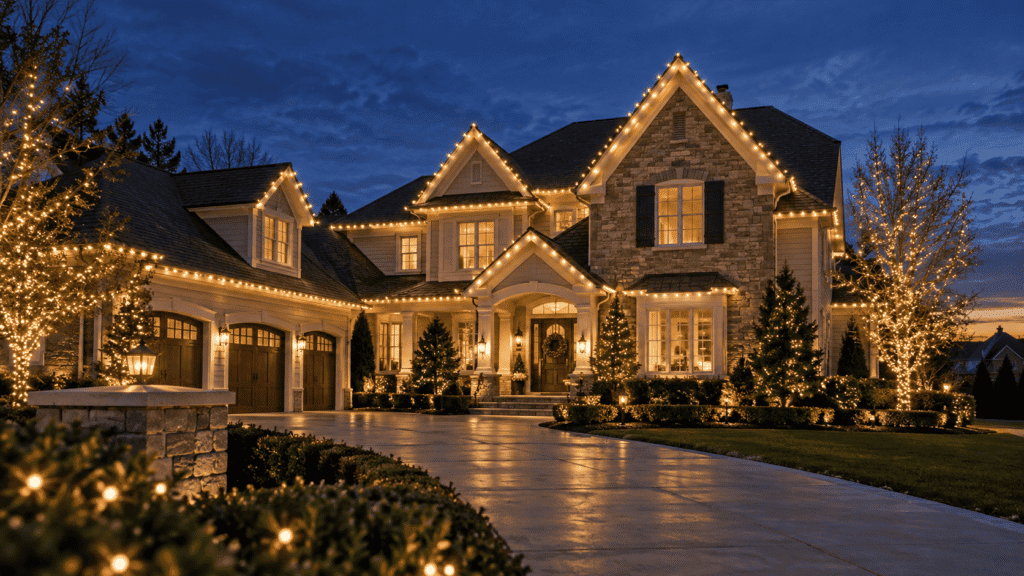
The case for professional Christmas light installation comes down to a single fact: a holiday display is two engineering problems at once. The first is structural — an attachment carrying wind load in the highest-pressure zones of a roof. The second is electrical — a temporary installation on circuits that must remain ground-fault protected and weatherproof for the entire time the display is in service. A homeowner on a ladder in November is not decorating; they are performing elevated structural and electrical work without the fall protection framework, the product listings, or the code knowledge that the work actually requires. Professional installation transfers both problems — and both categories of risk — to a crew equipped to solve them.
This guide covers what a well-informed decision about Christmas light installation requires: how professional installation compares to the do-it-yourself alternative and to consumer-grade retail product, where holiday lighting differs from permanent roofline lighting, what the product classes and performance standards actually specify, how attachment engineering protects the roof and the structures the lighting is mounted to, what the electrical requirements involve, what the installation process and the annual program look like, what drives cost, and how conditions across the markets Backyard Paradiso serves test the same standards in different ways.
Professional installation vs every alternative: when the service is justified
Professional Christmas light installation costs more than a homeowner doing the work with retail product. That is the fact that needs addressing before the technical details, because the decision to hire the work out is a decision about what is actually being purchased — and it is not primarily the lights.
Professional installation vs doing it yourself
The safety data frames this comparison before any discussion of design quality. Emergency-department estimates published by the U.S. Consumer Product Safety Commission for injuries involving holiday decorating have run in the range of twelve to fifteen thousand per season across the last decade of published releases, and falls — overwhelmingly from ladders and rooflines — are consistently the leading mechanism, accounting for more than a third of incidents in the published estimates. The National Fire Protection Association’s fire statistics add the second exposure: per NFPA’s published 2018–2022 annual averages, 155 home structure fires per year began with Christmas trees, with electrical distribution or lighting equipment involved in more than two of every five such fires, and an additional annual average of 835 home structure fires began with decorations other than trees.
Professional crews work under the federal occupational safety framework that a homeowner does not have: fall protection required at working heights of six feet or more under 29 CFR 1926.501, ladder positioning and extension rules under 29 CFR 1926.1053, and — most consequentially for roofline and mature-tree work — a minimum approach distance of ten feet from overhead power lines for anyone who is not a qualified electrical worker, under 29 CFR 1910.333. Service drops and lateral tree canopies routinely fall inside that ten-foot envelope on residential properties. The homeowner on a ladder next to the service drop is not breaking a rule; they are simply doing hazardous work without the framework that exists specifically because that work injures people every season.
Professional-grade vs consumer-grade product
Retail holiday lighting is a legitimate product class — listed to UL 588 as a temporary-use product with a nominal 120-volt input — but the federal product-safety rule that governs the category identifies exactly where the class fails. Under 16 CFR 1120.3, seasonal and decorative lighting products lacking minimum wire size, sufficient strain relief, or overcurrent protection are deemed substantial product hazards under the Consumer Product Safety Act. Those three characteristics — wire gauge, strain relief, overcurrent protection — are precisely the corners cut in the lowest tier of retail product, and they are the failure points that turn up as pulled-out conductors, separated connectors, and heat-discolored plugs by the second or third season.
Professional-grade product is specified rather than purchased off a shelf: commercial-duty cord and socket construction, listed outdoor wiring devices for timers and controls under UL 2438, and — for the light sources themselves — photometric performance that traces to actual test data rather than packaging claims. Light output and efficacy claims are verifiable only through ANSI/IES LM-79 test reports; lumen maintenance over time is measured under ANSI/IES LM-80 and projected under ANSI/IES TM-21. Color consistency is specified to ANSI C78.377 chromaticity categories with a stated tolerance — the reason two runs of nominally identical retail product can read as visibly different colors on the same roofline is that wide chromaticity tolerance bins permit exactly that mismatch.
Christmas light installation vs permanent roofline lighting
These are adjacent services, not competing ones, and the product standards themselves draw the line between them. Holiday lighting is a temporary-use product class: portable, plug-connected, in service for not more than 90 days, listed to UL 588 with cord sets and outdoor wiring devices under their own companion standards. Permanent roofline lighting is a luminaire installation — a different product class entirely, governed by UL 1598 as the tri-national luminaire standard, with LED drivers and control gear evaluated under UL 8750, hard-wired to branch circuits as a permanent part of the home’s electrical system.
The practical differences follow from the classification. A permanent system serves year-round architectural and accent lighting with holiday modes as one capability among many; a professional holiday installation serves the display season specifically, with complete design freedom each year and no fixed hardware on the home the other nine months. Many properties are well served by both — a permanent system carrying the year-round architectural layer, with holiday installation adding the elements a fixed roofline system cannot: tree wraps, wreaths and garland, ground displays, and design features that change from season to season. A display left in service beyond the 90-day temporary-use window, or hard-wired to a branch circuit, has moved out of the holiday product class entirely and into the territory where the permanent-lighting standards govern.
The framing question
The correct way to evaluate professional Christmas light installation is not against the price of a retail light set — it is against everything the retail light set does not include. What the service actually delivers is an engineered attachment system that protects the roof, an electrical design that keeps the display safe for the full season, a crew carrying the elevated-work risk under a proper safety framework, commercial-grade product with verifiable performance, a design composed for how the property reads from the street, and a homeowner whose November weekends do not involve a ladder. The lights are the visible fraction of the purchase.
Applications: where professional installation matters most
The engineering demands of holiday lighting differ substantially by where it is mounted — and the applications where professional installation delivers the most value are the ones where the attachment problem, the electrical problem, or both are hardest.
Rooflines
The roofline is the defining element of a residential holiday display and the most demanding attachment environment on the property. Under the wind-load framework of ASCE/SEI 7-22, attached decorative elements are analyzed as components and cladding, and the corner and edge zones of a roof — exactly where roofline lighting runs — carry the highest wind pressure coefficients on the entire building envelope, a zone structure documented in the National Institute of Standards and Technology’s wind-engineering publications. The same lighting run relocated a few feet inboard from a roof corner faces a materially different wind demand. Professional roofline installation uses non-penetrating clip systems that engage shingle edges, gutter lips, or ridge profiles without driving a single fastener through the roof covering — preserving both the tested wind rating of the roofing assembly and the manufacturer’s warranty terms.
Mature trees
Tree lighting on established specimen trees is arboricultural work before it is lighting work. Supplemental support systems in established trees are governed by the ANSI A300 standard series, and the operative practice principle is independent of edition: decorative loads on mature trees are carried by non-penetrating, adjustable, load-distributing attachments — never by fasteners driven into living tissue. Canopy work also puts installers into the elevation and power-line-proximity envelope where the occupational safety framework matters most; lateral tree canopies are among the most common intrusions into the ten-foot approach distance from overhead conductors.
Pergolas and outdoor living structures
An aluminum pergola, a covered outdoor kitchen, or a pavilion extends the display into the outdoor living environment — and each structure brings its own attachment constraints. Framing members are engineered elements: added lighting presents additional projected area to the wind on structures that are already open and wind-sensitive, and fastening into timber elements is governed by the connection provisions of the National Design Specification for Wood Construction. Structures that already carry landscape lighting or permanent lighting also set a chromaticity baseline — the holiday layer should be specified to coordinate with the existing lighting’s color temperature rather than clash with it.
Entries, walkways, and hardscape
Wrapped columns, lit entry features, and ground-level displays along walkways and drive courts anchor the display at eye level. Anchorage into concrete or masonry — piers, parapets, and paver hardscape — is a designed connection under the anchoring provisions of the American Concrete Institute’s structural concrete code, with post-installed anchors qualified under the companion ACI anchor-qualification standards for exactly the repeated wind loading a display experiences. Cord routing across walkways, turf, and entry paths must preserve accessible routes and avoid the trip and abrasion exposure that ground-level cord runs create.
Estate-scale displays
Large properties compound every one of the above: long rooflines, multiple structures, extensive tree inventories, and — critically — electrical demand that frequently exceeds the exterior receptacle capacity the home was built with. At estate scale, the design question is a load-calculation and circuit-architecture question before it is a product question, and voltage drop on long runs becomes the dominant electrical design constraint. This is the application tier where the difference between an installer and an engineering-led installation practice is most visible.
Product classes and performance standards: what the specifications actually mean
The holiday lighting market is opaque to homeowners largely because packaging claims are unregulated in practice while the underlying standards are precise. Understanding four specification areas cuts through most of it.
The temporary-use product class
Holiday lighting products are listed under UL 588, the standard for seasonal and holiday decorative products, whose scope defines temporary use as a period of installation and use not exceeding 90 days. Cord sets for that service are covered under their own standard, and outdoor wiring devices — timers, photocontrols, fused inline devices, and remote-control or synchronized devices — are listed under UL 2438 for temporary outdoor use with holiday lighting outfits. That 90-day boundary, repeated across all three standards, is the technical dividing line of the entire category: inside it, the product class is legitimate for what it is; beyond it, the installation belongs in the permanent luminaire class with entirely different requirements.
LED performance: what a lifespan claim is worth
LED light sources are characterized by measured data, not by round numbers on a box. Lumen maintenance — how much of the original light output remains after thousands of hours of operation — is measured under ANSI/IES LM-80 and projected forward under ANSI/IES TM-21. The Illuminating Engineering Society’s position statement on the projection method imposes a hard limit: projections may not exceed six times the duration of the underlying test data, which means ten thousand hours of measured data supports a projection of no more than sixty thousand hours — and a one-hundred-thousand-hour lifetime claim on consumer packaging is, by the industry’s own governing method, unsupported. In practice, the driver electronics rather than the LED itself typically determine when a lighting system fails — which is why professional-grade product selection weighs driver quality as heavily as diode specification.
Color consistency
Chromaticity — the actual color of white light — is specified under ANSI C78.377, which defines nominal correlated color temperature categories including 2200 K, 2500 K, 2700 K, 3000 K (Warm White), 4100 K (Cool White), 5000 K, and 6500 K (Daylight), each with defined tolerance ellipses. The tolerance is the part that matters for a display read as a single composition: product binned to a tight tolerance reads as one continuous color along a roofline, while product binned loosely produces the visible warm-to-cool drift between runs that is the signature of consumer-grade material. A property with existing landscape lighting has already established a color temperature — the holiday specification should be selected against it deliberately.
Controls
Timers, photocontrols, and remote or synchronized control devices for outdoor holiday service are their own listed product category under UL 2438, restricted to standard grounded plug configurations and covering fused devices, flasher control, and remote-control features within the listing. Control selection is part of the electrical design, not an accessory decision — a controller is an outdoor electrical enclosure that must hold its weatherproof integrity for the full season.
Attachment engineering: how the display stays up without damaging the home
Non-penetrating attachment as the governing principle
The single most important rule of professional holiday installation is that nothing penetrates the roof covering. Steep-slope roofing products earn their wind ratings under specific test methods — fan-induced wind resistance and shingle uplift resistance under the applicable ASTM standards — and those ratings apply to the assembly as tested. A screw or staple driven through a shingle introduces a fastener path that no wind-resistance test evaluated and that no roofing warranty contemplates. Professional installation uses purpose-made non-penetrating clips — UV-stabilized polycarbonate and glass-reinforced nylon constructions that engage shingle edges, gutter lips, and ridge caps by interference fit — precisely because they leave the weather barrier untouched.
Wind loading
Attached decorative assemblies — roofline runs, oversized wreaths, sculptural elements, tree-mounted features — present projected area to the wind at the building envelope’s highest-pressure locations. The components-and-cladding framework of ASCE/SEI 7-22 governs the analysis, and the zone structure is unforgiving: roof corners and edges, and wall edges, carry the highest pressure coefficients. A typical single-family residence is Risk Category II under that framework, with a design wind basis documented by NIST as a 700-year return-period gust. Individual light strings are light; assemblies with real projected area are not, and treating a large display element as structurally trivial is how displays end up on the lawn after the first winter wind event.
Hardware specification
Metallic hardware in the attachment stack is specified by alloy and coating, not by appearance. Stainless fastener alloys are grouped under ASTM F593 — the 304 family in one group, the 316 family in another — and selection between them is governed by the corrosivity of the site, classified under ISO 9223 by factors including the temperature-humidity complex and airborne salinity. Galvanized coatings on hardware and fasteners fall under their own ASTM specifications. The mechanisms that defeat otherwise adequate hardware — chloride pitting, galvanic coupling between dissimilar metals, crevice corrosion under clip footprints and washer faces — are addressed by correct specification at the outset, not by maintenance afterward.
Tree attachment
Attachment in living trees follows the arboricultural standard rather than any lighting standard: non-penetrating, adjustable, load-distributing hardware that the tree can be released from cleanly at takedown. Fasteners driven into living tissue create permanent wounds for a temporary display — a trade no professional practice accepts.
Electrical requirements: the two-layer structure of a compliant installation
Holiday lighting sits at the intersection of two regulatory layers that homeowners — and a fair number of installers — routinely conflate. The first layer is product safety: whether the lighting outfit, cord sets, wiring devices, and drivers are listed products fit for outdoor holiday service. The second is installation safety: whether the branch circuits, receptacles, grounding, and support conditions of the specific property comply with the electrical code as adopted in that jurisdiction. A listed product on a non-compliant circuit and a compliant circuit feeding an unlisted product are both defective installations. Professional practice addresses both layers.
Ground-fault protection
Exterior receptacles feeding a holiday display require ground-fault circuit-interrupter protection under the adopted electrical code — for one- and two-family dwellings, the corresponding provisions sit in the ground-fault protection section of the 2021 International Residential Code’s electrical chapters. The protective device itself is a Class A GFCI listed to UL 943, which trips when current leaking to ground reaches the range of four to six milliamperes — the personnel-protection threshold. This is the device standing between a damaged cord in a wet December landscape and a serious shock event, which is why a GFCI that trips repeatedly during the season is providing information, not malfunctioning: the correct response is diagnosis of the fault, never bypassing the protection.
Wet-location integrity
Outdoors is a wet location in electrical code terms. Exterior receptacles must sit in weatherproof enclosures that maintain their integrity with a plug inserted — the in-use cover requirement — and controllers, junction enclosures, and connection points across the display must hold their weatherproof ratings for the full season. Enclosure protection types are established under the ANSI/NEMA enclosure standard, and the listing conditions matter: the National Electrical Code makes a listed product’s installation instructions binding, which means an enclosure’s rated conditions, a clip’s stated substrate, and a driver’s stated ambient range are code obligations rather than suggestions.
What the fire code prohibits
NFPA 1, the Fire Code (2024 edition), carries the electrical-safety provisions most often cited against holiday installations, and the prohibited field practices are exactly the ones improvised displays rely on: daisy-chaining relocatable power taps, connecting power strips to extension cords to extend their reach, and using cords as a substitute for permanent receptacles. A professional installation is designed so that none of those practices is necessary — adequate circuit capacity, correctly sized listed cord assemblies, and connection architecture planned before the first light goes up.
Capacity and circuit architecture
Estate-scale displays frequently exceed the exterior electrical capacity a home was built with, and the design response is a load calculation under the adopted code’s branch-circuit calculation provisions — not an extension cord. On long runs, voltage drop becomes the dominant design constraint: a roofline or drive-court run can exceed the length assumptions behind ordinary residential branch circuits, and the visible symptom is dimming and color shift at the far end of the run. Circuit architecture — how many circuits, where they originate, and how runs are segmented — is the invisible half of a display that performs uniformly from end to end.
Jurisdiction variability
The National Electrical Code is adopted state by state and amended locally, on different editions and different schedules — the statutory mechanisms in Texas, Florida, New York, California, and elsewhere each produce their own adoption pattern, and municipalities layer local amendments on top. Whether a display element requires a permit, which code edition applies, and what the fire official’s requirements are can all differ between two neighboring municipalities. No threshold in this domain should be treated as a national constant — code and permit verification is a per-project step, and Backyard Paradiso performs it as part of every installation rather than quoting general rules.
The Christmas light installation process
Professional holiday lighting is an annual program, not a one-time transaction — and the process reflects a full season lifecycle.
Design consultation and site assessment
Every installation begins with a site assessment covering the design intent, the roofline geometry and linear footage, the tree and structure inventory, the exterior electrical capacity and receptacle locations, access conditions and working heights, and any HOA or jurisdictional requirements specific to the property. The assessment also inventories the existing outdoor lighting — landscape lighting, permanent lighting, and lit structures — so the holiday layer is specified to coordinate with what is already there.
Specification and design
The assessment produces the design: product class and grade, chromaticity specification, the attachment method for each element of the display, the control scheme, and the circuit plan. On properties where capacity is marginal, the specification stage is where that is identified and resolved — before installation, not during it.
Installation
The crew installs under the occupational safety framework the work requires — fall protection at height, correct ladder practice, and strict observance of power-line approach distances. Attachment is non-penetrating throughout: clips on rooflines, load-distributing hardware in trees, engineered anchorage where display elements meet hardscape. Cord routing is planned to stay clear of walkways, moving assemblies such as retractable awnings and motorized zip screens, and abrasion points. The display is energized, tested circuit by circuit, and reviewed against the design before the crew leaves.
In-season service
A display in service for weeks in winter weather will occasionally need attention — a segment outage, a tripped GFCI, a wind-displaced element. In-season service is part of the program: the homeowner reports the condition and the crew resolves it, rather than the homeowner climbing a ladder in December.
Takedown, inspection, and storage
At the end of the season the display comes down the same way it went up — safely and without damage to the home. Takedown doubles as inspection: cord jackets, strain reliefs, connectors, clips, and hardware are checked against the diagnostic indicators of wear, and components that show UV embrittlement, corrosion, strain-relief damage, or connector heat discoloration are flagged for replacement rather than stored for reuse. Components are labeled, packed, and stored in a manner that preserves them for the following season — the maintenance-program discipline that the lighting industry’s maintenance practice standards formalize.
Pre-season inspection
Before the next installation, stored assemblies are inspected and tested so that what goes up is known-good product. Over a multi-year program, this cycle — install, service, inspect, store, re-inspect — is what separates a display that performs identically every season from one that degrades a little more each year.
What drives Christmas light installation cost
Holiday installation cost is driven by the scope of the design, not by linear footage alone — and understanding the drivers explains why two properties with similar rooflines can carry very different project scopes.
Linear footage and display elements
Roofline footage is the baseline, but the element mix moves the scope more: tree wraps on mature specimens, wrapped columns, garland and wreath programs, and ground displays each carry their own labor and attachment engineering beyond simple footage.
Access and height
Working height changes everything about the labor scope. Two-story and three-story rooflines, steep pitches, and elements over hardscape all expand the safety framework, the equipment, and the crew time the work requires — the same drivers that make the do-it-yourself version of this work dangerous make the professional version more involved.
Electrical scope
A property with ample, well-placed exterior circuits is a different project from one where the display design approaches the home’s exterior capacity. Load assessment, circuit segmentation for long runs, and control architecture are engineering scope, and they scale with the ambition of the display.
Product grade and program structure
Commercial-grade product costs more than retail product and outlasts it by a margin that the performance standards make measurable — lumen-maintenance data of adequate duration is the difference between a documented service-life expectation and a packaging claim. Multi-year program structure matters too: a display designed once and re-installed across seasons amortizes the design and product investment differently than a single-season engagement.
Thinking about the cost as what it replaces
The homeowner alternative to professional installation is not zero cost — it is retail product replaced far more frequently, weekends spent at height in November and January, and personal exposure to the fall and electrical risks that the injury data quantifies every season. The professional program replaces all of it: the risk is carried by an equipped crew, the product performs for multiple seasons, the display is serviced when weather interferes, and the homeowner’s involvement is choosing the design. For properties where the December presentation matters — and in the neighborhoods Backyard Paradiso serves, it does — the program is the difference between lights on a house and a composed display.
How conditions test the standards across the markets
The standards that govern a defensible holiday installation do not change from market to market — only the conditions that test them do. Florida humidity and coastal salinity push hardware specification toward the higher-corrosion-resistance alloy groups and make enclosure integrity a season-long test rather than a formality. Colorado altitude intensifies UV exposure on polymer clips, cord jackets, and lenses — the degradation mechanisms the accelerated-weathering test methods exist to characterize. New Jersey freeze-thaw cycling works clip preload and clamped joints through repeated thermal movement. Illinois snow adds sustained load to attachments engineered for wind. Texas heat tests driver electronics and polymer components at the upper end of their rated ambient ranges. The specification work — alloy selection against site corrosivity, UV-stabilized polymer components, attachment methods qualified for cyclic loading — is how one installation standard holds across all of those environments. The full list of markets is on Markets We Serve.
Frequently asked questions about Christmas light installation
How long do professionally installed LED Christmas lights last?
Commercial-grade LED holiday lighting is specified against measured lumen-maintenance data rather than packaging claims. Light-output retention is measured under ANSI/IES LM-80 and projected under ANSI/IES TM-21, and the industry’s governing position statement limits any projection to six times the duration of the underlying test data — which is why round-number lifetime claims of one hundred thousand hours are unsupported by the industry’s own method. In practice, the driver electronics typically determine system life rather than the LED itself. A professionally specified system is selected for documented multi-season service, inspected at takedown, and re-verified before each installation.
Does a Christmas light display require a permit?
There is no universal answer — permit requirements, the applicable electrical code edition, and fire-official requirements are all set jurisdiction by jurisdiction, and they can differ between neighboring municipalities. State adoption statutes and local amendment authority make code applicability a per-property fact. Backyard Paradiso verifies the applicable requirements for each property as part of the installation process rather than applying general assumptions.
Can Christmas lights be attached with screws or staples through the roof?
No. Roofing products earn their wind ratings as tested assemblies, and a fastener driven through the covering introduces a penetration that no wind-resistance test evaluated and no roofing warranty contemplates. Professional installation uses non-penetrating clip systems that engage shingle edges, gutter lips, and ridge profiles by interference fit, leaving the weather barrier untouched. The same principle applies in trees, where the arboricultural standards call for non-penetrating, load-distributing attachment rather than fasteners in living tissue.
Are extension cords and power strips acceptable for Christmas lighting?
The Fire Code addresses this directly: NFPA 1 prohibits daisy-chaining relocatable power taps, prohibits connecting power strips to extension cords to extend their reach, and treats cords as temporary devices that are not a substitute for permanent receptacles. An improvised display leans on all three practices; a professional installation is designed so that none is necessary — adequate circuit capacity, correctly sized listed cord assemblies rated for outdoor holiday service, and a connection architecture planned before installation begins.
What is the difference between Christmas light installation and permanent roofline lighting?
The product standards draw the line. Holiday lighting is a temporary-use product class — portable, plug-connected, and in service for not more than 90 days under its governing listing. Permanent roofline lighting is a luminaire installation under the luminaire standards, hard-wired to the home’s branch circuits as a year-round system. The two are complementary: a permanent system carries year-round architectural lighting with holiday modes among its capabilities, while professional holiday installation adds the elements a fixed system cannot — tree wraps, garland, wreaths, ground displays, and a design that can change every season.
Are exterior Christmas lighting circuits safe around children and pets?
A correctly designed installation is protected by Class A ground-fault circuit interrupters listed to UL 943, which interrupt the circuit when leakage current reaches the four-to-six-milliampere personnel-protection threshold — the safeguard specifically intended to protect people from shock on exterior circuits. Professional cord routing keeps runs clear of walkways and play areas and out of reach of chewing and trip exposure, and every connection point uses listed outdoor devices in weatherproof configurations. A GFCI that trips repeatedly during the season is signaling a fault to be diagnosed, and the in-season service program handles exactly that.
Service areas
Backyard Paradiso designs, installs, services, and removes Christmas lighting across the markets it serves. Product specification, hardware grade, attachment method, and electrical design are adapted to the climate conditions and code requirements of each market. The full list is on Markets We Serve.
The display is temporary — the standard of work behind it is not
A holiday display is in service for a season, but everything that makes it succeed is permanent practice: attachment engineering that respects the roof, electrical design that stays protected in winter weather, product specified against measured performance, and a crew carrying the risk so the homeowner does not. A site assessment is the right starting point: it covers the design intent, evaluates the roofline, trees, and electrical capacity, confirms the applicable requirements, and produces a complete specification and quote. Consultations are available by appointment.