How Many Christmas Lights Can One Outdoor Circuit Handle?
Counting Watts Before Counting Bulbs
Watts, not bulb count, determine how much of a circuit’s capacity a Christmas light display consumes. Available capacity depends on what other loads – garage receptacles, porch fixtures, or landscape-lighting transformers – already occupy the same branch circuit. Wattage load is the sum of each run’s nameplate rating, the figure that governs whether a circuit can safely carry the display.
What the Circuit Can Give
Residential exterior branch circuits run at either 15 or 20 amperes, and the capacity available to a holiday light display is whatever remains after every other load on that circuit has been accounted for – garage receptacles, porch fixtures, and landscape-lighting transformers frequently share the same run. That remainder, not the circuit’s rated ceiling, is the operative number for any load calculation governed by NEC Article 220. Every exterior receptacle feeding a display must carry GFCI protection under NEC Article 210, a requirement that holds regardless of how the circuit’s remaining capacity ultimately pencils out.
Fifteen- and twenty-ampere exterior circuits and what already shares them
NEC Article 210 governs the branch-circuit ratings permitted for residential exterior receptacles, establishing 15- and 20-ampere, 120-volt circuits as the standard range for these outlets. That rating represents the ceiling, not the available capacity, because exterior circuits in residential construction routinely serve garage receptacles, porch fixtures, and landscape-lighting transformers simultaneously. The portion of circuit capacity that remains after those standing loads are accounted for is the only portion available to a holiday lighting display. Load calculation methodology under NEC Article 220 determines how those existing loads are summed and what headroom, if any, remains before a single strand of Christmas lights is connected.
Ground-fault protection on every receptacle that feeds a display
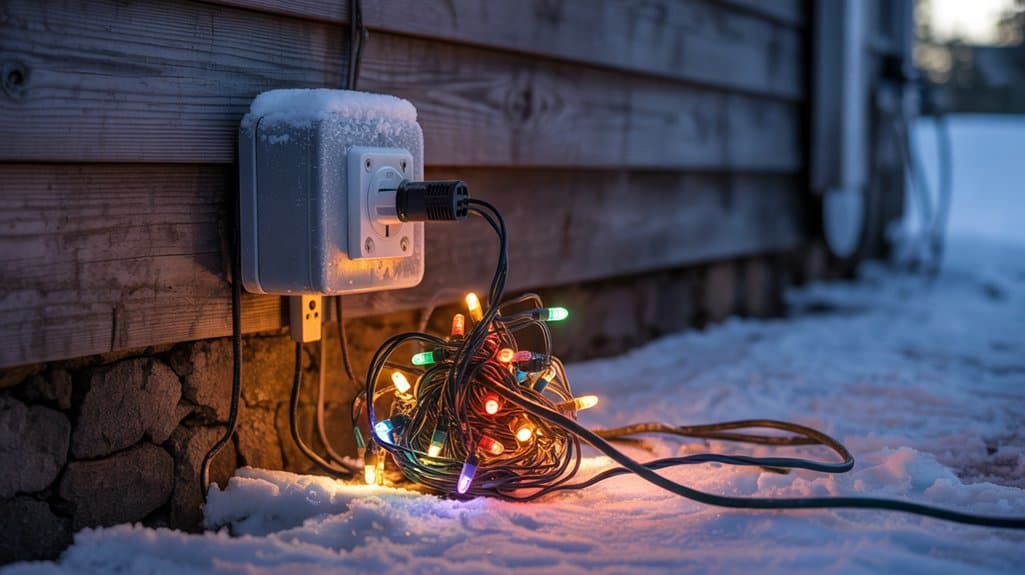
NEC Article 210 and the parallel IRC Section E3902 require ground-fault circuit interrupter protection on every exterior receptacle in one- and two-family dwellings, a requirement that applies without exception to any outlet supplying a holiday lighting display. That mandate is not a recommendation left to installer discretion; it is a code obligation that shapes how a display is designed from the first receptacle outward. Where a circuit lacks GFCI protection at the outlet, the receptacle must be brought into compliance before any display load is connected. The practical implication is that available capacity begins at a protected outlet, and any display configuration that routes power from an unprotected interior receptacle through a window or door falls outside compliant practice under both NEC Article 210 and the NFPA 1 cord-prohibition provisions.
What the Lights Take
The load side of the calculation begins with nameplate wattage: every run’s rated draw is summed, and that total is measured against whatever capacity the circuit retains after accounting for other connected devices. LED strings rewrite that arithmetic substantially, drawing a fraction of what equivalent incandescent runs demand and allowing a display of comparable visual scale to occupy far less of the available headroom. Manufacturer instructions also govern how many strings may connect end to end, and because NEC 110.3(B) requires listed equipment to be installed in accordance with its listing, that daisy-chain limit carries the force of code rather than remaining a discretionary guideline.
Summing nameplate load and why LED rewrites the count
NEC Section 110.3(B) requires that listed equipment be installed in accordance with its listing instructions, making a manufacturer’s daisy-chain limit a code obligation rather than a suggestion. That boundary becomes the first constraint on any display: regardless of how much capacity the branch circuit carries, no run may exceed the number of end-to-end connections the listing permits. The gap between incandescent and LED nameplate wattage then determines how much of that circuit capacity the display actually consumes. A traditional incandescent C9 socket cord draws substantially more current per foot than an equivalent LED string, and that difference, spread across a full roofline run, can shift available capacity by an order of magnitude – a distinction professional installers weigh before specifying product type.
Daisy-chain limits as a listing obligation
NEC Section 110.3(B) makes a manufacturer’s daisy-chain limit a code obligation, not an advisory guideline, by requiring that listed equipment be installed in accordance with its listing instructions. That single provision transforms what might otherwise appear to be a packaging recommendation into an enforceable constraint that sits upstream of all capacity calculations. A circuit may carry ample remaining load; if the listing permits only a fixed number of end-to-end string connections, that number is the ceiling. Professional installations treat the daisy-chain limit as the first filter applied during load design, with branch-circuit capacity evaluated only against the runs that survive that initial constraint.
Distance, Workarounds and Added Capacity
A roofline run drawing significant current across a long one-way span loses enough voltage that the far end dims on incandescent strings or causes LED rectifiers to behave erratically, and the corrective options – shorter individual runs, heavier SPT-2 cord, or feeding from both ends – each address the same underlying relationship between conductor length, current, and drop. Where the receptacle count itself is the constraint, extension cords and chained power taps are not a solution; NFPA 1 targets those practices directly, and the fire code’s position on them does not soften based on the season. When a display’s load genuinely exceeds what existing exterior circuits can carry, a licensed electrician pulling a permit for one or more dedicated exterior circuits – each with in-use weatherproof covers and GFCI protection – is the only code-conforming path forward.
Voltage drop on long roofline runs
Voltage drop along a roofline run rises directly with current draw and one-way conductor length, and falls with conductor size – a relationship that determines whether lights at the far end of a long display receive adequate voltage. Design practice, carried in informational notes to NEC Articles 210 and 215, targets approximately three percent drop on the branch circuit and five percent in total, though these figures are advisory rather than mandatory thresholds. Where drop exceeds those benchmarks, LED rectifiers at the far end behave erratically and incandescent lamps dim visibly. Recognized workarounds include shortening individual runs, substituting heavier SPT-2 cord for SPT-1 cord – both listed under UL 62 – feeding the same run from both ends, or installing an additional exterior receptacle closer to the load.
Practices the fire code prohibits and when a new circuit is the answer
NFPA 1, 2024 edition, Section 11.1 prohibits the use of extension cords as substitutes for permanent receptacles, power strips fed by extension cords, and chained relocatable power taps – practices that the fire code identifies as direct hazards in permanent or recurring installations. Routing a cord from an interior receptacle through a window or door introduces trip, pinch, and weather-seal problems that no workaround resolves adequately. When exterior receptacle capacity is exhausted, the correct remedy is a dedicated exterior circuit installed by a licensed electrician under a permit required by the authority having jurisdiction. Such circuits must carry GFCI protection and in-use weatherproof covers in accordance with NEC Article 210; only very large LED displays introduce harmonic distortion at a scale where IEEE 519-2022 guidance becomes relevant.
Frequently Asked Questions
Four questions surface repeatedly when homeowners and installers assess a holiday lighting load: how many strings may connect end to end, whether the circuit can be overloaded, why runs dim at their far ends, and whether shared circuits with outdoor kitchens or pool equipment are permissible. Each question has a code-grounded answer. The manufacturer’s daisy-chain limit governs string connections under NEC 110.3(B), circuit overload is a real consequence when continuous load approaches breaker rating, voltage drop explains far-end dimming, and pool or spa equipment sharing is a categorical no.
How many strings of Christmas lights can be plugged together?
Manufacturer instructions specify the maximum number of strings permitted in a daisy-chain, and that limit is a code obligation under NEC 110.3(B), not a suggestion. String count varies by product type, with LED runs typically allowing more connections than incandescent. Exceeding the listed limit violates the equipment’s listing.
Can Christmas lights overload a circuit?
Christmas lights can overload an outdoor circuit when their combined nameplate wattage exceeds available branch-circuit capacity. Incandescent strings consume far more current than LED runs, making string type the most consequential variable in any load calculation. NEC Article 220 governs how that capacity is properly calculated.
Why are my Christmas lights dim at the end of the run?
Voltage drop along a long cord reduces the voltage reaching the final strings, causing visible dimming on incandescent lights and erratic behavior in LED rectifiers. Drop increases with run length and current draw and decreases with heavier conductor gauge. Shorter runs, SPT-2 cord, or an added exterior receptacle correct the problem.
Can Christmas lights share a circuit with an outdoor kitchen or pool?
Christmas lights must not share a circuit with pool or spa equipment, and sharing with an outdoor kitchen reduces available capacity the display cannot reclaim. Pool and spa circuits carry dedicated requirements under NEC Article 680. Any consumed capacity from outdoor kitchen loads must be subtracted before calculating display wattage.
Christmas Lighting Designed to the Circuit by Backyard Paradiso
Residential Christmas lighting installations are governed by NEC Article 220 load calculations, NEC 110.3(B) compliance with listed-equipment instructions, mandatory GFCI protection under NEC Article 210, and the daisy-chain and cord prohibitions codified in NFPA 1 – a combination of requirements that makes circuit-capacity planning a code obligation rather than a preference. Backyard Paradiso brings that full framework to its Christmas lighting work, treating branch-circuit load calculation and LED specification as the foundation of every installation rather than an afterthought. Consultations are available by appointment, allowing designers to assess existing exterior circuits, identify shared loads from landscape lighting or outdoor kitchen equipment, and determine whether a dedicated circuit under permit is warranted before a single string is hung. A display designed to the circuit rather than to the bulb count is the one that stays lit through the season without tripping breakers or dimming at the far end of the roofline.