
Permanent Lighting: The Complete Guide for Homeowners
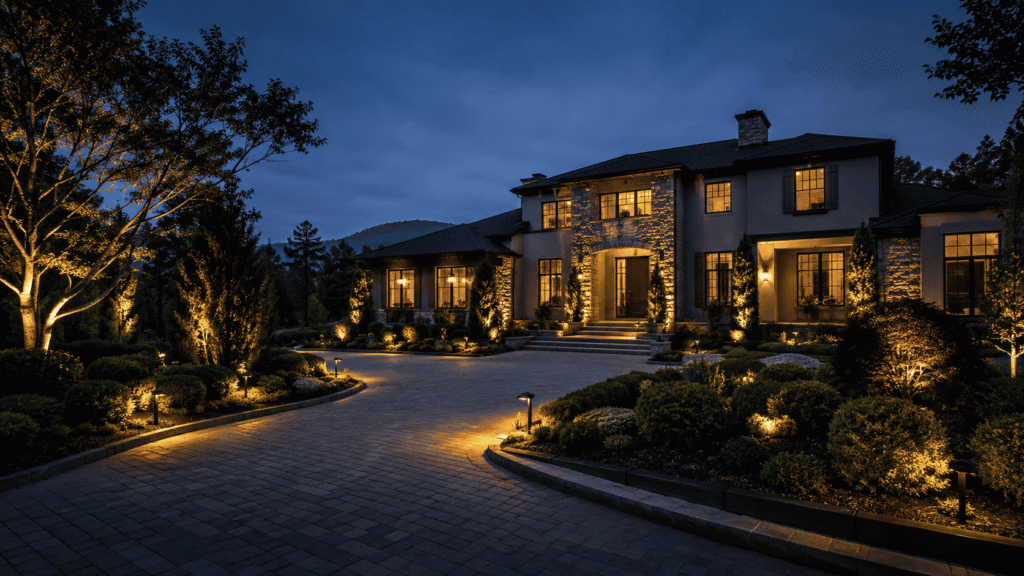
The homeowner who installs seasonal holiday lights gives up hours on the roofline every November or December, then more taking everything down in January. Add the time spent untangling, testing, and replacing burned-out strands, and the annual investment in a modest clip-light display approaches a full working day — every year, for a display that looks more or less the same as the year before.
Permanent lighting eliminates that cycle. But that is almost secondary to what it actually delivers — because the more compelling argument for permanent lighting is not the time saved in November. It is what the system provides during the other eleven months: a professionally designed architectural lighting installation that makes the home’s roofline and fascia look composed and intentional after dark, every night, regardless of the month.
Most homeowners discover this in the first February after installation. The holiday display is long gone from the neighbors’ houses. The landscaping is dormant. Dark falls by 5:30 p.m. And the house looks better at night than it ever has, running warm white, because the lighting system is doing exactly what architectural exterior lighting is supposed to do: making the building look good after dark.
This guide covers what a well-informed decision about permanent lighting requires: how the systems work, how fixture placement is designed (closer to architecture than most expect), what the system does during each month of the year, how permanent lighting compares to the annual holiday light service, what installation involves, and how the picture varies across the markets Backyard Paradiso serves.
What permanent lighting is — and what it is not
Architectural accent lighting with programmable color
The most accurate description of permanent lighting: architectural exterior accent lighting with programmable color capability. The system illuminates the home’s roofline, fascia, soffits, or architectural features using a permanently installed array of LED pixel fixtures. Most of the time — the majority of nights across the year — it runs in warm white, doing the same work that exterior architectural lighting has always done: defining the building against the dark, making it look occupied and maintained, giving the streetscape something intentional to look at.
The color programmability is what makes it different from conventional exterior lighting. Any color from a 16 million color palette is accessible from a smartphone app. Holiday displays, team colors, seasonal pastels, custom gradient effects — all available without touching a ladder or a strand of lights. But the sequence of value is worth being clear about. The everyday warm white mode is the primary function. The holiday capability is the secondary one. Homeowners who expect to mostly care about December and discover they care about it all year are describing the actual experience of living with the system.
How it differs from seasonal clip lights
The differences are real enough that comparing permanent lighting to clip lights is a bit like comparing a fixed outdoor sconce to a camping lantern propped on the porch railing. Both produce light. The similarity ends there.
Installation permanence. Permanent lighting fixtures are professionally mounted once — anchored to the fascia, soffit, or roofline with hardware designed for that substrate and rated for continuous outdoor exposure — and stay in place. Clip lights hang from gutters on plastic hooks, with no anchor point in the fascia or framing. After a few winters, the distinction between a fixture properly mounted to structural material and a strand clipped to a gutter becomes visible in the way the line looks from the street.
Fixture quality. Permanent lighting uses commercial-grade LED fixtures with IP65 or IP67 waterproofing ratings, UV-stable housings, and rated service lives measured in tens of thousands of hours. Consumer holiday light strands are designed and priced for seasonal use. They are not meant to be mounted continuously for years, and they perform accordingly.
Light output quality. Consistent color temperature, consistent brightness, fixtures aimed at the right surfaces from professionally determined positions. The visual difference between a well-designed permanent lighting installation and a clip-light arrangement is apparent in photographs and unmistakable in person.
Control. Permanent lighting is fully controlled from a smartphone. Color, brightness, pattern, schedule — all of it adjustable from inside the house without touching the fixture array. Adjusting a clip-light display requires a ladder.
Safety. This one is worth stating plainly. CPSC emergency-department estimates for holiday-decorating injuries have run 12,000 to 15,000 per season, with falls — overwhelmingly from ladders and rooflines — the leading mechanism. A permanent lighting installation eliminates roofline access for the operational life of the system.
How permanent lighting systems work
Individually addressable LED pixel fixtures
Modern permanent lighting systems use individually addressable LED pixel fixtures — small, weatherproof units containing red, green, and blue LED emitters (and in some systems a dedicated white channel for true warm white output without the color mixing that RGB-only fixtures require). Each fixture is controlled independently by the system’s controller, which means every single fixture in the array can be set to a different color and brightness at the same time.
That individual addressability is what makes gradient effects, chasing patterns, and effects like “sparkle” or “twinkle” possible. It is also why the visual quality of a permanent lighting display is categorically different from a clip-light arrangement where individual bulb control is not possible at any level. The difference between “this roofline has light on it” and “this roofline has a designed lighting effect on it” comes from addressability.
The controller
The system controller — installed in a protected location, typically inside a garage or in a weatherproof exterior enclosure — manages communication between the smartphone app and the fixture array. Current-generation systems communicate over WiFi, which means the system is accessible from anywhere with an internet connection, not just from the home network. The controller also handles power distribution to the fixture runs and stores the programmed scene and schedule library.
Controller quality is worth asking about when comparing installation quotes. Entry-level controllers support basic color and pattern functions but may have limited scheduling capability or fewer stored scenes. Better controllers handle more complex programming, support larger fixture arrays without signal degradation, and integrate with broader smart home ecosystems.
Power infrastructure
Permanent lighting systems require dedicated exterior electrical capacity — a properly rated outdoor circuit with appropriate weatherproofing, not an extension cord run through a window. Part of the site assessment before installation is evaluating the home’s existing exterior electrical capacity and determining whether a new circuit is needed. On most homes this is straightforward; on some older homes the panel and exterior wiring require upgrading before the lighting system can be installed correctly.
What the system does the other eleven months: a calendar
The single most common thing homeowners say after their first full year with permanent lighting is some version of: “I thought I was buying a better Christmas light system and I actually bought a year-round lighting system.” The twelve-month picture is worth walking through specifically, because it changes the math on the investment significantly.
| Period | What the system is doing | Why it matters |
|---|---|---|
| January | Warm white architectural mode. Holiday programming removed. In northern markets, dark by 4:45 p.m. | The neighbors’ clip lights came down weeks ago. This is the month that most clearly shows the difference between a home with year-round architectural lighting and one without it. The system is running as exterior accent lighting, not decoration. |
| February | Warm white, continuous. Valentine’s Day: red or pink programming available for the week. Dark by 5:30 p.m. in northern markets. | The darkest stretch of winter in most of the country. Homes with well-designed exterior lighting look maintained and inhabited. Homes without it look like no one has thought about how they appear at night. The difference is most visible in February. |
| March | Warm white transitioning to occasional spring colors as the season shifts. St. Patrick’s Day green is a common one-tap program. | Days are getting longer but evenings still dark enough for the system to do meaningful work. Spring color programming becomes a pleasant novelty after months of warm white. |
| April | Spring pastels available — soft pink, lavender, mint. Most homeowners default back to warm white as the primary mode after a few days of seasonal color. | Easter weekend typically prompts seasonal color programming. The rest of the month is warm white. Evenings are getting long enough that the system’s window is narrowing toward summer hours. |
| May–June | Warm white, operating in a shorter evening window as days lengthen. System scheduled to come on at astronomical dusk and off at midnight or later. Memorial Day red, white, and blue available. | Outdoor living season opens. The roofline lighting is now part of the visual backdrop for evenings on the deck, patio, or pergola. This is when the system starts working as ambient outdoor room lighting rather than just street-facing facade lighting. |
| July | Independence Day programming — red, white, and blue, typically the most-used seasonal display after December. Warm white for the remainder of the month. | July 4th is the second-most-common “show off the system” moment after December. One tap from the app, neighborhood visible, no ladder required. |
| August | Warm white, shorter operating window. Back-to-school transitions for some families. | The quiet month. The system is running, doing its architectural work, not doing anything notable. This is fine — it is doing what exterior accent lighting is supposed to do. |
| September–October | Fall color programming available — warm orange, deep amber, harvest palette. Halloween is typically the third-most-used seasonal display: deep orange and purple, sometimes gradient or pattern effects. | Days shortening again. The system’s evening window expands back toward winter hours. Halloween programming is genuinely popular — homeowners who did not expect to care about it usually do. |
| November | Thanksgiving warm amber available for the last week of the month. Dark by 5:00 p.m. in northern markets by month’s end. | The beginning of the period where the home is seen primarily after dark by anyone passing it. This is when the full-year value of architectural lighting becomes most visible again. Clip-light installations from neighbors start appearing during this month. |
| December | Full holiday programming. Any color, any pattern, scheduled to run at the times the homeowner wants. No installation. No takedown scheduled. The display is already there. | The month the system was probably sold on. By the end of the first year, it usually is not the most-valued month anymore — just the most visible one. |
The pattern that emerges across a full year: the system does meaningful work for roughly nine or ten months of the year in most climates. In northern markets — Denver, Colorado Springs, Romeoville, Secaucus — the window is longer because winter evenings start earlier and last longer. In Florida markets, the year-round outdoor living context means the system is interacting with the outdoor space differently, but operating year-round regardless.
Roofline fixture placement as a design problem
This is where permanent lighting installations vary more than most buyers expect — and where the difference between a thoughtful installation and a mediocre one is most visible from the street. Fixture placement is not just a technical decision about where to mount the hardware. It is an architectural decision about how the light reaches the home’s surfaces, how visible the fixtures are during daylight, and what the overall effect looks like from different vantage points.
Fascia-face mounting
Fixtures mounted on the face of the fascia board — the vertical surface at the roofline edge — direct light outward and downward. This mounting position produces the highest visible output from the street and the most visible fixture array during daytime. At nighttime, fascia-face fixtures produce a strong light presence that is clearly centered on the roofline.
Fascia-face mounting is appropriate when maximum streetside visibility is the goal, when the fascia board is wide enough to provide a stable mounting surface, and when the homeowner is comfortable with the fixtures being visible as a design element during the day. On homes with wide, clean fascia boards in good condition, the fixture array can look quite composed even in daylight. On homes with narrow or ornate fascia, it reads as hardware attached to architecture.
Soffit mounting
Fixtures mounted on the soffit — the horizontal underside of the roof overhang — direct light downward and outward, washing the fascia board and the wall below from above. In this configuration, the fixture itself is largely hidden from street level during daytime — seeing it requires standing close to the house and looking up. The nighttime effect is a wash of light on the facade rather than a line of visible fixture sources.
Soffit mounting produces a more refined appearance at close range and is the preferred position on homes where the homeowner wants the light effect without visible hardware during the day. The trade-off is lower direct output toward the street — the light is washing the home’s surfaces rather than projecting outward — and a requirement for an adequate soffit surface to mount to. Not all rooflines have usable soffit depth.
Under-eave mounting
On homes without traditional soffits — some contemporary designs, certain roofline profiles — fixtures are mounted at the eave edge itself, directing light downward along the building face. The effect is similar to soffit mounting, with the fixture positioned at the junction between roof and wall. Under-eave mounting requires evaluation of the specific roof edge condition and framing to confirm a stable and weatherproof mounting substrate.
Fixture spacing and visual density
Closer fixture spacing produces more visually continuous coverage — at 4 to 6 inches, the fixture array reads as a solid line of light from typical street viewing distances, and pattern effects like gradients appear smooth. Wider spacing at 9 to 12 inches produces a more distinct point-source appearance where individual fixtures are visible as separate light sources, and pattern effects have a more graphic quality.
Neither spacing is inherently better. Dense spacing tends to work well on homes with horizontal architectural emphasis and contemporary design language. Wider spacing can complement traditional architecture where a less continuous presence is more appropriate. The design decision about spacing is made during the site assessment, taking into account the home’s style, the intended viewing distance, and the homeowner’s aesthetic goals for both the white mode and the color display mode.
Single elevation vs. perimeter coverage
Most permanent lighting installations begin with the front roofline — the street-facing elevation that provides the most visible return on the investment. Many homeowners add side elevations at the same time, and some choose full perimeter coverage. The distinction matters in the twelve-month context: a front-elevation-only installation is optimized for street presence, while a perimeter installation also illuminates the home from the outdoor living spaces in the backyard.
A home whose front roofline is lit but whose back elevation is dark produces a different experience on a summer evening on the patio than one where the full roofline is covered. For homeowners whose outdoor living spaces are as important as curb appeal, the perimeter argument is strong. For homeowners primarily motivated by street presence and the holiday display, front elevation alone is often sufficient.
The smart control system
Color and brightness
The smartphone app gives access to the full range of colors available from RGB LED emitters — any specific color can be dialed in directly, matched to a reference (a team color, a brand color, a paint swatch), or selected from a preset palette. Brightness is independently adjustable, so a homeowner who wants the system running at reduced intensity during late-evening hours can schedule that without affecting the color program. The warm white everyday mode is typically a saved scene: one tap to activate, one tap to return to.
Preset programs and custom scenes
Most current-generation control systems ship with a library of preset programs covering the main use cases: warm white, holiday palettes, color cycling, sparkle, fade, and others. Homeowners can also create and save their own scenes — a specific gradient that works with the home’s exterior color, a particular holiday palette they prefer, a subtle effect for everyday use that is something other than solid warm white. Saved scenes persist in the controller’s memory and are immediately available from the app.
Scheduling
Automatic scheduling by clock time or by astronomical sunrise/sunset ensures the system comes on and goes off at the right times without manual switching. The sunset-based schedule adjusts automatically through the year as days lengthen and shorten — the system does not need to be reprogrammed seasonally to stay in sync with the actual dark hours. An overnight cutoff time keeps the system from running through the night when no one is awake to appreciate it.
Smart home integration
More sophisticated installations integrate the permanent lighting into broader home automation systems — the exterior lighting coming on as part of an “arrive home” scene alongside the driveway lights and porch fixtures, or holiday display programs triggered automatically on relevant calendar dates. Integration capability varies by controller system and by the smart home platform in use. Integration goals are worth raising during the design consultation to confirm the selected system supports them.
Permanent lighting vs. annual holiday light service
Backyard Paradiso offers both permanent lighting installation and a seasonal holiday light service — professional installation and removal of temporary holiday displays each year. They serve different homeowners, and the comparison is worth making plainly.
The annual holiday service makes sense for homeowners who want a professional-quality holiday display, have no interest in a year-round architectural lighting system, and prefer a lower annual expenditure over a larger upfront investment. It is a real service with real value. The display goes up professionally, looks good, comes down in January, and the homeowner does not think about lighting until next November.
Permanent lighting makes sense for homeowners who want the year-round architectural value, want full control over the display from a phone, and are ready to treat exterior lighting as a home improvement investment rather than a recurring seasonal expense. The upfront cost is higher. The per-year cost — when spread across a decade of use with no recurring installation fees — is lower. And the aesthetic result is better by a meaningful margin.
The crossover point varies by homeowner. A common pattern: someone uses the annual holiday service for a season or two, sees the permanent installation on a neighbor’s house in February running warm white, and asks about it. The year-round value that was not part of the original decision becomes the deciding factor.
One thing worth being clear about: the two services are not in competition for the same function. Permanent lighting does not replace the annual holiday service for homeowners who only want holiday coverage. Annual holiday service does not replace permanent lighting for homeowners who want year-round architectural illumination. The question is which use case matches the actual goals.
Permanent lighting and landscape lighting: two systems, one picture
Permanent lighting illuminates the building. Landscape lighting illuminates the property. They are distinct systems that address different components of the nighttime environment, and a home with both looks materially different from a home with only one.
Permanent roofline lighting defines the architectural silhouette — the home’s roofline glowing warm white against the dark sky, the fascia and upper wall surfaces picked out from the night. Landscape lighting fills in the ground plane — specimen trees illuminated from below, pathway lights defining the walkway, paver surfaces given ambient light, the outdoor living area made usable after dark. Both systems together produce a property that is designed to be seen at night, not just functional during daylight.
The practical design implication: the two systems benefit from being planned together. The coverage priorities for permanent roofline lighting and the placement of landscape uplighting interact — a mature tree lit from below in the front yard changes what the roofline lighting is doing visually behind it. When both systems are designed at the same time, the result is more cohesive than when they are installed separately and independently.
Residential and commercial installations
Permanent lighting is used in both residential and commercial contexts, and the system technology is the same across both. The design methodology and scale differ.
Residential installations focus on architectural accent lighting for the home’s roofline and fascia, with holiday and seasonal display capability as the secondary function. The design priorities are street presence, year-round aesthetic quality, and ease of use for a homeowner who will operate the system themselves from a smartphone.
Commercial installations focus on brand expression, facade illumination, and curb appeal for retail, hospitality, and commercial properties. They typically involve longer fixture runs, higher-output fixtures, and more complex programming than residential installations. A restaurant that wants to run brand-color lighting during operating hours, shift to seasonal displays for holidays, and schedule automatic on/off around the business day has different requirements from a single-family home — but the underlying technology handles both.
For commercial installations, the design consultation covers the facade geometry, brand color specifications, and operational requirements in the same way a residential assessment covers roofline geometry and homeowner preferences.
The installation process
Site assessment
Before any hardware is ordered or installed, the site assessment evaluates the home’s roofline geometry, fascia and soffit condition, substrate for fixture mounting, existing exterior electrical capacity, and the design goals — which elevations to cover, what fixture positions work best for the architecture, what the target aesthetic is for the warm white everyday mode. The assessment also identifies whether any electrical infrastructure work is needed before installation can proceed.
System design
Based on the assessment, the fixture layout, spacing, mounting positions, and power distribution runs are planned. The controller location is identified — protected from direct weather exposure but accessible for initial setup and any future programming changes. Wiring routes from controller to exterior fixture runs are mapped, noting any sections where conduit or raceway protection is needed in exposed locations.
Electrical infrastructure
If the site assessment identified the need for a new dedicated circuit or exterior electrical upgrades, that work is completed before fixture installation. Running permanent lighting on an improvised or undersized circuit is the main installation shortcut that causes system problems downstream — proper electrical infrastructure is the foundation the system runs on.
Fixture installation
Fixtures are mounted at the designed positions using hardware appropriate to the substrate — fascia, soffit, or under-eave mounting hardware differs by application. Wiring runs are routed to the controller location, with exposed sections protected by conduit or raceway. Fixture spacing is maintained consistently across the run; inconsistent spacing is the most visible quality indicator when evaluating an installed system from the street.
Controller setup and commissioning
The controller is installed, connected to power, and programmed with an initial scene library. WiFi pairing and smartphone app setup are completed with the homeowner present. Scheduling configuration, default scene selection, and a walkthrough of the control interface are part of the commissioning process. The homeowner should leave the commissioning session able to operate the system independently.
What drives permanent lighting cost
Permanent lighting cost is driven primarily by linear footage — the total run length of fascia, soffit, or roofline to be covered — along with fixture density, mounting position, and whether any electrical infrastructure work is needed.
Front elevation only. The entry scope for most single-family homes with a standard front roofline. Installed cost covers fixture supply, mounting hardware, wiring runs, controller, app setup, and commissioning.
Front and sides. Adding side elevations to the front coverage scales the cost with total linear footage and the complexity of the roofline geometry. Homes with multiple roof transitions, dormers, or other architectural features that require additional fixture runs sit toward the upper end of this tier.
Full perimeter. Complete roofline coverage — all four elevations — is the top tier. Larger homes, those with complex rooflines, or those requiring electrical panel upgrades sit at the top of the range.
Commercial installations. Priced based on facade scale and fixture specification. A retail storefront with a straightforward linear fascia runs at comparable per-linear-foot cost to residential; larger commercial facades with complex geometry or higher-output fixture requirements are quoted based on the specific scope.
What is included in every installation. Fixture supply, mounting hardware, wiring runs, controller, smartphone app setup, initial scene programming, scheduling configuration, and commissioning walkthrough.
What can add to cost. New dedicated circuit installation (scaling with panel location and run length), electrical panel upgrades on older homes, conduit runs in exposed locations, and specialized mounting requirements on non-standard fascia or soffit conditions.
Across a multi-year horizon with no recurring installation or removal fees, the per-year cost of a permanent installation falls below that of a professional seasonal service for any homeowner who wants more than six weeks of coverage per year — and the seasonal service carries no year-round value and no control capability.
Service market considerations
Colorado Springs and Denver
Colorado’s long winters give permanent lighting more operating hours per year than almost any other market. From late October through late March, dark falls before 6 p.m. and the home is lit for six or more hours every evening. Holiday coverage runs from Halloween through New Year’s without any installation cycle. The year-round architectural value in Denver and Colorado Springs is not a secondary benefit — it is the primary one, because the ratio of dark evening hours to daylight hours is higher here than in the Florida or Texas markets.
Naples and Orlando
Year-round outdoor living means the permanent lighting system is regularly visible from the outdoor living areas — the pool deck, the lanai, the patio. The interaction between roofline lighting and landscape lighting matters more here than in markets where outdoor living is seasonal, because the system is serving as ambient outdoor room lighting as much as streetside facade lighting. In Naples specifically, coastal property values and the premium on curb appeal make exterior architectural lighting a meaningful differentiator at the property level. Salt air exposure in Collier County coastal installations also makes fixture specification matter more than in inland markets — IP67-rated housings and corrosion-resistant hardware are the right specification here, not a premium option.
San Antonio
San Antonio has strong community participation in seasonal and holiday decoration — the ability to produce a polished display without ladder work resonates here more directly than in markets with lower seasonal decoration engagement. The July 4th programming also gets meaningful use in a market with strong civic and community identity around national holidays. The year-round warm white mode works well against the warm-toned stucco and masonry homes common in the area.
Romeoville
Will County’s winters are long and dark. By November, commuters are leaving for work before sunrise and returning after sunset. The home’s nighttime presentation is what most neighbors and passersby see for a significant portion of the year. A well-lit roofline in February — when the landscape is dormant and nothing else is doing visual work on the property — is a more impactful investment here than in markets where the home is visible in good daylight conditions for more of the year.
Secaucus
Higher-density suburban properties with shorter lot widths mean neighbors and passing pedestrians are closer to the home’s facade. The visual impact of architectural lighting is felt at a shorter viewing distance, and the difference between a home with permanent lighting and an unlit neighbor is more apparent in dense streetscapes than in suburban lots with larger setbacks. The proximity to New York City also means homeowners here tend to be more aware of architectural lighting as a design element — it is visible in commercial and residential contexts in the city that do not exist in lower-density markets.
Frequently asked questions about permanent lighting
What is permanent lighting?
Permanent lighting is a professionally installed architectural exterior lighting system using individually addressable LED pixel fixtures mounted on the home’s fascia, soffit, or roofline. The system produces warm white architectural accent lighting year-round and can be changed to any color, pattern, or display via smartphone app — including holiday displays, team colors, and custom programs. It replaces both the seasonal clip-light installation cycle and conventional static exterior accent lighting.
How is permanent lighting different from Christmas lights?
The differences are in fixture quality, installation method, control capability, and intended use. Christmas lights are consumer products designed for seasonal clip-on use, controlled by a single on/off switch, and producing variable output that degrades over time. Permanent lighting uses commercial-grade IP65/IP67-rated LED fixtures professionally anchored to the home’s structure, controlled via smartphone app with access to 16 million colors and programmable scheduling, and designed for continuous outdoor service over a decade or more. The aesthetic result in holiday mode is also categorically better — consistent spacing, consistent brightness, and designed effects that clip-light arrangements cannot produce.
Does permanent lighting use a lot of electricity?
No — it is one of the more common surprises for homeowners who ask this. Individual LED pixel fixtures draw a fraction of a watt each — an entire front-roofline run typically consumes less power than a single incandescent bulb. Run nightly, the annual operating cost registers as a minor line item on a household electric bill. By comparison, a comparable incandescent holiday light installation running only during December would draw many times that power for a fraction of the operating time.
Can I change the colors myself?
Yes — full color and brightness control is in the homeowner’s hands via the smartphone app, with no access to the fixture hardware required. Any color from the full RGB palette is available, preset scenes can be activated in one tap, and custom programs can be created and saved. Scheduling is also managed from the app. After commissioning, the homeowner operates the entire system independently.
How long do permanent lighting fixtures last?
Commercial-grade LED permanent lighting fixtures carry rated lumen-maintenance lifespans measured in tens of thousands of hours — a service horizon spanning well over a decade of nightly operation. Real-world longevity depends on fixture quality, installation conditions, and environmental exposure, but a well-specified installation on a properly maintained structure should operate without significant degradation for a decade or more. The weatherproof fixture housings — rated IP65 or IP67 — are designed for continuous outdoor mounting, not seasonal use and storage.
Do I need an electrician for the installation?
The installation requires proper exterior electrical capacity — a dedicated circuit with appropriate weatherproofing and GFCI protection, as required by the NEC for outdoor circuits, not an extension cord. Whether the home already has adequate capacity is determined during the site assessment. If a new circuit or electrical panel work is needed, that is handled as part of the installation scope. Backyard Paradiso installations are completed to code, permitted where required by the jurisdiction, and include the electrical infrastructure work necessary for the system to operate correctly and safely.
Can permanent lighting be added to just one side of the house and expanded later?
Yes. Starting with the front elevation and adding sides or the back elevation later is a common approach, particularly for homeowners who want to see the system in use before committing to full perimeter coverage. The controller and power infrastructure are sized for the eventual full scope at initial installation when possible, which makes adding fixture runs later more straightforward than if the initial installation was scaled only to the front. This is worth discussing during the design consultation so the infrastructure is planned correctly from the start.
Does permanent lighting work with my existing smart home setup?
Many current-generation permanent lighting controllers integrate with the major smart home platforms, depending on the specific system. Integration capability varies by controller, so it is a useful question to raise during the design consultation if smart home integration matters. Even without platform integration, the system’s own app provides full control including scheduling, scene programming, and remote access from anywhere with an internet connection.
Service areas
Backyard Paradiso installs permanent lighting systems across the markets it serves. Fixture specification, mounting approach, and electrical infrastructure recommendations are adapted to each property’s architecture, local climate conditions, and electrical code requirements. The full list is on Markets We Serve.
Every home has a nighttime appearance — few have been designed
For most of the year, the primary visual impression a home makes on anyone passing it happens after dark. The landscape is not doing work in January, and the curb appeal that photography captures does not exist at 7 p.m. on a February evening. What exists is whatever the roofline looks like against the night sky — which, without architectural lighting, is nothing in particular. A site assessment evaluates the roofline geometry, mounting options, and existing electrical capacity, walks through design options for the specific architecture, and produces a quote based on the actual scope. Consultations are available by appointment.