
Outdoor Kitchen: The Complete Guide for Homeowners
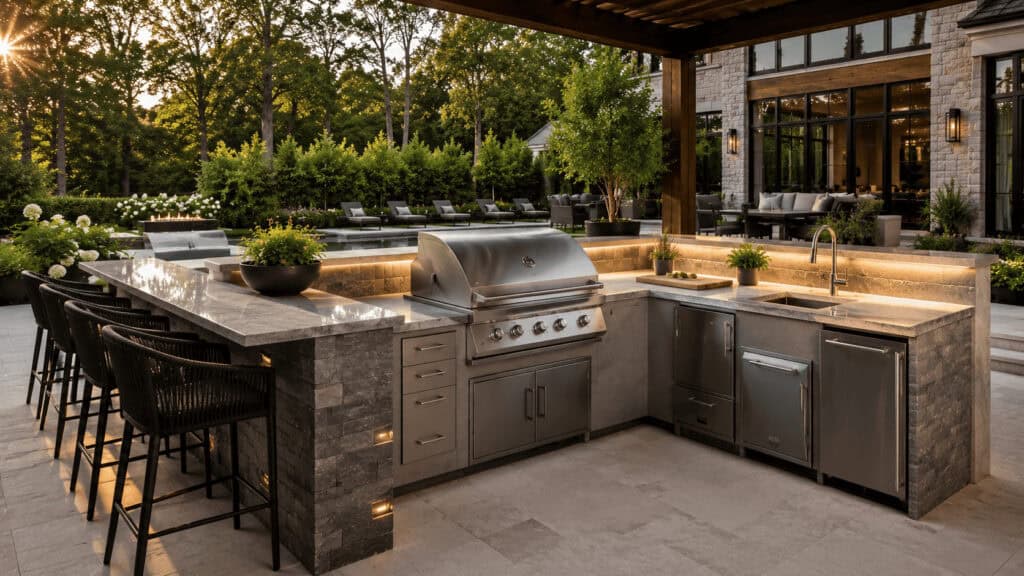
An outdoor kitchen is the single improvement that most changes how a backyard is actually used. Not because it adds a grill — most homeowners already have one — but because it eliminates the friction that keeps outdoor entertaining from reaching its potential. The constant trips inside for prep space, for tools, for drinks, for a surface to set things down. A properly designed Backyard Kitchen brings the full functionality of indoor cooking outside, creating a space where the cook is part of the gathering rather than separated from it by a sliding glass door.
This guide covers everything relevant to a well-informed outdoor kitchen decision: what the complete kitchen ecosystem looks like beyond the cabinet boxes, what materials are appropriate for outdoor cabinetry and why the specification matters, how layout and design work in practice, what the three trade connections (gas, electrical, plumbing) mean for project planning, what HOA and permit considerations apply, what drives cost, and how the outdoor living environments across the markets Backyard Paradiso serves affect outdoor kitchen design priorities. Whether the project is a compact grilling station or a full-scale entertaining kitchen, the information here supports decisions that hold up under years of actual use.
What a complete outdoor kitchen actually includes
Most homeowners start the outdoor kitchen conversation thinking about a grill. A complete outdoor kitchen involves considerably more — and understanding the full ecosystem before focusing on any single component produces better design decisions and a more realistic project budget.
Cooking appliances
Built-in grills are the primary cooking appliance. Built-in grills — designed to be drop-in mounted into a countertop cutout — produce a cleaner finished appearance than freestanding grills and anchor the kitchen’s identity as a permanent installation. Gas grills require a dedicated gas line connection. Natural gas is the preferred specification for a permanent kitchen because it eliminates propane tank management; propane is appropriate where natural gas service is not available at the installation location.
Griddles and side burners expand cooking versatility — the flat griddle for breakfast cooking, smash burgers, and flat-surface applications; side burners for sauce work, boiling, and applications that do not suit grill grates. These are typically integrated into the countertop alongside the primary grill.
Pizza ovens — wood-fired or gas — have become a popular addition in larger configurations. They require their own combustion air and exhaust provisions but produce a cooking capability no other appliance replicates.
Built-in smokers — pellet or charcoal units integrated into the cabinet run — provide smoking capability without a separate freestanding unit in the yard.
Refrigeration
Outdoor-rated refrigeration — specifically designed for outdoor ambient temperature exposure, direct sun, and humidity — is essential for any outdoor kitchen used for entertaining. Standard indoor refrigerators are not rated for outdoor use and will fail; their compressors cannot handle the temperature swings and heat exposure of an outdoor installation.
Outdoor-rated undercounter refrigerators in stainless steel finish are the standard — sized to fit under a countertop section, providing cold storage for beverages, prepared ingredients, and perishables without indoor trips. Outdoor-rated beverage centers and keg drawers are common additions for entertainment-focused setups.
An outdoor-rated refrigerator changes how the kitchen functions during a gathering — guests serve themselves, the cook has cold ingredients at hand, and the outdoor space operates as a self-sufficient environment for hours.
Sink and plumbing
An outdoor sink requires a cold water supply connection and a drain connection to either a code-compliant drain line or a dry well/French drain system where volume and local code permit. Hot water service typically requires a small dedicated outdoor tankless heater or a long run from the interior supply — most outdoor kitchens operate cold-water-only unless the installation is close to the home’s plumbing.
A sink significantly reduces cleanup friction — hand washing, produce rinsing, and post-cooking cleanup all happen at the kitchen rather than requiring trips inside.
Countertops
Outdoor kitchen countertops must handle UV exposure, moisture, freeze-thaw cycling in northern markets, and heat from adjacent cooking appliances.
Granite: Dense, heat-resistant, and appropriate for outdoor use when properly sealed. Requires periodic resealing — more frequently in humid environments. Available in a wide range of colors and patterns. The same material used on paver and hardscape applications, creating coordination potential across the outdoor environment.
Porcelain: The most maintenance-free option — near-zero porosity means no sealing required, stain resistance is inherent, and freeze-thaw performance in northern markets is excellent. Large-format porcelain slab countertops are the premium specification in contemporary designs.
Concrete: Custom-formed in any color and finish, integrating naturally with the surrounding hardscape. Requires sealing and periodic maintenance.
Stainless steel: All-stainless countertops integrated with stainless cabinetry produce a clean, commercial kitchen aesthetic and require no maintenance. The most sanitary specification for surfaces adjacent to cooking appliances.
Storage and accessories
Pull-out trash and recycling compartments, utensil drawers, paper towel holders, bottle openers, and towel bar hardware are the practical details that determine how functional the kitchen is day-to-day. Soft-close door and drawer hardware is essential for outdoor use — the mechanical dampening prevents doors and drawers from being slammed by wind. Access doors for propane tank storage require appropriate ventilation provisions for the enclosed space.
Why outdoor kitchen cabinet material matters more than almost anything else
The cabinet infrastructure is the component most homeowners focus on last and should focus on first. Every other design decision — appliance selection, countertop material, layout — can be reconsidered or upgraded later. The cabinets are what everything else attaches to and sits on, and they are the component most exposed to the weather conditions that will define the kitchen’s long-term performance.
Why indoor cabinetry fails outdoors
Standard indoor cabinetry — wood face frames, MDF or plywood box construction, standard hardware — has a service life measured in months rather than years in outdoor conditions. Wood swells and contracts with moisture cycling, causing face frame joints to separate and doors to warp. MDF absorbs moisture and swells irreversibly, destroying the box construction from inside. Standard cabinet hardware corrodes in outdoor humidity, developing rust that stains adjacent surfaces and fails mechanically.
This is not a quality problem with indoor cabinetry — it is a specification problem. The same product that performs correctly for decades inside a kitchen will fail within a season outside it.
Grade 304 stainless steel: the outdoor kitchen standard
Grade 304 stainless steel is the primary material specification for Backyard Paradiso outdoor kitchen cabinets.
304 stainless is a food-safe grade austenitic stainless — the same specification used in commercial kitchen equipment. The food-safe designation means the alloy produces a non-porous surface that does not harbor bacteria, does not react with food contact, and meets professional kitchen sanitation standards. For a surface where food preparation happens, this is a meaningful distinction from materials that look comparable but do not share the food-safety specification.
The weather resistance of 304 stainless is driven by its chromium content — the chromium forms a passive oxide layer on the steel surface that continuously regenerates when exposed to oxygen, providing corrosion resistance that does not depend on coatings or finishes that can chip, scratch, or degrade over time. 304 stainless does not rust, warp, or swell, and provides no substrate for insect activity. In the humid subtropical conditions of Naples and Orlando, the high-UV environment of Colorado, and the freeze-thaw cycles of Will County, it performs correctly without a maintenance program.
304 stainless is also termite-proof and pest-resistant — a relevant specification in the southern markets where wood-based cabinet construction in outdoor environments invites termite infestation within a few years.
Marine-grade 316 stainless and powder-coated aluminum
For coastal and pool-adjacent installations — the Naples market in particular, where salt air proximity is a legitimate corrosion driver — marine-grade 316 stainless provides enhanced resistance to chloride-induced corrosion beyond what 304 delivers. The 316 alloy adds molybdenum to the composition, specifically improving performance in chloride environments. Where 316 is specified for the cabinetry, fasteners should match the grade.
Powder-coated aluminum is an alternative for structural components of the outdoor kitchen frame — excellent weather resistance, available in a wide range of colors to match the overall outdoor design palette, and lighter weight than stainless. Aluminum frames combined with stainless steel door and drawer fronts is a common specification that balances performance and visual flexibility.
What to avoid
Wood-framed outdoor kitchen cabinets, regardless of finish or sealant, will deteriorate on a timeline determined by climate — faster in humid subtropical markets, slower in dry climates, but consistently. Cedar and teak are more resistant than softwood but not appropriate for enclosed cabinet construction in any outdoor environment. Polymer cabinets (HDPE) are weather-resistant and low-maintenance but lack the structural rigidity, surface quality, and food-safe specification of stainless for the primary cabinet infrastructure.
Layout and design fundamentals
The work triangle in outdoor context
The kitchen work triangle — the functional relationship between the cooking station, the prep/sink area, and the storage/refrigeration — applies outdoors as it does indoors. A layout that places the grill, the sink, and the refrigeration at reasonable distances from each other creates efficient workflow. A linear layout works well for smaller configurations; an L-shape or U-shape creates more surface area and better workflow separation for larger kitchens.
Integration with the pergola and covered outdoor living space
The most effective outdoor kitchen installations are located under or adjacent to a covered structure — an aluminum pergola with a motorized louvered roof, a covered patio, or a dedicated kitchen pavilion. Shade makes cooking comfortable in hot markets, overhead coverage protects the kitchen from direct rain during use, and the defined overhead structure creates the sense of a room rather than a counter in the open yard.
Backyard Paradiso’s outdoor kitchen installations frequently integrate with pergola structures — the kitchen counter run positioned at the edge of the pergola’s covered zone, with the seating and dining area inside the covered structure and the cooking zone oriented toward the outdoor living space. This configuration keeps smoke and cooking heat directed away from the sitting area while keeping the cook visually connected to the gathering. Adding motorized zip screens to the pergola creates a weather-enclosed dining environment adjacent to the cooking station — rain does not end the dinner party.
Surface integration
The outdoor kitchen is typically positioned on a paver or concrete surface rather than directly on lawn — both for aesthetic reasons (the hard surface defines the kitchen zone) and practical ones (a grass surface beneath a cooking station becomes damaged and muddy with regular use). The paver selection for the kitchen area should coordinate with the broader patio system and should use a surface specification appropriate for cooking grease and cleaning chemicals — porcelain pavers and sealed concrete pavers are the most practical choices. Artificial grass in the surrounding yard creates a clean transition from the hard-surfaced kitchen zone to the soft-surfaced lawn area.
Fence and privacy integration
An outdoor kitchen positioned within a composite privacy fence perimeter feels like a room rather than a station in an open yard. The fence provides the visual enclosure that makes the kitchen space feel intimate and defined at property scale. Landscape lighting along the fence line and permanent lighting on the home’s exterior complete the nighttime environment that makes the outdoor kitchen usable for evening entertaining.
Deck-mounted outdoor kitchens
Outdoor kitchens can be installed on elevated composite decks with appropriate structural consideration. The weight of stainless cabinets, granite or porcelain countertops, and a full appliance load requires substructure reinforcement beneath the kitchen zone — additional joists, beams, or a dedicated footing point. Gas, water, and electrical connections routed through the deck require planning during the deck build rather than after. The result — cooking and dining at the same level as the home’s interior living spaces — is one of the most appealing outdoor kitchen configurations available.
Utility connections: the three trades that make an outdoor kitchen permanent
An outdoor kitchen with a built-in gas grill, an outdoor-rated refrigerator, and a sink involves three separate licensed trade connections — gas, electrical, and plumbing. This is unique among residential outdoor living improvements, and it is the factor that most significantly affects project planning, permitting, and timeline. Understanding the trade scope upfront prevents surprises during installation.
Gas line
A built-in gas grill in a permanent outdoor kitchen almost always requires a dedicated gas line run from the home’s gas service. This is licensed plumber or gas fitter work in all jurisdictions — not a DIY scope, not a general contractor scope in most states. A properly installed, pressure-tested, inspected gas line is the only correct specification. The run distance from the home’s gas service to the kitchen location, the line sizing for the appliance BTU demand, and the shutoff valve placement all need to be planned as part of the kitchen design rather than figured out during installation.
Electrical
Outdoor refrigerators, lighting, exhaust fans, and any electrical outlets in the outdoor kitchen require dedicated GFCI-protected outdoor circuits. All outdoor electrical work requires a licensed electrician and in most jurisdictions an electrical permit. Planning the circuit count and routing during the kitchen design phase avoids the disruption and added cost of running circuits after the countertops and cabinets are installed.
Plumbing
A sink requires supply and drain provisions. Supply connection to the home’s cold water line (and potentially hot water if desired) and drain connection to a code-compliant system are licensed plumber scope in all jurisdictions.
Coordinating the three trades
The installation sequence matters. Gas, electrical, and plumbing rough-in connections need to be in place before the cabinet infrastructure is set — running pipes and conduit after the cabinets are installed is significantly more disruptive and expensive. A well-managed outdoor kitchen installation schedules the trade rough-in work first, then the cabinet and countertop installation, then the appliance drop-in and final connections. Backyard Paradiso coordinates trade contractor scheduling as part of the project scope.
Building permits
The combination of gas, electrical, and plumbing connections typically triggers building permit requirements even in jurisdictions that do not require permits for a freestanding grill on a patio. Most outdoor kitchen installations in permanent structures with utility connections require a building permit. HOA approval is required before permit application in governed communities — and HOA requirements in master-planned communities across Collier County, Orange County, and El Paso County may impose constraints on placement, materials, and design that go beyond the building code.
Backyard Paradiso manages permit coordination including trade contractor scheduling for the gas, electrical, and plumbing connections that are part of the kitchen installation scope.
What drives outdoor kitchen cost
Outdoor kitchen cost is driven by cabinet infrastructure, appliance selection, countertop material, utility connection scope, and regional labor costs. What follows is how each component contributes to the total.
Cabinet infrastructure
Stainless steel cabinetry is priced by the linear foot of cabinet run and is the largest single line item in most projects. A 10-linear-foot kitchen is a reasonable size for a functional entertaining setup; the cabinet run length, door and drawer count, and grade (304 versus 316) set the number.
Appliances and equipment
The built-in gas grill is the primary appliance cost and varies widely with size and specification. Outdoor-rated refrigeration is the second. Side burners, griddles, sinks, and accessories are each incremental additions. Pizza ovens and built-in smokers are premium items that expand the cost range based on the cooking capabilities the homeowner wants.
Countertops
Granite and porcelain countertops are priced per square foot installed at outdoor-kitchen specification. Stainless steel and concrete countertops fall in similar ranges depending on the fabrication complexity.
Utility connections
Gas line runs, electrical circuits, and plumbing connections are each priced on run distance and local labor rates. The three-trade total is a significant line item that is sometimes underestimated in early budgeting.
Complete installed system
A complete outdoor kitchen with stainless cabinetry, built-in grill, refrigerator, sink, countertops, and utility connections spans a wide range depending on scope, appliance specification, countertop selection, and market. Compact configurations sit at the lower end; expansive multi-zone kitchens with premium appliances at the upper end.
Thinking about outdoor kitchen cost as an investment
Outdoor kitchens are among the highest-return outdoor improvements in markets where outdoor living is year-round or near-year-round. In Naples, Orlando, San Antonio, and Denver, an outdoor kitchen presents as a premium feature at resale while providing direct quality-of-life value through its entire service life. The value argument is strongest for stainless steel installations — a stainless kitchen that looks and performs correctly after ten years presents as a premium feature. A deteriorating wood-framed or polymer-cabinet kitchen presents as a liability. The comparison is one-time versus recurring: one installation, then years of daily use without the replacement cycle that lesser materials impose.
Outdoor kitchen maintenance: what stainless steel actually requires
One of the advantages of specifying grade 304 stainless for the primary cabinet infrastructure is the maintenance profile — but “stainless” does not mean “maintenance-free.” What follows is the realistic routine.
Cabinet and surface cleaning
Stainless surfaces are wiped down with a soft cloth and mild soap solution after each use to remove food residue, grease spatter, and fingerprints. For a deeper clean, a dedicated stainless steel cleaner restores the surface finish and removes water spots and light oxidation. Always wipe in the direction of the grain — wiping against the grain can create micro-scratches that dull the surface over time.
Countertop maintenance
Granite countertops require resealing every one to two years — more frequently in humid markets and in kitchen zones where grease exposure is high. Porcelain countertops require no sealing at any point. Stainless steel countertops require the same wipe-down routine as the cabinets. Concrete countertops require resealing on a schedule similar to granite.
Appliance care
Built-in grills require grate cleaning after each use and periodic burner and firebox cleaning. Outdoor refrigerators benefit from condenser coil cleaning once or twice per year — the outdoor environment introduces more dust and debris to the condenser than indoor placement would. Sinks require standard cleaning; outdoor drain systems may need periodic flushing to prevent debris accumulation.
Seasonal considerations
In freeze-thaw markets (Romeoville, Colorado Springs, Denver, Secaucus), winterizing the plumbing is required before the first freeze — draining the supply line and the sink trap prevents ice damage to the plumbing connections. Gas lines and electrical circuits do not require winterization. A fitted cover over the countertop and grill opening reduces debris accumulation during months of reduced use but is not required for the stainless cabinet infrastructure itself.
What stainless does not require
No painting. No staining. No sealing (the cabinets themselves, not the countertops). No insect treatment. No structural maintenance. No hardware replacement under normal conditions. The soft-close hinges and drawer slides specified for outdoor use are rated for tens of thousands of cycles without adjustment.
How outdoor cooking culture shapes kitchen design across the markets
The outdoor kitchen conversation is different in every market Backyard Paradiso serves — not because the products change, but because how people cook and entertain outdoors varies with climate, culture, and the length of the outdoor season. What follows is how cooking culture drives the design.
Year-round entertaining markets: where the outdoor kitchen is daily infrastructure
In Naples, Orlando, and San Antonio, outdoor cooking is not a seasonal activity — it is a lifestyle. The outdoor kitchen in these markets is used multiple times per week year-round, which means the design needs to accommodate daily-driver functionality rather than occasional entertaining.
Naples installations carry the highest material specification demands — marine-grade 316 stainless for coastal properties, sealed granite or porcelain countertops, outdoor-rated appliances with marine-grade hardware throughout, and covered installation under a pergola or pavilion as a standard feature. The year-round subtropical humidity and salt air proximity in Collier County’s coastal zone require the most robust specification available.
Orlando installations face year-round humidity, frequent afternoon rain, and pool-adjacent placement for many kitchens — waterproof material specification and drainage planning around the kitchen zone are essential. Orange County permit requirements for gas connections are consistently enforced.
San Antonio’s outdoor entertaining culture makes the outdoor kitchen one of the most consistently valued improvements in the market. High UV and summer heat make shade coverage from a pergola a practical necessity for comfortable cooking from May through September. Caliche soil in Bexar County affects footing design for any structure supporting the kitchen — the same consideration that applies to every below-grade installation in this market.
Extended-season grilling markets: where coverage extends the window
Colorado Springs and Denver have an outdoor season that runs April through October with a core grilling season of May through September. The outdoor kitchen here is used heavily but seasonally, which shifts the design priority toward coverage — a pergola with a motorized louvered roof extends the usable season at both ends and makes the kitchen functional during Colorado’s characteristic afternoon thunderstorms.
Freeze-thaw cycling through spring and fall makes material specification important — stainless steel, granite or porcelain countertops, and outdoor-rated appliances handle temperature cycling correctly. Plumbing winterization is required before the first freeze. UV intensity at altitude is the highest among the markets served and affects countertop sealant longevity and any finish material exposed to direct sun.
Romeoville concentrates outdoor kitchen use into five to six months of the Illinois outdoor season. The pergola or pavilion coverage that makes the kitchen usable through more of that window is the design element that delivers the most functional return in a short-season market. Stainless specification handles the 42-inch frost line and aggressive freeze-thaw cycling without special provisions beyond plumbing winterization.
Compact urban markets: where efficiency and footprint matter most
Secaucus and Hudson County’s small lot sizes make compact outdoor kitchen configurations appropriate — a focused 6 to 8 linear foot installation with grill, refrigerator, and prep surface delivers full entertaining functionality in a constrained footprint. The L-shape configuration works well in corner placements that maximize counter surface without consuming the entire patio area. Access logistics for equipment and material delivery in dense-lot conditions require planning at the design stage — the same consideration that affects deck, fence, and paver installations in Hudson County.
Frequently asked questions about outdoor kitchen installation
What is the best material for outdoor kitchen cabinets?
Grade 304 stainless steel is the strongest specification — food-safe, non-porous, termite and pest resistant, and corrosion resistant without surface finishes that can degrade. For coastal and pool-adjacent installations, 316 marine-grade stainless provides enhanced chloride resistance. Powder-coated aluminum frames with stainless door and drawer fronts are a common alternative that balances performance with visual flexibility.
Can regular kitchen cabinets be used for an outdoor kitchen?
No. Standard indoor cabinetry — wood frames, MDF or plywood boxes, standard hardware — is not designed for outdoor exposure. Moisture cycling, UV, and outdoor temperatures cause accelerated deterioration of materials not rated for outdoor conditions. Service life of indoor cabinets in an outdoor application is measured in months rather than years.
How long do outdoor kitchen cabinets last?
Grade 304 stainless steel outdoor kitchen cabinets routinely achieve service lives measured in decades under outdoor conditions with minimal maintenance — periodic cleaning with mild soap and stainless steel cleaner for cosmetic upkeep. Wood-framed alternatives deteriorate substantially faster under the same exposure, regardless of initial finish quality.
What appliances does an outdoor kitchen need?
The core configuration for a functional entertaining kitchen is a built-in gas grill, an outdoor-rated refrigerator, and a sink. Adding a side burner, griddle, or flat-top surface expands cooking versatility. Beyond that — pizza ovens, smokers, kegerators — depends on how the kitchen will actually be used. Every appliance placed outdoors must be specifically rated for outdoor installation.
Do outdoor kitchen cabinets need to be covered?
Cabinets specified for outdoor use do not require a cover to perform correctly. However, a covered installation under a pergola or pavilion extends the kitchen’s usable season, improves cooking comfort in hot and rainy markets, and provides UV protection that extends countertop sealant and appliance finish life. Covered installation is recommended in every market Backyard Paradiso serves.
Is a permit required for an outdoor kitchen?
Most permanent outdoor kitchen installations with gas, electrical, and plumbing connections require a building permit. The three-trade combination triggers permit requirements even in jurisdictions that do not require permits for freestanding grill setups. HOA approval is a separate process required before permit application in governed communities. Backyard Paradiso manages both permit and HOA processes as part of the project scope.
How long does outdoor kitchen installation take?
Most residential outdoor kitchen installations complete within one to three weeks depending on scope, utility connection complexity, and countertop fabrication lead time. Trade rough-in work (gas, electrical, plumbing) typically requires one to three days. Cabinet and countertop installation requires one to three days. Appliance drop-in and final connections complete the project. Permit review — two to four weeks — is the longest lead item and should be factored into scheduling from the start.
Service areas
Backyard Paradiso designs and installs outdoor kitchens with grade 304 stainless steel cabinetry across the markets it serves. Material specifications, trade contractor coordination, and HOA management are adapted to the conditions and requirements of each market. The full list is on Markets We Serve.
The outdoor kitchen is where the cook joins the gathering
No more trips inside for prep space, for tools, for drinks. A properly designed Backyard Kitchen puts the full cooking experience outside — and puts the cook in the middle of the evening rather than separated by a sliding glass door. A site assessment is the right starting point: it reviews the space, cooking priorities, and entertaining style, and produces a complete design and quote. Consultations are available by appointment.