Can Christmas Lights Start a Fire, and What Prevents It?
How Holiday Lights Start Fires
Holiday lights can and do start fires through four distinct mechanisms: defective product, circuit overload, heat at the lamp, and moisture-driven arcing. Risk severity depends on installation conditions, including whether product carries a valid listing mark, how loads are distributed across circuits, and whether receptacles are GFCI-protected. Holiday lights are electrical lighting assemblies designed to illuminate residential displays.
The Product
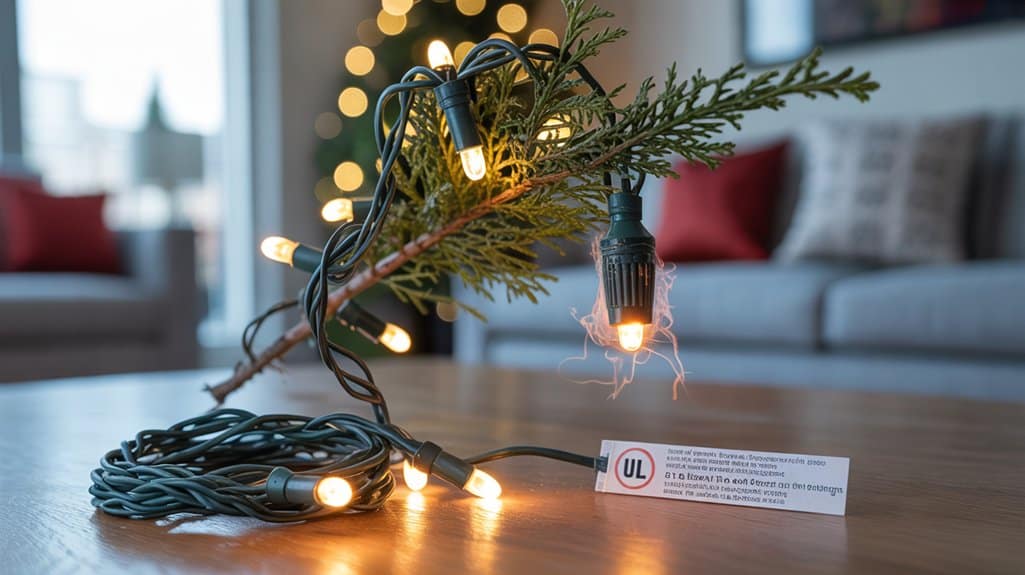
The Consumer Product Safety Commission’s substantial-product-hazard rule identifies three defects that make seasonal and decorative lighting a fire hazard: undersized conductors, insufficient strain relief, and absent overcurrent protection. Undersized wire heats under load; inadequate strain relief pulls conductors from their terminations and creates arcing; a missing fuse allows a fault to run unchecked until something ignites. Listed product carries an inline fuse in the plug and must pass UL 588’s fire and performance tests, which is precisely why unlisted or counterfeit product is the first thing a fire investigator examines.
The three defects the federal hazard rule names
The Consumer Product Safety Commission’s substantial-product-hazard rule, codified at 16 CFR 1120.3, identifies three specific defects in seasonal and decorative lighting that elevate a product to hazardous status: undersized conductors, insufficient strain relief, and absent overcurrent protection, each evaluated against the performance requirements of UL 588. Undersized wire heats under normal load, creating a thermal ignition path before any fault is detectable. Inadequate strain relief allows mechanical stress to separate conductors from their terminations, producing arcing at the point of failure. A missing inline fuse – required in the plug of listed product – permits a fault current to run unchecked through the cord. Fire investigators treat the absence of UL listing as a primary finding at holiday-light fire scenes.
Listed, fused and tested versus unlisted
UL 588 sets the fire-test and electrical-performance floor that separates listed holiday lights from unlisted product sold through the same retail channels. Listed product carries an inline fuse in the plug, passes conductor-load and fire-exposure testing, and bears the mark of a nationally recognized testing laboratory; those requirements are binding conditions of listing, not voluntary additions. Unlisted or counterfeit product carries none of those assurances, and fire investigators treat the absence of a listing mark as a primary finding at holiday-light fire scenes. Where a cord, plug, or socket shows damage, the governing guidance under NEC 110.3(B) requires that the manufacturer’s instructions – including any replacement or retirement criteria – be followed as a condition of lawful use.
The Circuit and the Lamp
Even a listed, properly fused string becomes a hazard when the circuit feeding it is asked to carry more than it is rated for. Daisy-chaining beyond a manufacturer’s stated limit violates NEC 110.3(B), because that limit is a listing instruction and hence carries the force of code; the heat that builds in overloaded connectors and cord jackets is the ignition sequence, not its preamble. Incandescent lamps compound the risk by running hot at the source – against a dried tree, fabric, or accumulated debris, that surface temperature is sufficient to ignite.
Overload, daisy chains and the cords the fire code prohibits
NFPA 1 prohibits the use of extension cords and relocatable power taps as permanent wiring, designating them as a recurring ignition path in home fire incidents. Daisy-chaining light strings beyond the manufacturer’s stated limit compounds this hazard; because those limits are incorporated as listing instructions, NEC 110.3(B) makes exceeding them a code violation, not merely a manufacturer preference. Each additional string added in series increases resistive heating at connectors and cord insulation alike. Cords routed under rugs, pinched in doorframes, or pressed against window sashes abrade over time, concentrating heat at the damage point and creating conditions for ignition well before any visible sign of failure appears.
Heat at the lamp and the fuel it touches
Incandescent Christmas light strings operate at lamp surface temperatures capable of igniting dry evergreen needles, cured leaves in gutters, and natural fiber fabrics on contact. The mechanism is straightforward: heat output at an incandescent lamp is concentrated at the glass envelope, and materials in direct contact need only reach their ignition threshold, not an open flame. NFPA’s statistical reporting on Christmas tree fires for 2018 through 2022 identifies electrical distribution or lighting equipment as a factor in more than two of every five home structure fires beginning with Christmas trees, a figure that reflects both product failure and proximity of a heat source to combustible material. LED Christmas lights eliminate the dominant heat pathway at the lamp itself, representing the most significant single risk reduction available through product selection.
Water, Protection and Prevention
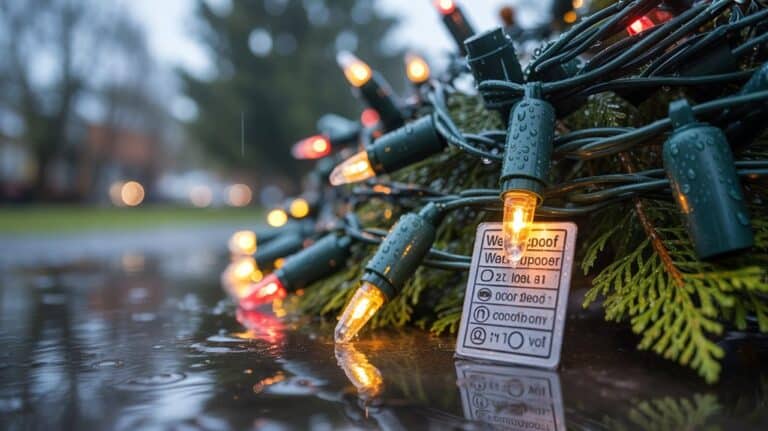
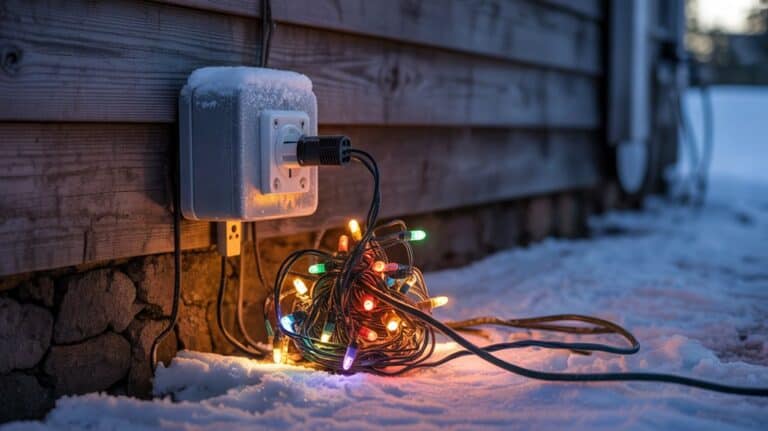
Moisture is the third ignition pathway, and it is quieter than overload. When water infiltrates a connector or socket, leakage current tracks across contaminated surfaces and produces arcing before any visible damage appears on the cord jacket. The Class A GFCI required on exterior receptacles under NEC 210.8 trips at roughly 4 to 6 milliamperes of ground leakage – a threshold low enough to interrupt many wet-connection faults before sustained heating begins – yet a GFCI that trips repeatedly is reporting an active fault, not malfunctioning, and bypassing it removes the last barrier between a degraded connection and ignition.
Wet connections, arcing and what the GFCI does
Moisture inside a holiday light connector or socket produces leakage current and arcing that can ignite surrounding materials before a standard breaker responds. NEC Section 210.8 and IRC 2021 Section E3902 require ground-fault circuit interrupter protection on exterior receptacles specifically because this failure path is predictable and recurring. A Class A GFCI, rated under UL 943, trips at approximately 4 to 6 milliamperes of ground leakage, interrupting many wet-connection faults before conductors reach ignition temperatures. Connectors left in contact with standing water, soil, or wet leaves represent the highest-exposure condition; keeping connections sealed and elevated off grade eliminates the moisture pathway that the GFCI alone cannot always address in time. A GFCI that trips repeatedly is detecting a fault, not malfunctioning, and bypassing it removes the last protective layer between a wet connection and a fire.
The prevention checklist a professional installation follows
NEC Section 110.3(B) makes the manufacturer’s daisy-chain limit a binding installation requirement, meaning any string count that exceeds the stated maximum constitutes a code violation regardless of whether the circuit breaker trips. That threshold governs load accumulation at the connector level, where resistance heating begins before upstream overcurrent protection responds. Listed product carries an inline fuse in the plug, rated under UL 588, that provides the first overcurrent response closest to the fault; a blown fuse that is bridged or replaced with a higher-rated substitute removes that protection entirely. Timers that de-energize the display during unattended overnight hours reduce cumulative thermal exposure across cords, connectors, and mounting points, addressing a risk that no single device eliminates on its own.
Frequently Asked Questions
Several recurring questions about Christmas lights concern the interaction between product type, weather exposure, and unattended operation. LED holiday lights run cool enough at the lens to substantially reduce ignition risk against adjacent combustibles, though they are not exempt from the wiring and overcurrent failures that govern any lighting assembly. Whether the concern is rain-exposed connectors, overnight operation without a timer, or the continued use of incandescent strings with intact fuses and undamaged jackets, the governing variables are product listing status, circuit load, and the condition of every termination at installation.
Are LED Christmas lights a fire hazard?
LED Christmas lights present a substantially lower fire hazard than incandescent alternatives because the lamp surface runs cool, eliminating heat-to-combustible ignition as a primary risk. Electrical faults from damaged cords, overloaded circuits, or unlisted product remain hazards regardless of lamp type. GFCI-protected receptacles and listed product with intact inline fuses address those residual risks.
Can outdoor Christmas lights catch fire in the rain?
Outdoor Christmas lights can catch fire in the rain when moisture enters connectors or sockets, producing leakage current and arcing. A Class A GFCI, required on exterior receptacles under NEC 210.8, trips at roughly 4 to 6 milliamperes of ground leakage, interrupting many wet-connection faults before sustained heating occurs. Connectors should remain sealed and elevated off the ground.
Is it safe to leave Christmas lights on all night?
Leaving Christmas lights on all night is not recommended. Unattended operation extends the period during which a cord fault, overloaded connector, or heat contact with dry material can progress to ignition without intervention. A timer eliminates unattended energization and is the most direct mitigation available.
Are incandescent Christmas lights safe to use?
Incandescent Christmas lights carry measurably higher fire risk than LED alternatives because their lamps generate enough surface heat to ignite dry greenery, fabric, or debris on contact. Listed product with intact fuses reduces but does not eliminate that thermal hazard. LED lamps remain the most significant single risk reduction available through product choice.
Safe Christmas Lighting Installation by Backyard Paradiso
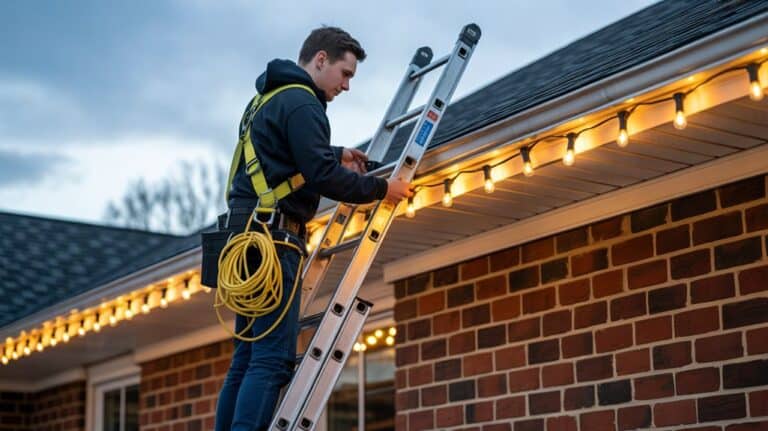
Residential installations generally must contend with exterior receptacle requirements under NEC 210.8, GFCI protection mandates governed by the adopted code edition in each jurisdiction, and the product-listing obligations of NEC 110.3(B) that make manufacturer daisy-chain limits binding regardless of local amendment. Backyard Paradiso works within this regulatory framework as a matter of routine on Christmas and holiday lighting installations, applying the same load-summing discipline, listed-product verification, and cord-management standards the article addresses. Consultations are available by appointment for property owners seeking a professional assessment of circuit capacity, GFCI receptacle condition, and display configuration before energizing a new installation. Backyard Paradiso welcomes inquiries from property owners who prefer to have these decisions made against a documented technical standard rather than informal practice.