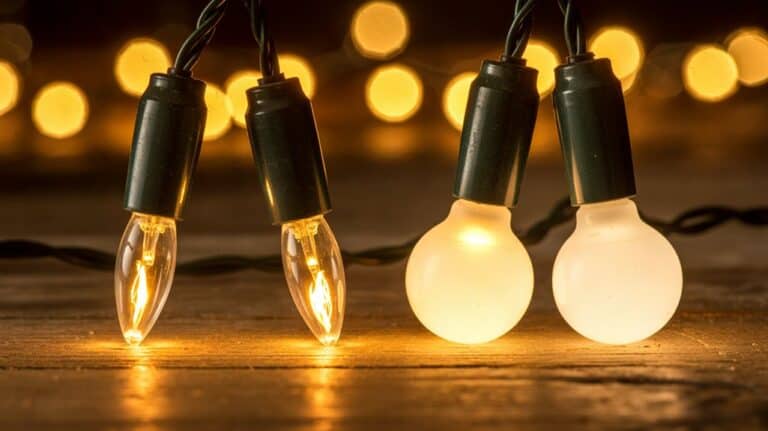
What Does a Professional Christmas Light Installation Include?
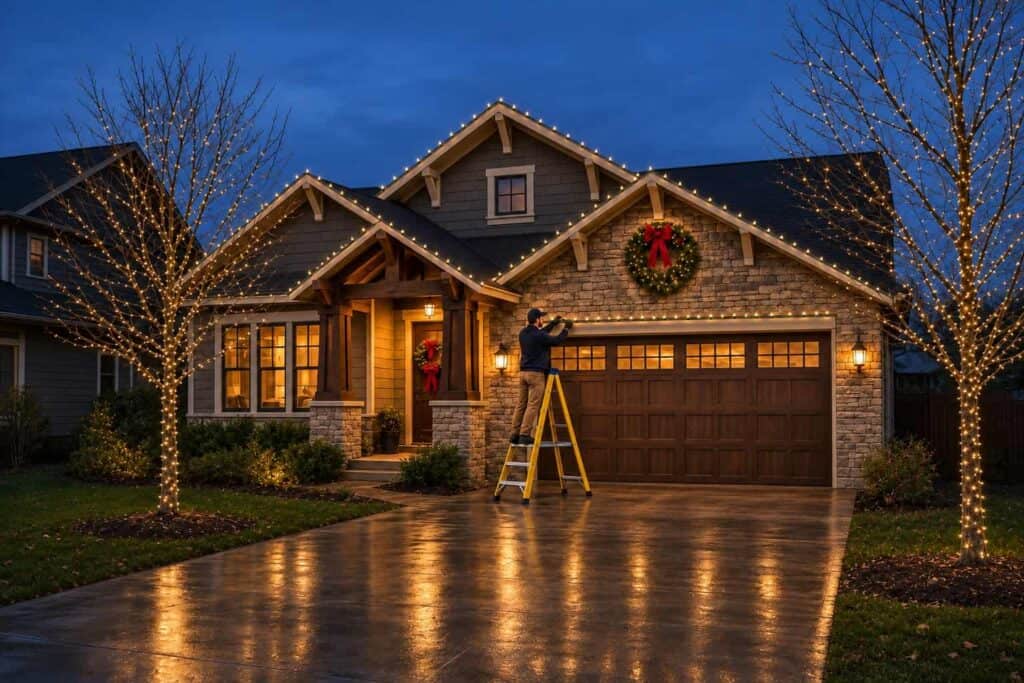
Image is AI-generated to illustrate a professional lighting installation.
The Phases of a Professional Installation
A professional Christmas light installation moves through six defined phases: design and site review, product specification, load planning, installation, season service, and removal with storage. Each phase depends on conditions found during the prior one, meaning a hazard or circuit shortfall discovered early reshapes what follows. The installation itself is a short engineering project coordinated across roofline attachment, electrical capacity, and fall-protection compliance rather than a simple decorating task.
Design and Survey
Every professional installation opens with a site walk that establishes the composition – which rooflines, ridgelines, gables, columns, and landscape features will carry light – before any product is ordered or a single clip is placed. That walk drives three parallel surveys: attachment conditions across shingle edges, gutter profiles, ridge caps, masonry, and trim; exterior circuit capacity, GFCI protection, and run distances from available receptacles; and hazard mapping that accounts for overhead service lines within the approach envelope defined by 29 CFR 1910.333 and roof heights that trigger fall-protection requirements under 29 CFR 1926.501. Light trespass toward neighboring properties is assessed against IES exterior lighting recommended practice, and any association covenants or local display ordinances remain the homeowner’s obligation to confirm, since those rules vary by jurisdiction.
Composition, attachment survey and electrical survey
Every professional Christmas light installation begins with a property walk governed by three distinct technical surveys before a single clip is placed or a single foot of cord is measured.
The composition review identifies which rooflines, ridgelines, gables, columns, windows, trees, and landscape features will carry light, and that visual plan then drives the attachment, electrical, and hazard surveys that follow. The attachment survey assesses shingle type, edge condition, gutter profile, ridge caps, masonry, and trim – each surface determining which non-penetrating clip profile is appropriate. The electrical survey documents exterior receptacle locations, GFCI protection status, in-use cover presence, shared circuit loads, and run distances. Light trespass toward adjacent properties is evaluated under IES exterior lighting recommended practice, and any association covenants governing holiday light displays remain the homeowner’s responsibility to confirm before installation proceeds.
Hazards: power lines, roof height and neighbors
Federal regulation 29 CFR 1910.333 establishes a ten-foot approach envelope around energized overhead lines, a clearance threshold that directly governs where ladders, cords, and crew can operate during a Christmas light installation. Any roofline, tree, or gable position falling within that envelope requires an alternate access method or formal coordination with the serving utility before work proceeds. Roof height introduces a parallel constraint: 29 CFR 1926.501 triggers fall-protection requirements at six feet above a lower level, a threshold most residential rooflines exceed. Light trespass toward neighboring properties is evaluated concurrently under the same IES recommended practice, completing the three-part hazard review that closes out the design and survey phase.
Specification and Load Planning
Once design locks the composition, specification translates those decisions into cord gauge, lamp count, and connector type – each choice carrying a consequence that follows the installation through its entire 90-day window. Commercial-grade socket cord, terminated to the measured run and fitted with sealed connectors, eliminates the coiled surplus and mid-run splices that concentrate moisture and mechanical stress at the worst possible points. Load planning then closes the loop: run wattages are summed against available exterior circuit capacity under NEC Article 220, daisy-chain limits are honored as listing instructions per NEC 110.3(B), and extension-cord chaining is ruled out entirely under NFPA 1 – leaving a dedicated exterior circuit, where existing capacity falls short, as the responsible path forward.
Commercial-grade cord, one color bin, sealed connections
ANSI C78.377 defines the color-temperature bins that determine whether LED lamps across a property read as a unified field or as a mismatched collection of competing hues. Because bin tolerances allow meaningful variation even within a single labeled color temperature, a professional specification locks every lamp on a job to one bin code rather than one marketing descriptor. Cord specification follows the same logic of precision: UL 62-listed SPT-1 or SPT-2 socket cord is cut and terminated to the measured run, eliminating coiled surplus that traps heat and mid-run splices that introduce resistance. Load planning under NEC Article 220 then confirms that the summed run wattages stay within available exterior circuit capacity, with daisy-chain limits honored as listing instructions per NEC 110.3(B).
Circuit arithmetic and the practices that are ruled out
NEC Article 220 governs how run wattages are summed against available exterior circuit capacity, establishing the arithmetic boundary that determines whether a proposed lighting layout is code-compliant before a single clip is set. That calculation accounts for every load sharing the circuit, not only the holiday lights, because exterior receptacles commonly serve landscape fixtures, security lighting, and seasonal equipment simultaneously. Daisy-chain limits carry equal authority: NEC 110.3(B) requires that listing instructions be followed as a condition of code compliance, and those instructions cap how many cords may connect end-to-end regardless of whether the total wattage appears acceptable. Extension-cord chaining and power strips are ruled out entirely under NFPA 1, a prohibition the Christmas lights guide addresses in full.
Installation, Service and the Off-Season
Installation day marks the point where specification becomes structure, and a compliant crew’s methods at the roofline determine whether the finished display holds through wind events without voiding the roof covering’s tested rating. In-season service follows a narrow decision tree – most dark runs trace to a tripped GFCI or a compromised connector rather than a failed lamp string – and a professional program includes a defined response path rather than leaving the homeowner to troubleshoot. Removal, executed within the 90-day window that governs the product’s listing class, closes the project with cord and connector inspection, labeled storage by run, and a layout record that makes the following season’s reinstallation reproducible.
How a compliant crew works at the roofline and on other structures
Federal regulation under 29 CFR 1926.501 requires fall protection for workers on roofs or elevated surfaces at or above six feet. A compliant crew arrives with harnesses, anchor points, and ladders configured to the requirements of 29 CFR 1926.1053, treating each roofline run as a controlled work environment rather than an improvised errand. Clips replace staples, nails, and screws through the roof covering, preserving the wind-resistance rating established under ASTM D3161 and D7158. Connectors are elevated and oriented downward to shed water, and a dusk test with spacing and alignment adjustments closes the installation phase. Through the display window, a compliant service path addresses the most common failure modes – tripped GFCIs, wet connectors, and wind-displaced clips – without requiring a full reinstallation.
In-season service, removal, inspection and storage
Removal at the close of the display window applies defined inspection criteria to every component before anything goes into storage. Each cord, connector, clip, and lamp set is checked for jacket damage, cracked socket collars, corroded contacts, and failed lamps, with damaged components flagged for replacement rather than returned to inventory. The UL 588 90-day classification defines the outer boundary of compliant display time, making timely removal a technical obligation rather than a preference. Runs are labeled by location and stored with a layout record that allows the following season’s installation to proceed from documented measurements, eliminating redundant site surveys and reducing the margin for mismatched color-temperature bins across the property.
Frequently Asked Questions
Homeowners approaching a professional Christmas light installation for the first time tend to carry the same cluster of questions: what the service actually covers, who supplies the product, how long the work takes, and whether takedown is part of the arrangement. Those questions are not incidental – their answers define the scope of the engagement and shape decisions about circuit readiness, storage, and the following season’s reinstallation. What follows addresses each directly, grounded in the installation framework this article has laid out.
What is included in professional Christmas light installation?
Professional Christmas light installation covers site review, product specification, load planning, attachment, a dusk alignment test, in-season service, and removal with storage. Scope varies by property complexity, existing circuit capacity, and whether systems such as landscape lighting or pergolas introduce attachment or color-matching constraints. Association covenants remain the homeowner’s responsibility to confirm.
Do professional installers provide the lights?
Most professional installers supply the lights as part of a full-service program, retaining ownership of the product across seasons. Some programs offer client-owned product installation instead, though compatibility with commercial-grade UL 588 cord and connector specifications must be confirmed. Storage and reinstallation from a saved layout record is a common feature of supplier-owned programs.
How long does a professional Christmas light installation take?
Installation time for a typical residential property runs two to six hours for a single crew. Run length, roof complexity, and the number of attachment surfaces – gutters, ridgelines, gables, trees, and pergolas – each extend the timeline. Properties requiring a licensed electrician to add exterior circuit capacity are scheduled separately.
Do professional Christmas light installers take the lights down?
Removal is a standard phase of most professional Christmas light installation programs, not an optional add-on. Takedown follows the same fall-protection and ladder-compliance rules as installation, and cords, connectors, clips, and lamps are inspected for damage before storage. Many programs retain the product and reinstall from a saved layout record the following season.
Professional Christmas Light Installation by Backyard Paradiso
Residential Christmas light installations carry concurrent obligations across fall-protection thresholds under 29 CFR 1926.501, electrical load compliance under NEC Article 220, attachment requirements that preserve roof covering wind ratings under ASTM D3161 and D7158, and color-temperature consistency governed by ANSI C78.377. Backyard Paradiso brings demonstrated command of each of those technical layers to professional holiday light installation, translating design intent into a system that holds through the full display window without code compromise. Consultations are available by appointment for homeowners evaluating scope, circuit readiness, or the structural constraints introduced by pergolas, glass railings, or composite fencing. A professionally installed and stored system comes back out of storage the following season with its layout record, labeled runs, and inspected components intact, which is what makes reinstallation a repeat rather than a redesign.