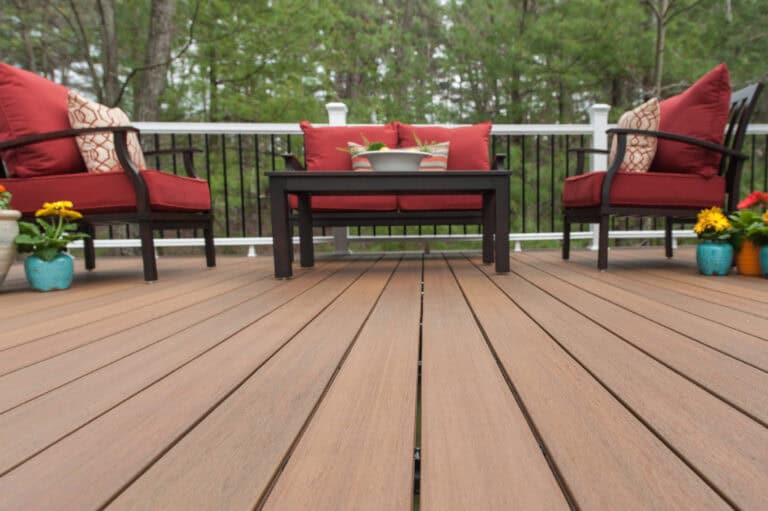
What Are the Overall Pros and Cons of Composite Decking Versus Wood Decking?
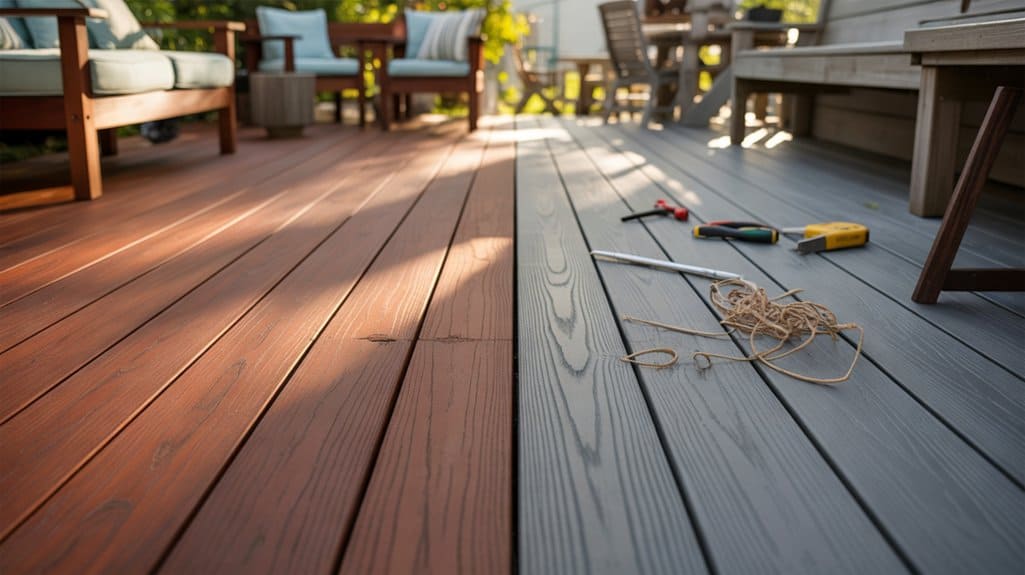
Composite Decking Versus Wood Decking
Both composite and wood decking serve residential outdoor platforms capably, but neither material is universally superior across every installation condition. Substructure framing, exposure severity, maintenance commitment, and upfront budget tolerance determine which performs better in a given application. Composite deck boards are engineered surface members combining wood fiber and thermoplastic resin, designed to replace solid-sawn lumber as the walkable layer of a deck assembly.
Where Composite Comes Out Ahead
Capped composite and cellular PVC decking earn their strongest argument on maintenance, where the absence of a staining, sealing, or sanding obligation over the product’s service life represents a structural difference in ownership demands rather than a minor convenience. The capstock layer also denies surface boards the organic nutrition that sustains mold colonization, and biodeterioration resistance tested under ASTM D7032 Section 4.8 places qualifying products on par with preservative-treated or naturally durable heartwood. Code recognition follows from that performance record: IRC 2021 R507.2.2 requires composite deck boards to carry an ICC-ES AC174 evaluation report, which means the product’s structural ratings, including joist spacing and span limits, are traceable to independent third-party testing rather than manufacturer assertion alone.
Maintenance, rot and surface integrity over the service life
ASTM D7032 rates capped composite decking for biodeterioration resistance equivalent to preservative-treated or naturally durable heartwood, a performance threshold that pressure-treated pine achieves only through chemical impregnation and that cedar achieves only when heartwood content is high and consistent. The significance for surface integrity is structural: a capped board denies mold colonies the cellulosic nutrition that drives surface degradation in wood, so the checking, splintering, and cupping that accumulate in wood decking over successive wet-dry and freeze-thaw cycles do not occur. USDA Forest Products Laboratory field studies document the corresponding reduction in maintenance burden. Where wood requires a recurring stain or sealer cycle to preserve surface integrity, composite’s capstock requires only periodic cleaning with oxygen-based cleaners applied within pressure limits specified by the product evaluation report.
Code recognition and biodeterioration ratings
IRC 2021 Section R507.2.2 requires that composite deck boards carry an ICC-ES AC174 evaluation report before installation on code-compliant residential decks. That evaluation report is the instrument through which ASTM D7032 biodeterioration ratings translate into enforceable code recognition, confirming that capped composite boards meet the decay and insect resistance threshold otherwise satisfied by preservative-treated lumber or naturally durable heartwood. The practical consequence is that composite decking enters a project with a documented performance basis rather than a presumed one. Span and load ratings for composite boards derive from the same D7032 evaluation, not from lumber tables, which means the structural case for the material and the code case for the material arrive through a single, auditable source.
Where Wood Comes Out Ahead
Wood holds a clear advantage at the point of purchase, where material costs run lower than capped composite or cellular PVC regardless of species or treatment grade. On a hot afternoon in direct sun, wood’s surface temperature stays measurably cooler underfoot—a consequence of the thermoplastic matrix holding heat at the surface and of the darker pigments many composite lines offer. When a board is damaged, wood’s repairability is straightforward: a homeowner or contractor can sand, re-seal, or swap individual boards without forfeiting any performance rating or warranty standing.
| Property | Capped composite | Pressure-treated or cedar |
|---|---|---|
| Finish maintenance | Rinse and clean; no stain or sealer | Stain or sealer on a recurring cycle |
| Rot and insect resistance | Rated per ASTM D7032 Section 4.8 | Treatment to AWPA U1 or naturally durable species |
| Surface in direct sun | Runs hotter, dark colors most | Cooler |
| Dimensional behavior | Thermal expansion; gapped per evaluation report | Moisture swelling, checking, cupping |
| Span basis | Product rating per ASTM D7032 / ICC-ES AC174 | AWC NDS and DCA 6 span tables |
| Repair | Section replacement; no refinishing | Board replacement or refinishing |
| Code path | IRC 2021 R507.2.2 with evaluation report | IRC 2021 R507 prescriptive |
Cost at purchase, surface temperature and feel underfoot
Wood decking carries a lower upfront material cost than capped wood-plastic composite or cellular PVC decking, a distinction that holds across residential installations regardless of species or preservative treatment. Beyond purchase price, solid wood boards transmit far less radiant heat to bare feet than dark composite surfaces, which field measurements have documented reaching temperatures well above ambient air temperature under direct sun exposure. That thermal difference is a property of the polymer and its pigmentation rather than any structural deficiency. Wood also delivers a tactile quality — the natural grain texture and cooler surface — that many homeowners weigh alongside the financial calculus when choosing between the two material categories.
Repairability and refinishing
Wood decking permits board-by-board replacement and surface refinishing because the finish is applied to the wood rather than built into a thin factory shell. A single board damaged by impact, checking, or severe cupping can be removed and substituted without disturbing adjacent material, and the entire surface can be sanded, restained, or resealed to restore its original appearance. Capped composite and cellular PVC boards carry no equivalent path: once the capstock is breached, aftermarket paint or sealer is not authorized under the evaluation report and can void the rating, so the damaged board is replaced rather than refinished. That asymmetry positions wood as the more recoverable material across the full service life, particularly in installations subject to mechanical impact or concentrated point loads.
What Both Share and What Decides It
Regardless of which surface board an owner selects, the pressure-treated substructure beneath it remains governed by the same IRC 2021 R507 provisions, making the structural frame a constant rather than a variable in this decision. What does shift the calculus is the intersection of climate exposure, anticipated use intensity, and the owner’s planning horizon—factors that weight the recurring maintenance burden of wood differently depending on whether the deck faces sustained moisture, seasonal freeze-thaw cycling, or heavy foot traffic. An owner planning a short stay may find the lower upfront cost of wood more compelling, while one intending to remain through the full service life of the installation stands to recover composite’s premium through reduced maintenance obligations over time.
The pressure-treated substructure under either surface
IRC 2021 Section R507 governs the substructure beneath every residential deck regardless of what surface board is installed above it. Posts must meet AWPA U1 Use Category UC4A, while joists require UC3B, and those designations hold whether the owner selects composite boards or wood planks for the walking surface. This shared foundation means the structural and decay-resistance requirements of the framing are settled before the surface-board decision begins. Ledger connections and guardrail assemblies represent the catastrophic failure modes in residential deck construction, as research from Virginia Tech and the Penn State PHRC confirms, and neither failure mode is influenced by the choice of decking material laid across the joists.
Climate exposure, use pattern and how long the owner plans to stay
The length of time an owner plans to occupy a residence is a primary financial variable in the composite-versus-wood decision, because the higher upfront material cost of composite boards is recovered only across a service life long enough to offset the recurring maintenance expenditure that wood requires. Composite decking’s ASTM D7032-rated resistance to biodeterioration and its freedom from staining, sealing, and sanding cycles favor installations where the owner intends to remain for an extended period. Wet, shaded, and freeze-thaw exposure conditions accelerate checking, cupping, and decay in wood boards, compressing the interval before refinishing or replacement becomes necessary. NADRA lifecycle cost analysis and resale recovery data frame the long-term value comparison, making ownership horizon the axis on which the financial case most clearly turns.
Frequently Asked Questions
The composite-versus-wood decision generates a consistent set of questions from homeowners evaluating both materials, and several technical points recur often enough to warrant direct treatment. Whether composite’s performance justifies its upfront cost, how its surface temperature and joist-spacing requirements affect practical use, and where its known liabilities concentrate are the questions that most reliably shape final decisions. None of these questions has a universal answer, because the right choice depends on maintenance tolerance, site exposure, and structural conditions that vary across residential installations.
Is composite decking better than wood?
Neither material is categorically better; each outperforms the other on different criteria. Composite decking eliminates the recurring maintenance cycle and resists biodeterioration per ASTM D7032, but carries higher upfront material cost and surface heat concerns. The better choice depends on budget, maintenance preference, and site conditions.
What are the disadvantages of composite decking?
Composite decking carries higher upfront material costs, retains significant heat on dark boards in direct sun, and requires precise gapping to manage thermal expansion and contraction. Flexural creep under sustained load also necessitates closer joist spacing than dimensional lumber tables permit. Damaged capstock cannot be refinished, and aftermarket paint or sealer can void the product’s AC174 evaluation report rating.
Does composite decking get hotter than wood?
Composite decking surfaces measurably exceed air temperature in direct sun, with dark-colored boards reaching the highest readings. Wood decking stays comparatively cooler under the same conditions, making surface temperature a meaningful comfort consideration. Board color selection can partially offset this effect for composite installations.
Does composite decking need more joists than wood?
Composite decking generally requires closer joist spacing than dimensional lumber because composite boards exhibit flexural creep under sustained load. Allowable spans come from each product’s ASTM D7032 rating rather than from lumber tables such as AWC NDS or DCA 6. Installers must consult the product’s ICC-ES AC174 evaluation report to confirm the correct spacing.
Composite Deck Installation Across the Markets Backyard Paradiso Serves
Residential deck boards are governed by IRC 2021 R507.2.2, which requires composite and cellular PVC products to carry an ICC-ES AC174 evaluation report establishing span ratings, joist spacing, and biodeterioration resistance under ASTM D7032, while the supporting substructure must meet AWPA U1 use-category requirements independently of whichever surface board is selected. Backyard Paradiso applies that full code framework across composite deck installation projects, translating product evaluation report requirements and AWPA U1 classifications into substructure and surface board specifications that hold under authority-having-jurisdiction review. Consultations are available by appointment for homeowners weighing the lifecycle cost position and resale recovery that NADRA research associates with low-maintenance composite surfaces against the lower upfront material investment that pressure-treated pine and cedar present.