What Is the Difference Between C7 and C9 Christmas Lights?
C7 and C9: What the Numbers Mean
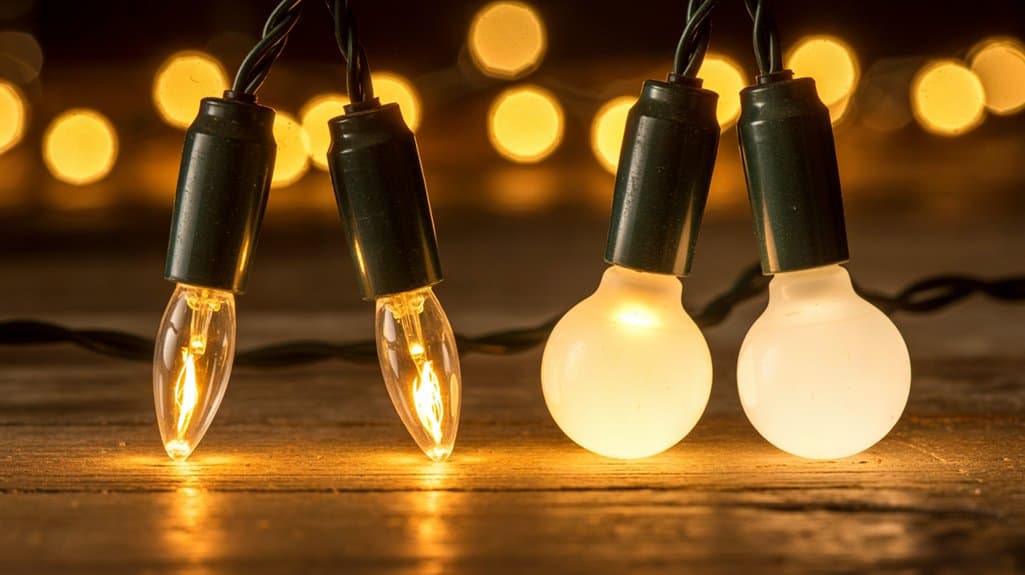
The letters and numbers in C7 and C9 carry specific dimensional meaning: C denotes a cone-shaped lamp profile, and the numeral denotes nominal diameter in eighths of an inch, making a C7 nominally seven-eighths of an inch across and a C9 nominally one inch and one-eighth. These are general industry convention, not values defined by a formal standard. The two sizes use different screw bases – candelabra for C7, intermediate for C9 – making sockets, cords, and bulbs non-interchangeable between them.
Size, Base and Where Each One Belongs
The nominal diameter difference between a C7 and a C9 – seven-eighths versus nine-eighths of an inch – determines the screw base each lamp requires, and because candelabra and intermediate bases are dimensionally incompatible, sockets, cords, and lamps do not cross between the two sizes. That physical distinction carries a direct design consequence: C9 lamps read as the bolder point of light at distance, making them the conventional choice for rooflines on two-story homes and long ridgelines where scale demands visual weight. C7 lamps, finer in both diameter and projected presence, suit single-story eaves, porch railings, and window outlines where the shorter sightline rewards a more restrained profile.
Nominal diameter, screw base and why they do not interchange
C7 Christmas lights use a candelabra screw base while C9 Christmas lights use the larger intermediate screw base, making sockets, cords, and lamps from one size physically incompatible with the other. The dimensional distinction follows general industry convention: the C designation denotes a cone-shaped profile, and the trailing number indicates nominal diameter in eighths of an inch, placing the C7 at nominally seven-eighths of an inch across and the C9 at nominally one and one-eighth inches. Because the base dimensions differ, a C9 lamp cannot seat in a C7 socket cord, and no adapter corrects for the mismatch without defeating the listed configuration of the assembly. Specifying the correct replacement lamp consequently requires knowing both the bulb designation and the base type of the installed cord.
Rooflines, eaves and sightlines: matching bulb scale to the house
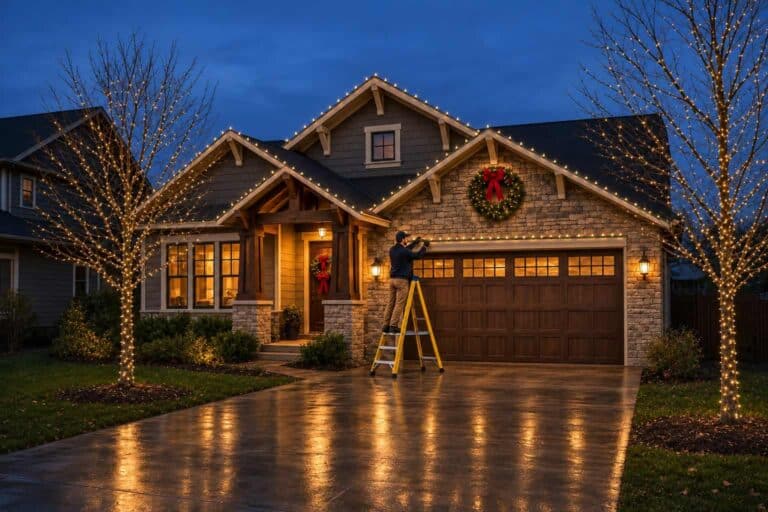
C9 Christmas lights, with their nominally one-and-one-eighth-inch diameter, are the conventional choice for rooflines on two-story homes and long ridgelines where viewing distance demands a bolder point of light. The C7, finer at nominally seven-eighths of an inch, reads in proportion on single-story eaves, porch railings, window outlines, and shorter sightlines where the larger lamp would overwhelm the architectural scale. Socket spacing on the cord amplifies this effect: closer spacing produces what reads as a continuous line of light, while wider spacing resolves as individual points, and that spacing is set by the cord rather than adjusted in the field. Matching bulb scale to house scale, before any other variable is chosen, determines whether the finished roofline reads as deliberate or accidental.
| Attribute | C7 | C9 |
|---|---|---|
| Nominal diameter | Seven-eighths inch | One and one-eighth inch |
| Screw base | Candelabra | Intermediate |
| Visual scale | Finer point of light | Bolder point of light |
| Typical placement | Single-story eaves, railings, windows | Rooflines, ridgelines, two-story homes |
| Incandescent power draw | Lower per lamp | Higher per lamp |
| LED retrofit available | Yes | Yes |
| Cord class | Socket cord listed under UL 62; outfit under UL 588 | Socket cord listed under UL 62; outfit under UL 588 |
| Wind exposure at roof edge | Smaller projected area | Slightly larger projected area |
Cord, Power and Serviceability
The cord carrying C7 or C9 lamps on a professional roofline installation is a socket cord – typically SPT-1 or the heavier-jacketed SPT-2 parallel cord – listed under UL 62 as flexible cord, with the assembled outfit falling under UL 588 as a decorative lighting product. Incandescent C9 lamps draw more watts per socket than their C7 counterparts, a distinction that shapes circuit planning considerably; LED retrofit lamps in either base size reduce per-socket draw to a fraction of incandescent consumption, which changes the arithmetic of how many sockets a single circuit can carry. Because both sizes use screw-base sockets at fixed intervals along the cord, a failed lamp is replaced individually without disrupting the rest of the run – a serviceability advantage that separates professional socket cord product from consumer string sets with fixed, non-replaceable lamps.
Socket cord, listed product classes and replaceable lamps
Professional roofline socket cord for Christmas lights is listed under UL 62 as flexible cord, with the assembled outfit – sockets, cord, and screw-base lamps together – falling under the seasonal decorative lighting product class defined by UL 588. That listing structure matters because it ties the product to defined safety requirements distinct from consumer string sets with fixed, non-replaceable lamps. The screw-base design of both C7 and C9 systems is a direct serviceability advantage: a failed lamp is replaced individually without taking down the run, a characteristic that professional-grade socket cord preserves by design. Because each lamp size uses a different base – candelabra for C7, intermediate for C9 – sockets, cords, and replacement lamps are not interchangeable between the two sizes, and mixing them on a single run is not possible without reconfiguring the cord.
Power draw and what LED retrofits change
Incandescent C9 lamps draw more watts per socket than incandescent C7 lamps, a difference that compounds quickly across a full roofline run as lamp count climbs. LED retrofit lamps, available in both candelabra and intermediate bases to fit existing C7 and C9 socket cord respectively, draw a small fraction of the wattage of their incandescent counterparts, which changes circuit load calculations substantially. That reduction allows more lamps per circuit without approaching breaker limits, though the full arithmetic of circuit capacity – conductor rating, outlet loading, and the UL 588 assembly boundaries – is addressed in a companion post on how many lights one circuit can carry. What the power distinction means at the point of selection is straightforward: lamp technology and bulb size are independent decisions, and either size can be run in LED or incandescent form without altering the cord or socket configuration.
Consistency Across the Property
Consistency across a roofline depends less on the choice between C7 and C9 than on holding three variables constant: color temperature bin, lens style, and socket spacing. ANSI C78.377-2017 defines correlated color temperature in nominal categories, but lamps from different production runs or different manufacturers can occupy different MacAdam-ellipse tolerance bins within the same nominal category, and that variance reads as mismatched color to anyone viewing the roofline from the street. Spacing and lens geometry compound the issue – closer socket intervals merge individual points into a continuous line while faceted lenses scatter light differently than smooth ones, so mixing either variable mid-run produces a result that looks unplanned rather than deliberate.
Color temperature bins and why mixed runs look wrong
ANSI C78.377-2017 defines the correlated color temperature bins and MacAdam-ellipse tolerance ranges that govern how white Christmas lights render at the lamp level, and a run built from lamps sourced across different bins will produce visible color variation even when every package is labeled the same nominal temperature. A warm-white lamp nominally rated at 2700 K and a cool-white lamp nominally rated at 4100 K are separated by a gap the eye reads immediately at roofline distances; less obvious, but equally problematic, is mixing lamps that share a nominal CCT yet fall in different MacAdam-ellipse tolerance steps. Compounding the bin mismatch, incandescent and LED lamps produce fundamentally different spectral distributions, so blending the two technologies on a single run compounds the inconsistency beyond what bin tolerances alone create. Consistency of CCT bin, ellipse step, and lamp technology across the entire property matters more to the finished appearance than the choice between C7 and C9.
Spacing, lens style and wind exposure at the roof edge
ASCE/SEI 7-22 Chapter 30 governs components-and-cladding wind pressures at roof edges and corners, where uplift and lateral loads on attached objects are highest. The C9 cord, being heavier-jacketed and carrying a larger lamp with greater projected area, presents more surface to those elevated edge pressures than C7 assemblies do, making consistent clip spacing and secure gutter or shingle-edge seating more consequential at those locations. Lens style introduces a separate consistency variable: faceted lenses scatter light across a broader cone while smooth lenses read as a tighter point, and mixing the two profiles along a single run produces an irregular rhythm visible at street distance. Spacing set by the cord itself – commonly around one foot between sockets for roofline work – determines whether the finished run reads as a continuous line of light or as discrete individual points.
Frequently Asked Questions
A handful of questions recur whenever installers or homeowners compare the two sizes, and most of them trace back to the same underlying variables: socket compatibility, visual output, and lamp technology. C7 lamps do not fit C9 sockets, and the reverse is equally true – the candelabra and intermediate bases are dimensionally distinct, making cords, sockets, and lamps non-interchangeable between sizes. Whether C9 reads as brighter, whether LED retrofit lamps match the visual character of incandescent, and which size suits a given roofline each depend on conditions – viewing distance, correlated color temperature, lens profile, and the scale of the structure – that the following answers address in turn.
Are C9 bulbs brighter than C7?
C9 lamps generally produce more light output than C7 lamps in incandescent form, owing to their larger filament and higher wattage. LED retrofits in either size can narrow or erase that gap depending on the driver and optics chosen. Lamp technology, not bulb size alone, determines brightness.
Can C7 bulbs be used in C9 sockets?
C7 bulbs cannot be used in C9 sockets; the two sizes use different screw bases, with C7 lamps fitting a candelabra base and C9 lamps fitting the larger intermediate base. Sockets, cords, and bulbs are not interchangeable between the two sizes. Mixing components compromises the listed assembly under UL 588.
Which is better for a roofline, C7 or C9?
C9 is the conventional choice for rooflines, particularly on two-story homes and long ridgelines viewed from the street, where its larger visual scale reads clearly at distance. C7 suits shorter sightlines, single-story eaves, and finer outlines where the smaller profile is proportionally appropriate. Consistency of size and color bin across the full run matters as much as the size selected.
Do C9 LED bulbs look the same as incandescent C9?
LED C9 lamps do not render identically to incandescent C9s under all conditions. Incandescent lamps produce a warm, omnidirectional glow with a continuous spectrum, while LED lamps vary by color bin and lens type, making bin consistency per ANSI C78.377-2017 critical. Mixing the two technologies on one roofline is the most common cause of visible mismatch.
Roofline Christmas Lighting by Backyard Paradiso
Residential installations generally contend with a combination of wind-exposure conditions governed by ASCE/SEI 7-22 Chapter 30 components-and-cladding pressures, UL 588 product-class requirements, and jurisdiction-specific code thresholds that together determine how Christmas light systems must be specified, attached, and maintained across a roofline. Backyard Paradiso works within this technical framework on a regular basis, bringing demonstrated familiarity with commercial-grade socket cord selection, non-penetrating attachment methods, and color-bin consistency to roofline Christmas lighting installations. Consultations are available by appointment for homeowners evaluating C7 versus C9 scale decisions, lamp technology shifts, or full-property layout planning, and the same standard of technical discipline applies regardless of property scale or roofline complexity.