How Are Christmas Lights Installed Safely on a Second Story?
What Safe Second-Story Lighting Work Requires
Safe second-story Christmas light installation requires fall protection, correct ladder positioning, power-line clearance, and non-penetrating attachment methods on every job. OSHA’s six-foot trigger under 29 CFR 1926.501(b)(1) means every standard eave height mandates a harness or protected platform for any professional crew. Second-story work is the category of holiday light installation where roofline height, wind-pressure edge zones, and proximity to service drops converge into compounding hazards.
Falls and the Rules Written Because of Them
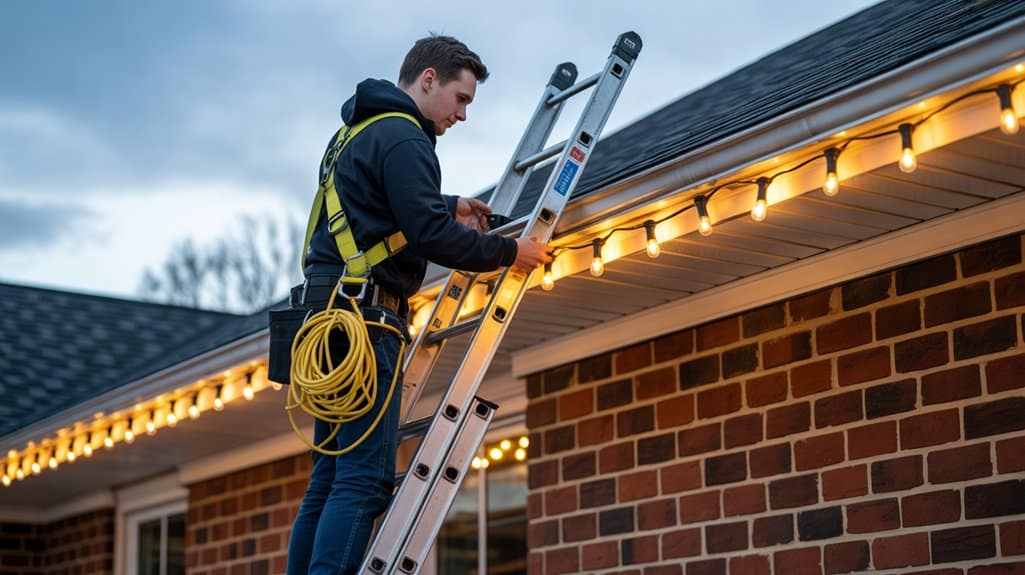
Every second-story eave clears six feet above grade, which means every crew member working that elevation falls under OSHA’s requirement for a guardrail, safety net, or personal fall-arrest system before the first clip goes on. That threshold is not incidental – CPSC emergency-department data has consistently placed falls as the leading injury mechanism in holiday-lighting work, accounting for a substantial share of the roughly 12,000 to 15,000 decorating-related injuries reported per season over the last decade of releases. Ladder discipline compounds the exposure: OSHA mandates that side rails extend at least three feet above the upper landing surface and that a non-self-supporting ladder be set at a base distance of approximately one-quarter its working length, conditions that the typical homeowner setup – footed on soft ground, leaned against a gutter – routinely fails to meet.
The six-foot fall-protection trigger and what it means on an eave
OSHA 29 CFR 1926.501(b)(1) requires that any employee working on a surface six feet or more above a lower level be protected by a guardrail system, safety net, or personal fall-arrest system. Every standard second-story eave clears that six-foot threshold by a substantial margin, placing the entire roofline within mandatory fall-protection territory for any professional crew. The Consumer Product Safety Commission has estimated roughly 12,000 to 15,000 holiday-decorating injuries per season over the last decade of releases, with falls representing the largest share of that total. Those figures are what drove the regulatory framework that homeowners should expect a compliant crew to follow visibly: harnesses clipped to roof anchors, or work conducted from a properly guarded elevated platform, before a single clip is set along the eave.
Ladder setup rules that separate safe work from the usual
29 CFR 1926.1053 requires that the side rails of a ladder extend at least three feet above the upper landing surface and that the base be set at a horizontal distance of approximately one-quarter of the ladder’s working length from the structure it leans against. Those dimensional requirements exist because deviations from either figure change the load geometry at the rails and shift the probability of a kick-out or tip-over failure. Ladders footed on uneven ground, rested against a gutter, or leaned against a cord run represent the recurring failure pattern that the standard was written to prevent. Where ladder side rails could contact energized equipment, the same regulation requires nonconductive rail material, a condition directly relevant at second-story heights where service drops and secondary conductors routinely fall within reach.
Power Lines and the Roof Edge
Two hazards converge at the second-story roofline that a ground-level layout never encounters: the service drop and the wind-pressure zones that govern how anything attaches to the roof edge. OSHA 29 CFR 1910.333(c)(3)(i)(A) holds unqualified workers at least ten feet from energized overhead conductors at or below 50 kV, a clearance that routinely intersects the eave at corner and gable conditions, which is why a compliant layout sometimes stops short of what the homeowner assumed was a natural terminus. At those same corners and edges, ASCE/SEI 7-22 identifies the highest components-and-cladding wind pressures on the roof plane, making non-penetrating clips – rather than fasteners that breach the weather barrier – the attachment method that keeps the roof covering’s tested wind rating intact.
The ten-foot approach distance and why layouts route around it
29 CFR 1910.333(c)(3)(i)(A) requires any unqualified person working from an elevated position to maintain a minimum clearance of ten feet from overhead power lines operating at 50 kV or below. At second-story height, that envelope routinely intersects the service drop entering the structure, the secondary conductors running along the eave line, and tree canopies grown close to the roofline – distances that appear safe from the ground but compress markedly once a worker or ladder reaches eave height. A professional crew accounts for this geometry during the layout phase, before a single clip is placed, which is why a roofline run sometimes stops short of a corner or routes around a gable rather than following the most direct decorative path. The power line clearance requirement, not aesthetic preference, drives those decisions.
Wind zones at the roofline and non-penetrating attachment
ASCE/SEI 7-22 Chapter 30 assigns the highest components-and-cladding wind pressures to the corner and edge zones of a roof, precisely the areas where second-story Christmas light installations concentrate. Those elevated pressures mean that any attachment method penetrating the roof covering – staples, nails, or screws driven through shingles or into fascia – risks compromising the weather barrier and undermining the wind rating the roofing assembly was tested to achieve under ASTM D3161 or D7158. Non-penetrating clips at the shingle edge, gutter lip, or ridge preserve that tested rating by transferring load without breaching the membrane. The Christmas lights guide covers non-penetrating attachment hardware and ASCE 7 wind zone mapping in depth; at the second-story roofline, those principles are not optional refinements – they are the minimum standard a compliant installation meets.
Power Up High and Taking It Down
A second-story Christmas lights installation demands a clear path to a ground-fault-protected exterior receptacle – one with a weatherproof cover rated for use with an inserted plug – because cord chaining across a roofline is the practice the fire code (NFPA 1) prohibits, and it creates both a shock and fire hazard at the point of connection. Long runs at eave height introduce meaningful voltage drop, so circuit loading requires calculation before the layout is finalized rather than after complaints arise. Removal at season’s end operates under identical fall-protection and ladder requirements as the original installation, and professional crews treat it as a separate planned operation rather than an afterthought.
Reaching a protected receptacle without cord chaining
NEC Section 210.8, as adopted in the International Residential Code Section E3902, requires ground-fault circuit-interrupter protection on exterior receptacles in one- and two-family dwellings, and every cord run serving second-story Christmas lights must terminate at a receptacle that meets this requirement. Second-story installations present a particular challenge because the physical distance from eave to outlet frequently exceeds what a single cord can bridge without introducing extension-cord chaining, which the NFPA 1 provisions prohibit in occupied and residential contexts. Circuit planning – confirming that the run’s total length does not produce problematic voltage drop and that the connected load stays within the circuit’s rated capacity – must precede installation, not follow it. A weatherproof cover rated for use with an inserted plug keeps the connection compliant regardless of precipitation conditions throughout the display period.
Removal carries the same risk
OSHA 29 CFR 1926.501(b)(1) applies to removal work at second-story height with the same force it carries during installation, because the regulation governs any employee on a working surface six feet or more above a lower level regardless of whether work is being added or taken down. Cold-weather conditions compound the hazard: ladder rails contact frozen ground, shingles carry frost, and gloved hands reduce grip on both rungs and clips. The Consumer Product Safety Commission has reported roughly 12,000 to 15,000 holiday-decorating injuries per season across the last decade of releases, with falls representing the largest share. Every fall-protection, ladder-setup, and power-line clearance requirement that governed the original installation governs the crew on that same roofline in January.
Frequently Asked Questions
Second-story Christmas light installations generate consistent questions about professional methods, personal risk, and regulatory clearances. Professionals rely on harnesses, roof anchors, and correctly staged ladders – not improvised footing – because OSHA’s six-foot fall-protection trigger covers every standard eave at that height, and the consequences of non-compliance are physical, not administrative. The ten-foot clearance requirement from overhead lines under 29 CFR 1910.333(c)(3)(i)(A) shapes layout decisions at the roofline in ways that are not always obvious from the ground, which is why a run sometimes stops short of a corner where a service drop runs close.
How do professionals hang Christmas lights on a two-story house?
Professional crews hang Christmas lights on a two-story house using personal fall-arrest systems, correctly positioned ladders, and pre-planned cord routes that respect overhead service drops. OSHA 29 CFR 1926.501(b)(1) mandates fall protection at six feet above a lower level, a threshold every second-story eave exceeds. Non-penetrating clips and ground-fault-protected receptacles complete a compliant installation.
Is it safe to put Christmas lights on a second-story roof yourself?
Second-story Christmas light installation carries serious fall risk that makes professional crews the safer choice for most residential rooflines. CPSC emergency-department estimates recorded roughly 12,000 to 15,000 holiday-decorating injuries per season, with falls representing the largest share. OSHA fall-protection requirements triggered at six feet apply to those crews, underscoring the hazard any untethered person faces at eave height.
How far from power lines do Christmas lights need to be?
Any Christmas light installation work conducted from an elevated position must maintain at least ten feet of clearance from overhead power lines at or below 50 kV, per 29 CFR 1910.333(c)(3)(i)(A). Service drops and secondary conductors along eaves frequently fall within that envelope at second-story height. Roofline layouts sometimes stop short of a corner for exactly this reason.
Do installers use harnesses to hang Christmas lights?
Compliant crews working on second-story roofs do use harnesses, along with roof anchors and other personal fall-arrest systems required under OSHA 29 CFR 1926.501(b)(1) for surfaces six feet or more above a lower level. Steep-pitch roofs and high eaves make guardrails impractical, leaving a tied-off harness the standard solution. Removal at season’s end triggers identical fall-protection requirements.
Second-Story Christmas Light Installation by Backyard Paradiso
Second-story Christmas light installation operates under a layered set of technical mandates – OSHA 29 CFR 1926.501(b)(1) fall-protection requirements triggered at six feet, ladder configuration standards under 29 CFR 1926.1053, the ten-foot overhead line clearance threshold of 29 CFR 1910.333(c)(3)(i)(A), and ASCE/SEI 7-22 Chapter 30 wind-pressure considerations at roof edge and corner zones. Backyard Paradiso’s second-story installation work is built around demonstrated command of these requirements, applied through crews equipped with appropriate fall-arrest systems, correctly configured ladders, and attachment methods that preserve the roof covering’s tested wind rating. Consultations are available by appointment for residential properties where eave height, service drop proximity, or roof geometry raises the technical threshold beyond a standard installation. Professional installation keeps the fall risk off the homeowner and protects roofing assemblies whose wind ratings depend on fastener integrity remaining undisturbed.