
Landscape Lighting: The Complete Guide for Homeowners
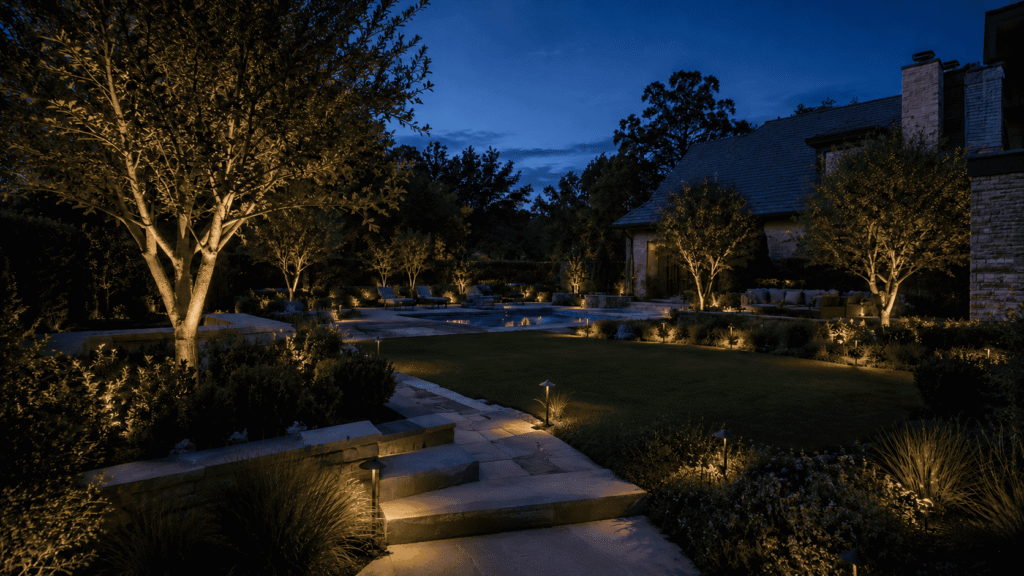
Most outdoor spaces look completely different after dark — and not in a good way. The same backyard that photographs beautifully in afternoon light becomes a flat, undifferentiated void at 8pm. The pergola disappears. The specimen tree loses its character. The paver patio that represented a serious investment becomes invisible from the dining room window. A well-designed landscape lighting system changes that equation fundamentally — it does not just illuminate, it composes the nighttime version of the outdoor space with the same intentionality that good interior lighting brings to a room.
This guide covers what informed decisions about residential landscape lighting require: how professional design methodology works and why it matters more than fixture selection, what the different fixture types accomplish and where each belongs, how low-voltage LED systems differ from line-voltage and solar options, how smart control systems extend what a lighting installation can do, what the installation process involves, what drives cost, and how the landscape character across the markets Backyard Paradiso serves affects lighting design priorities. Whether the project is adding lighting to a newly built outdoor living environment or upgrading a system that has fallen short, this guide covers what a quality installation involves and what separates it from a basic one.
Landscape lighting vs permanent lighting: understanding the distinction
Backyard Paradiso offers two distinct lighting service categories — landscape lighting and permanent lighting. Before going deeper on landscape lighting, it is worth establishing what each is and why the distinction matters for project planning.
Landscape lighting refers to the system of in-ground, stake-mounted, surface-mounted, and fixture-directed lights that illuminate the landscape elements and outdoor living surfaces of a property — trees, shrubs, planting beds, pathways, driveways, patios, water features, and architectural details. Landscape lighting is low-voltage LED-based, typically installed in buried cable runs from a transformer, and designed to be adjustable as the landscape changes and grows over time.
Permanent lighting refers to architectural accent lighting installed directly on the structure of the home — most commonly on fascia, soffits, or rooflines — that provides year-round illumination of the home’s exterior elevations and can be programmed for holiday color displays, team colors, and seasonal effects. Permanent lighting replaces the annual Christmas light installation and takedown cycle while providing consistent nighttime curb appeal through every month of the year.
The two systems work together rather than competing — landscape lighting illuminates the property’s landscape, hardscape, and outdoor living environment, while permanent lighting illuminates the home’s architectural exterior. A complete outdoor lighting design for a residential property typically includes both. This guide covers landscape lighting in detail; the permanent lighting guide covers the architectural system.
Design methodology: how professional landscape lighting actually works
The difference between a professional landscape lighting design and a DIY installation is not primarily the fixtures — it is the design thinking that produces a coherent nighttime composition rather than a collection of lit objects. Understanding the methodology first makes the fixture discussion that follows more useful, because it frames each fixture type as a tool serving a design intent rather than a product to be purchased in isolation.
The design conversation
A professional landscape lighting design starts with understanding how the property is actually used at night and what elements of it deserve illumination. Which spaces are used after dark — the patio, the pool area, the front entry? What views matter most — from inside the home looking out, or from the street? What are the primary landscape features — mature trees, a garden wall, a water feature? What is the intended emotional character — dramatic and bold, warm and intimate, clean and contemporary? How does the lighting need to integrate with other elements — the pergola, the deck, the fence perimeter?
The answers to these questions determine fixture types, placement priorities, and beam specifications before the first stake is driven.
Layering: the technical foundation of good design
Professional landscape lighting uses multiple layers of light at different heights and intensities to create depth and visual interest. A single-layer installation — all uplights, or all path lights — reads as flat regardless of the quality of the individual fixtures. A well-designed system layers three levels:
High-level light: Tree canopy uplights, moonlighting fixtures, pergola-mounted downlights — the upper layer that establishes the large-scale structure of the nighttime composition.
Mid-level light: Architectural uplights, wall-wash fixtures, large shrub uplights — the middle layer that connects the upper canopy to the grade-level elements.
Grade-level light: Path lights, step lights, grazing fixtures, in-hardscape well lights — the lower layer that defines surfaces, edges, and transitions.
Each layer operates at a different intensity. The high-level tree lighting typically runs at higher output than the path lighting, with mid-level architectural accents at intermediate levels. The result is a composition with visual depth and hierarchy rather than a uniformly illuminated surface.
Color temperature: warm vs cool
LED fixtures are available across a range of color temperatures measured in Kelvin. Landscape lighting design almost universally uses warm white (2700K to 3000K) for residential applications — the warm white spectrum flatters most landscape materials (wood, stone, foliage, brick) and creates an inviting character appropriate for the residential outdoor living environment. Cool white (4000K and above) reads as harsh in residential settings and makes exterior surfaces look institutional rather than inviting.
Within the warm range, 2700K produces a slightly amber cast that suits traditional and tropical landscapes, while 3000K is cleaner and more neutral, appropriate for contemporary designs. The specific Kelvin selection is a design decision that affects how the entire system reads at night.
Beam angles
Fixture beam angle determines how light spreads — a narrow spot (10 to 15 degrees) creates a tight column appropriate for tall trees and dramatic accent work. A medium flood (25 to 40 degrees) provides broader coverage for mid-size specimens and architectural uplighting. A wide flood (60 degrees and above) washes a large surface area for low groundcover planting and broad facades.
Most professional designs use a mix of beam angles — narrow spots for the high-canopy tree work, floods for mid-level and grade work — rather than a uniform beam across the whole system.
Landscape lighting fixture types: what each one does
With the design framework in place, each fixture type makes more sense as a tool that serves a specific role within the layered composition.
Uplights and spotlights
Uplights are ground-mounted or stake-mounted fixtures that direct a beam of light upward — the primary tool for illuminating trees, architectural features, and vertical landscape elements from below. The effect ranges from dramatic (a narrow, high-lumen beam at the canopy of a mature oak) to subtle (a wide-flood uplight washing the base of a planting bed). Spotlight fixtures are directional and adjustable, allowing precise beam placement as plants grow and change over time.
Uplighting is the technique that most powerfully changes the character of an outdoor space after dark. A mature tree illuminated from below has a completely different visual presence than an unlit tree — the canopy becomes luminous, the trunk gains dramatic shadow play, and the entire scale of the outdoor space reads differently. Multiple fixtures aimed at the same tree from different directions produce a three-dimensional, natural result that a single fixture cannot achieve.
Path lights
Path lights are stake-mounted fixtures that illuminate walkways, garden paths, and the perimeter of outdoor living areas from a low mounting height — typically 12 to 18 inches above grade. Their primary function is safety — defining the edge of a path clearly enough for safe navigation after dark without the broad overhead illumination that would wash out the rest of the lighting design. Their secondary function is visual rhythm — a row of well-spaced path lights along a paver walkway creates a cadence that draws the eye toward a destination and defines the transition between outdoor zones.
Path light design requires attention to spacing, height, and optics. Overlapping beam spread between adjacent fixtures creates hot spots and the “runway” appearance of path lighting done without design intent. Proper spacing produces distinct, overlapping pools of light that read as intentional.
Well lights
Well lights are in-ground fixtures installed flush with the surface — in a paver patio, concrete, decking, or in a planting bed at grade. They illuminate upward without any above-grade fixture visible during the day. Well lights are the appropriate choice for uplighting in high-traffic areas where a stake fixture would be a trip hazard, and for creating pools of upward light from within a hardscape surface.
In-hardscape well lights — set flush in a paver surface — create effects no stake-mounted fixture can replicate: light appearing to rise from the patio itself, washing a pergola post or garden wall from below at close range, or creating a glowing grid effect within a paver field at night.
Step lights and deck lights
Step lights are recessed into the vertical face of stair risers or retaining walls, directing light downward onto the step tread for safety. In any elevated deck or outdoor living space with steps to grade, step lighting is both a safety requirement and a design element — the warm glow from a series of step lights on a deck staircase is one of the details that most significantly improves the nighttime character of an outdoor space.
Deck lights are recessed or surface-mounted fixtures installed on deck surfaces, railings, or post bases — providing ambient illumination across the deck and defining its perimeter at night. Post cap lights on deck posts, recessed tread lights in deck boards, and railing-mounted fixtures all contribute to the nighttime character. Glass railing systems on elevated decks allow step lighting and deck perimeter lighting to read cleanly without the visual interruption that solid railing systems create.
Downlights and moonlighting
Downlights are fixtures mounted in elevated positions — in tree canopy, on pergola structures, on exterior walls — that direct light downward onto the surface below. Rather than revealing individual features in dramatic isolation, downlighting washes a surface with diffuse, directional light from above.
Moonlighting is a specific downlighting technique where fixtures are mounted high in a tree canopy and aimed downward through the foliage — the light filtering through leaves creates the shifting, dappled pattern of natural moonlight on the ground surface. It is one of the most sophisticated landscape lighting effects available, requiring the right tree structure and carefully specified fixtures, but the result is the most naturalistic and least “installed-looking” effect in the landscape lighting vocabulary.
Pergola-mounted downlighting — fixtures integrated into the pergola framing above the outdoor living space — provides practical task and ambient illumination for dining and entertaining at night. When the pergola includes motorized zip screens for enclosure, the downlighting creates an indoor-quality lighting environment in the enclosed outdoor room.
Grazing lights
Grazing is a technique where a fixture is placed very close to a surface — a stone wall, a brick facade, a composite fence panel — and directed along the surface face rather than across it. The raking light reveals surface texture dramatically, with every shadow and relief element casting a shadow. A stone garden wall that reads as flat from across the yard becomes a visually complex, textured element when grazed with a properly placed fixture.
Water feature and pool lighting
Pools, water features, and fountains require fixtures specifically designed for submerged and wet-location installation. Underwater LED fixtures in pools and fountains create a fundamentally different visual character — the pool becomes a glowing element in the nighttime composition rather than a dark void. Above-water feature lighting — directional spotlights aimed at a waterfall or fountain from a dry position — creates reflection and movement that adds animation to the nighttime landscape.
Low-voltage LED: why it is the right system for residential landscape lighting
Residential landscape lighting operates on low-voltage systems — typically 12-volt — rather than the 120-volt line voltage used for household electrical. Understanding why matters for both the installation process and the DIY vs professional question.
Safety and accessibility
Low-voltage systems are inherently safer than line-voltage. The 12-volt current does not present a shock hazard, which allows wiring runs to be buried at 6 inches below grade (the NEC Table 300.5 depth for landscape lighting circuits of 30 volts or less, versus the substantially deeper burial required for most line-voltage wiring methods) and field connections to be made without conduit protection. This makes the system both safer to install initially and easier to modify as the landscape evolves — adding or moving a fixture does not require licensed electrical work.
The transformer — the listed isolating power unit that converts 120-volt household current to 12-volt — is the connection point to the home’s electrical system and the only component that requires licensed electrical work. Everything downstream of the transformer can be installed and modified without an electrical permit in most jurisdictions.
LED technology: why it changed the category
LED light sources have effectively replaced halogen in professional landscape lighting. The performance advantages are decisive: LED fixtures draw a fraction of the energy of equivalent halogen MR16 fixtures — a difference that compounds across a multi-fixture system. Quality LED fixtures carry rated lumen-maintenance lifespans that exceed halogen lamp life many times over. LED maintains consistent color temperature over its lifespan (halogen shifts toward yellow as lamps age), produces significantly less heat (protecting adjacent plant roots and mulch), and is compatible with the digital dimming systems that modern transformers support.
Solar landscape lighting: where it works and where it falls short
Solar-powered path and accent lights are appropriate for low-demand applications — casual path marking, garden accents, and perimeter definition where consistent output and long operating hours are not critical. Composite fence post cap solar lights fall in this category — they add ambient perimeter lighting and protect post tops from moisture, but they do not replace a wired landscape lighting system.
The limitations for a serious lighting design are significant: solar output is weather-dependent and inconsistent, battery capacity limits operating time, lumen output is a fraction of wired LED, and consumer solar fixture quality generally does not match professional wired fixtures. For the primary lighting elements — tree uplighting, architectural accents, entertaining area illumination — wired LED is the appropriate system.
Smart control systems and automation
A professionally designed landscape lighting system without smart control is like a high-end audio system without volume control. The ability to adjust, schedule, and scene the lighting to different conditions and uses is what turns a system that is merely installed into one that is actively useful.
Transformer controls and zones
Modern landscape lighting transformers support multi-zone control — different circuit runs switched independently, allowing different areas to illuminate on different schedules or at different intensities. The front yard curb appeal lighting might run dusk to midnight. The backyard entertaining area runs on demand. Pool feature lighting runs on a separate schedule from pathway safety lighting.
Smart home integration
Contemporary landscape lighting systems integrate with the major whole-home automation platforms, as well as directly with smartphone apps through dedicated landscape lighting controllers. Remote control, schedule management, scene setting, and integration with motion sensors and other smart triggers are all available in current-generation systems. The same smart home ecosystem and voice assistants that control a motorized pergola louvre roof can control the landscape lighting alongside it.
Automation and astronomical clocks
Automation reduces energy consumption by ensuring lights run only when intended, extends fixture lifespan by reducing operating hours, and makes the system convenient enough to actually use as designed. Digital timer controls with astronomical clocks — which automatically adjust on/off timing as sunrise and sunset shift through the seasons — ensure correct operation year-round without manual adjustment as day length changes.
The landscape lighting installation process
Design and site assessment
Every Backyard Paradiso landscape lighting installation begins with a site visit — ideally conducted at dusk or after dark so the existing nighttime character of the property can be evaluated directly rather than imagined from a daytime assessment. The property is walked, primary features worth illuminating are identified, design goals are discussed, and fixture placements, types, and wiring routes that will produce the intended result are documented.
The design documentation drives the material specification and quote. Accurate fixture placement and cable routing from the site visit produces an installation that goes in correctly the first time rather than requiring significant repositioning afterward.
Transformer installation
The transformer is installed at a GFCI-protected exterior outlet — typically near the garage, the HVAC equipment area, or another location with a protected outdoor outlet. In installations requiring a new exterior outlet, a licensed electrician handles that component before the landscape lighting installation begins. The transformer is mounted, connected, and its zone control and timing features configured.
Cable routing
Low-voltage cable runs from the transformer to fixture locations through buried cable at a minimum of 6 inches below grade. In hardscape areas — beneath pavers, through concrete — cable is run in conduit installed before the surface is placed, with junction points at accessible locations for future service.
Planning cable routing before installation begins is the detail that determines how clean the system is to service in the future. Cable runs that are not documented, that cross under hardscape without conduit, or that are too short for future repositioning create complications that accumulate over the system’s life. This is one of the clearest advantages of installing landscape lighting as part of a coordinated outdoor living build — when the paver patio, deck, and fence are being installed simultaneously, cable conduit can be placed beneath hardscape surfaces before they are finished.
Fixture installation and aiming
Fixtures are staked, recessed, or mounted according to the design plan. After installation, each fixture is aimed — beam direction adjusted to produce the intended effect at the target feature. Aiming is a hands-on process done after dark with the system running: the installer observes the effect, adjusts the aim, and confirms the result in context with surrounding fixtures and the overall composition.
Aiming correctly is what closes the gap between a technically correct installation and one that produces a well-designed result. It requires time, experience, and a calibrated eye for what reads as natural — it cannot be accomplished from a site plan alone.
System commissioning and programming
Once all fixtures are aimed, the control system is programmed — zones configured, schedules set, intensity levels adjusted. The commissioning walkthrough with the property owner confirms each zone functions as intended and demonstrates the control system operation.
Seasonal adjustments and maintenance
Landscape lighting systems benefit from periodic adjustment as plants grow, as the landscape evolves, and as seasonal changes affect which features are prominent. An annual or bi-annual service visit — checking aim, cleaning lenses, confirming cable burial, and adjusting schedules — keeps the system performing at its designed level. Under LED, fixture maintenance is limited to cleaning; lamp replacement is rarely required within the first decade.
What drives landscape lighting cost
Landscape lighting cost is driven by fixture count, fixture quality, cable routing complexity, control system specification, and regional labor costs.
Fixture count and system scope
A small entry and pathway installation — 10 to 15 fixtures covering the front entry, walkway, and a few planting bed accents — is the entry point for professional landscape lighting. A comprehensive system covering front and backyard landscape features, pool area, outdoor living spaces, and architectural accents may involve 40 to 80 or more fixtures. System scope is the primary cost driver.
Fixture quality
Professional-grade fixtures differ from consumer-grade products in housing material (brass, copper, or marine-grade aluminum vs plastic), lens quality, optical precision, and waterproofing specification (IP65 or higher). Professional fixtures cost more per unit and perform significantly better over their service life — the fixture that still operates correctly at year twelve rather than developing housing corrosion, lens clouding, or connector failure within the first few years.
Cable routing complexity
Systems that require cable runs beneath existing hardscape, through dense root systems, or across large properties with long run distances cost more than systems on open lawn areas with straightforward routing. This reflects installation effort, not margin.
Control system
A basic timer transformer is the entry-level control option. Multi-zone digital transformers with smartphone app control and smart home integration add to the system cost but deliver meaningfully better functionality across the system’s lifespan.
Cost ranges
The installed cost of a professionally designed and installed residential landscape lighting system with LED fixtures varies with system scope, fixture count and quality, and regional market. Entry-level front yard systems fall toward the lower end. Comprehensive front and backyard systems with pool lighting, outdoor living area lighting, and smart control fall toward the upper end. Systems in premium markets (Naples, Denver, Secaucus) reflect higher labor costs.
These are installed system costs inclusive of design, transformer, fixtures, cable, installation labor, and commissioning. Maintenance and system expansion are typically billed separately.
Thinking about landscape lighting as an investment
Landscape lighting is one of the few exterior improvements that extends the usable hours of every other outdoor investment. The pergola, the paver patio, the deck, the Backyard Kitchen, the artificial grass — every one of these becomes invisible after dark without lighting. A lighting system priced at a small fraction of the surrounding infrastructure extends the usability of the entire outdoor living investment from daytime-only to evening hours year-round — a one-time installation that pays back on every evening the space is used. That math makes landscape lighting among the highest-return investments in the outdoor living category.
How landscape character shapes lighting design across the markets
The outdoor environments across the markets Backyard Paradiso serves present different lighting opportunities based on landscape maturity, climate, outdoor living patterns, and property character. Rather than listing markets individually, what follows is how each landscape type drives the design — with the specific markets where each applies.
Mature tree canopy markets: where uplighting delivers the highest impact
Markets with established neighborhoods and mature tree coverage present the most dramatic uplighting opportunities. Denver’s Washington Park and Congress Park neighborhoods — mature elms and oaks with high canopy — produce some of the most visually striking tree uplighting results among the markets served. San Antonio’s Alamo Heights corridor and the live oak coverage through the established Hill Country neighborhoods offer similar canopy-lighting potential. Naples’ mature royal palms and tropical specimens have a completely different character when lit from below — the trunk texture and crown structure of a tall palm at night creates an effect that has no daytime equivalent.
In these markets, tree uplighting is typically the single highest-impact element of any landscape lighting design. Two or three professionally aimed uplights on a mature specimen tree produce more visual change per fixture than almost any other placement.
Year-round outdoor living markets: where lighting is daily infrastructure
In Naples, Orlando, and San Antonio, outdoor spaces are used year-round — which means landscape lighting is not a seasonal amenity but a daily infrastructure component. Pool lighting in the Florida markets is among the most-used elements of any installation given the year-round outdoor culture. The combination of pool lighting, tropical feature uplighting, pergola downlighting, and Backyard Kitchen task lighting is the full-scope configuration most installations in these markets involve.
Coastal properties in Collier County require marine-grade fixture specifications — brass, copper, or marine-grade aluminum housings and stainless steel hardware rated for salt air proximity. Standard aluminum fixtures that perform well in inland markets will show corrosion within a few years in a coastal environment.
Seasonal extension markets: where lighting maximizes a shorter outdoor window
In Romeoville and the northern Illinois market, the outdoor season runs roughly May through October. Evening use is a significant share of total outdoor time in a six-month season — being able to use the patio, deck, and outdoor living space after 7pm requires lighting. A well-designed system does not just illuminate the space — it extends the functional season by making every available evening usable rather than surrendering the space at sunset.
Colorado Springs and Denver share this seasonal dynamic with the added factor of Colorado’s abundant sunshine — outdoor spaces are used into the evening regularly through nine or ten months of the year, making lighting a high-utility investment even in a market with real winter. UV intensity at altitude requires UV-stable fixture finishes across all installed products.
Urban and dense-lot markets: where precision and property presentation matter most
Secaucus and the Hudson County corridor present a different lighting opportunity. Urban and dense suburban properties benefit from landscape lighting both for the outdoor use extension it provides and for the property presentation it delivers. In a market where property values are supported by Manhattan proximity and buyers evaluate outdoor space quality closely, a well-lit outdoor environment at night is part of the property’s market presentation. Small-lot installations require precise fixture placement and careful cable routing in confined spaces where every fixture is visible from multiple angles.
Frequently asked questions about landscape lighting
What is the difference between landscape lighting and permanent lighting?
Landscape lighting illuminates the property’s outdoor environment — trees, planting beds, pathways, hardscape, water features, and outdoor living spaces — using stake-mounted, in-ground, and surface-mounted low-voltage LED fixtures. Permanent lighting illuminates the home’s architectural exterior — installed on fascia, soffits, or rooflines — and provides year-round exterior illumination with programmable color capability. The two systems are complementary and often installed together as part of a complete outdoor lighting design.
How long does a landscape lighting installation last?
Professional-grade LED fixtures carry rated lumen-maintenance lifespans measured in tens of thousands of hours — a service horizon spanning well over a decade of nightly use. The mechanical components (cable, connectors, transformer) are designed for long outdoor service. Quality systems routinely perform for well over a decade with minimal maintenance. The primary service requirement is annual or bi-annual adjustment and cleaning rather than component replacement.
Is a permit required for landscape lighting?
Low-voltage landscape lighting systems typically do not require a building permit — the 12-volt system does not trigger the safety concerns that require permits for line-voltage work. If the installation requires a new exterior outlet or any line-voltage electrical work at the transformer connection, a licensed electrician handles that under an electrical permit. Requirements are confirmed during each site assessment.
What is the best landscape lighting for trees?
It depends on the tree’s size, canopy structure, and trunk character. Large specimens with high canopy (mature oaks, elms, palms) typically use narrow-spot or medium-flood LED uplights with higher lumen output to reach the canopy from grade. Ornamental trees with lower canopy are lit with lower-output wide-flood fixtures at closer range. Multiple fixtures from different directions produce a more three-dimensional result than a single fixture — the additional light eliminates the flat shadow a single source creates on the far side of the canopy.
Can landscape lighting be expanded after installation?
Yes. A properly installed low-voltage system is designed for expansion. Each transformer has a rated wattage capacity; as long as added fixture wattage stays within that capacity (or the transformer is upgraded), new fixtures can be added to existing cable runs or new runs from the transformer. LED’s low per-fixture wattage means significant additions typically stay within transformer capacity without upgrade.
How are landscape lighting fixtures protected from weather?
Professional-grade outdoor fixtures carry IP65 or higher waterproofing ratings — protected against water jets from any direction. Housings in brass, copper, or marine-grade aluminum resist corrosion and maintain finish quality over years of outdoor exposure. For coastal installations, marine-grade specifications ensure salt air resistance. Connectors and cable terminations are waterproof and designed to maintain integrity through years of wet exposure.
Service areas
Backyard Paradiso designs and installs professional landscape lighting systems across the markets it serves. Fixture specifications, control system recommendations, and design priorities are adapted to the landscape character and outdoor living patterns of each market. The full list is on Markets We Serve.
An outdoor space deserves a nighttime version as good as the daytime one
Every outdoor living investment — the pergola, the patio, the deck, the kitchen — goes dark after sunset without lighting designed to reveal it. A site assessment conducted at dusk is the right starting point: the property is walked, the primary opportunities identified, design goals discussed, and an accurate system design and quote produced. Consultations are available by appointment.