
Backyard Batting Cages and Training Nets Guide
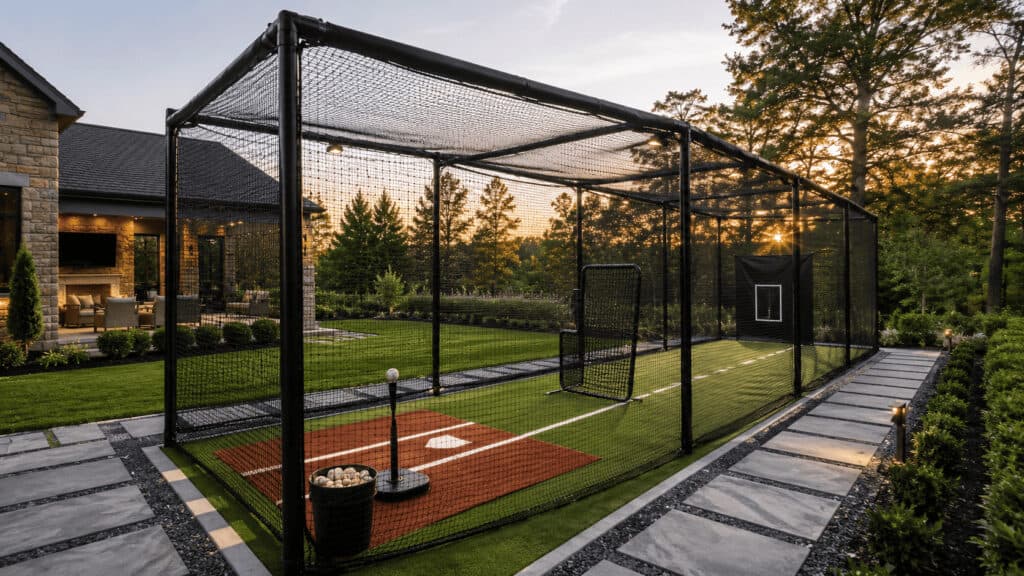
There is a version of athletic development that most serious families know but rarely state explicitly: the athletes who separate themselves from the rest are not always the most gifted. They are often the ones with the most access. Access to a cage when they want one, not when the facility schedule opens up. Access to fifty extra swings on a Tuesday evening after school. Access to the accumulated repetitions of a player who can practice whenever the moment is right rather than whenever a rental window is available.
Backyard training infrastructure is how that access is created. Not as a replacement for team practice or facility work — but as the layer underneath it that accumulates quietly over a full season. Two hundred extra swings a week is roughly three thousand swings by the time the season opens. Against a player who got to the facility twice a week and waited for a lane, that is a meaningful gap — and it is not about talent, it is about infrastructure.
The economic argument is a one-time versus recurring one. Facility cage rental is an hourly, recurring expense that scales with training frequency and never converts into owned infrastructure. A properly installed backyard system is a one-time installation that is available every day at any hour and requires no commute or wait. The economics are secondary, though. The development argument — what unlimited, self-scheduled repetition produces over the course of a year — is the reason serious families build these systems.
This guide covers the complete decision picture: what each sport configuration requires technically, how to read a netting specification and what questions to ask before signing an installation contract, what the 3D design and planning process involves, what surface and structural options exist, what permits and HOA approvals typically require, and what drives cost across the markets Backyard Paradiso serves.
Sport configuration technical reference
Every sport has specific netting, framing, surface, and spatial requirements determined by the ball dimensions, flight velocities, and training patterns of that game. The table below is the reference baseline used during design consultation; it establishes the technical starting point for each sport category before the conversation turns to a specific yard and athlete.
| Sport | Typical Velocity Range | Recommended Netting | Standard Cage / Net Dimensions | Primary Training Applications |
|---|---|---|---|---|
| Baseball (adult) | Youth machine: 40–65 mph HS/College machine: 65–90 mph Live pitching: up to 95+ mph | #42 knotted polyethylene or nylon, 1.75″ mesh | 70’L × 12–14’W × 12’H (standard) 55’L minimum functional adult | Batting practice (tee, soft toss, machine, live), pitcher-to-batter live sessions, swing mechanics video work, pitching bullpen at the far end |
| Baseball (youth) | Youth machine: 30–55 mph Coach pitch: 30–45 mph | #36 or #42 knotted, 1.75″ mesh | 35–55’L × 12’W × 10–12’H | Machine work, coach pitch, tee work, soft toss — compact footprint allows full-function youth training in most suburban lots |
| Softball (fast-pitch) | Pitching machine: 50–75 mph Live pitching: 55–75 mph competitive | #42 knotted, 1.75″ mesh | 55–65’L × 12–14’W × 12’H (windmill motion requires full-height clearance) | Batting practice, windmill pitcher live reps, pitching mechanics work from mound, fielding drills within cage |
| Golf | Irons: 80–120 mph clubhead Driver: 90–130 mph clubhead Ball speed: up to 180+ mph | #36 knotted, mesh smaller than golf ball diameter (1.68″) | 10–15’W × 10’H net backstop (minimum) Full bay: 12–15’W × 10’H × 15’D | Full swing with all clubs, launch monitor integration, short game chip targets, putting green adjacent to hitting bay |
| Soccer | Youth: 25–45 mph High school: 40–70 mph Elite: 70–100+ mph | #36 knotted or heavy knotless, 4″ mesh for goal net | Full size: 8’H × 24’W Youth: 6’H × 18’W Rebounder: 6’H × 6–8’W | Shooting and finishing practice, penalty training, rebounder work for first touch and passing repetition, goalkeeper training |
| Football | Spiral velocity: 50–60 mph (youth) 60–80+ mph (HS/College) | #42 knotted, 1.75″ mesh minimum — spiral impact requires heavier spec than soccer | 10–12’H × 10–15’W target net (typical) | Quarterback accuracy work, route-running and catching for receivers without a second player, agility drill containment |
A few things are worth noting in this table. The velocity column matters because it drives netting weight specification — a system specified for youth machine speeds will not hold up correctly if the same cage is used for live high-school pitching three years later. Backyard Paradiso designs for the athlete’s projected trajectory, not just the current age group. The cage that works for a 10-year-old machine hitter should still be functional when that player is a 14-year-old throwing 75 mph live.
Sport configurations in detail
Baseball
The standard backyard baseball training setup is a fully enclosed batting cage — a rectangular netting structure that contains batted balls within the cage perimeter. The fully enclosed design is what separates a proper batting cage from a backstop net: there is no ball retrieval required after every swing, no balls escaping into the yard, and no need for a shagger during machine work. The athlete loads the machine, steps in, and takes their swings.
An adult standard cage at 70 feet is long enough to accommodate a pitching machine at the back end with realistic pitch trajectory simulation. It is also long enough for a pitcher to throw live to a batter — the configuration that provides the highest-quality batting practice rep because the ball comes out of a real arm. For youth players, a 35-to-55-foot cage handles all machine and coach-pitch applications cleanly and fits in a substantially smaller yard footprint.
Inside the cage, the configuration determines the training function. A pitching machine on a wheeled stand that can be repositioned provides versatility. A mounted tee at the batting position handles swing mechanics work. A net divider that creates a separate pitching lane at the far end allows a pitcher to throw bullpen sessions while the cage is in use for batting at the other end — two athletes training simultaneously in the same structure.
Softball
Fast-pitch softball shares most of its equipment requirements with baseball but has two differences that matter for cage design. Pitching distance for competitive fast-pitch is shorter than baseball — 43 feet for high school, 40 feet for younger divisions — which means a 55-to-65-foot cage handles the same function as a 70-foot baseball cage. And the windmill delivery requires full vertical clearance above the mound position: a 12-foot cage height is the minimum for a pitcher working through a full windmill motion without restriction.
Travel team softball players benefit from a cage long enough for both batting practice with a machine and live pitching sessions — at least 55 feet. A cage that is too short for full-speed machine pitching at realistic distance defeats the purpose of the system for a competitive player. This mistake appears frequently in pre-fab kits that are sold at youth dimensions without noting that they are not adequate for competitive use.
Golf
A backyard golf practice bay ranges from a simple hitting net — a netting backstop on a steel frame that catches balls hit into it — to a fully configured practice environment with a launch monitor, artificial turf hitting surface, target landing areas, and a separate putting green. A launch monitor measures ball speed, launch angle, spin rate, and carry distance, providing data feedback that turns a practice session into a diagnostic one — the difference between hitting balls and understanding ball-striking. The right scope depends on how seriously the golfer practices and what aspect of the game is being worked on.
The technical requirement that matters most for golf is netting mesh size. A golf ball is 1.68 inches in diameter. Any mesh opening larger than that allows ball penetration at impact — and at driver-speed ball velocities over 150 mph, a ball that penetrates the netting rather than being absorbed by it is dangerous. Golf hitting nets must be specified with mesh openings smaller than a golf ball and with netting weight and tensioning appropriate to absorb repeated driver-speed impact without rebounding the ball back toward the player. This is the specification detail most consumer golf nets get wrong, and it is the reason so many consumer golf nets fail within a season of serious use.
Golf training systems integrate naturally with artificial grass hitting surfaces — the same product used in outdoor living applications but specified for the divot-taking and repeated impact of a training station. A proper hitting surface at the batting position makes a meaningful difference in the quality of the swing feedback the practice session provides.
Soccer
Soccer training configurations address two distinct training needs that require different equipment. Shooting and finishing practice — working on accuracy, power, and goal-scoring situations — needs a goal net with properly tensioned posts that handle repeated full-speed shot impact without post movement or net deformation. A goal net that moves when the ball hits it at full pace gives the shooter false feedback about where the ball is being struck.
The second need — passing, first touch, and technique repetition — is served by a rebounder net: a frame with an angled net surface that returns balls at a predictable angle for first-touch practice. A good rebounder allows a player to accumulate hundreds of first-touch and passing repetitions per session without a training partner, which is the backyard training infrastructure equivalent of a batting tee: the tool that makes solo skill development possible at scale.
Standard goal installations use engineered steel posts anchored appropriately for the soil conditions — a goal that tips forward under a hard shot into the top corners is a liability, not a training asset. Goal posts are sized and anchored to stay planted under the hardest shots the player can produce.
Football
Football training systems are primarily accuracy and route-running focused. A quarterback working through a full throwing session needs a large enough net target to give meaningful accuracy feedback without constantly chasing errant throws across the yard. A net that catches everything — the accurate throws and the misses — lets the session flow as continuous repetition rather than constant ball retrieval.
The specification challenge with football netting is rotational impact. A tight spiral at 60 mph does not hit a net the same way a baseball does — the rotating ball grabs the mesh and applies shear force that knotless netting does not handle well over time. Knotted netting specification at #42 weight is the right call for football training nets that will see daily use through a full season.
Professional netting specification: a buyer's inspection checklist
This section exists because the netting specification is where the largest gap between a professionally installed system and a consumer kit lives — and it is the gap that is hardest to see when comparing quotes rather than comparing installed systems side by side after two seasons of outdoor use.
Most buyers evaluating batting cage quotes are comparing prices on systems that look similar in product photography. The netting that costs half as much often does not look different until it starts to fail — and when it fails, it fails in ways that range from annoying (balls escaping the cage perimeter) to dangerous (ball penetration through degraded mesh at high velocity).
Questions to put to any installer before accepting a quote:
- What is the netting construction — knotted or knotless? Knotted netting maintains its mesh geometry under repeated ball impact. Knotless woven netting stretches at impact points over time, enlarging the mesh opening progressively and eventually allowing ball penetration. For any application involving ball velocities above 40 mph, knotted is the correct specification.
- What is the netting weight — #36, #42, or heavier? #42 is the standard specification for adult batting cage applications. #36 is appropriate for youth and golf. Consumer kits frequently use lighter netting than the application requires. Ask what ply and weight is being specified and why.
- What is the UV treatment specification? Outdoor netting without UV stabilization loses tensile strength progressively through sun exposure — the mesh becomes brittle at impact points and the mesh openings enlarge. Professional netting uses UV stabilization treatment, typically incorporating HALS (hindered amine light stabilizers) into the polymer at manufacture — the same technology used in high-quality outdoor building materials. Ask whether the netting is UV-stabilized and to what standard. Professional netting is treated; cheap netting often is not.
- What is the steel gauge for the frame? Light-gauge frame tubing flexes under wind loading and net tension, producing a structure that moves and eventually fatigues at the connection points. Ask what gauge is being used and whether it has been engineered for the span and load of the specific configuration.
- How is the frame corrosion-protected — galvanized, powder-coated, or painted? Hot-dip galvanization provides the best long-term corrosion protection; powder coat is the best appearance option with good durability. Painted steel is the economy option that requires periodic repainting to maintain protection. All are legitimate; the question is what the spec sheet says, not what the brochure implies.
- What is the anchoring system — concrete footings, auger anchors, or ground stakes? Ground stakes are adequate for calm conditions and temporary installations. For a permanent outdoor batting cage, engineered anchoring appropriate to the soil conditions is the correct specification. Ask what is being used and why it is appropriate for the soil type.
- What is the warranty on the netting and the frame separately? Professional netting carries a multi-year warranty against UV degradation and manufacturing defect. If the quote does not include explicit warranty terms for both netting and frame, ask for them in writing before signing.
The most common post-installation regret among homeowners who started with a consumer kit is netting that lasted one season before balls began escaping through it. That is a #36 knotless consumer net on an application that required #42 knotted. The difference between the two specifications is a small fraction of total installed cost. It is not where to save money.
Frame and anchoring systems
Steel frame specification
The frame is what keeps the cage geometry intact over time — the structure that holds the netting at the correct tension and dimensions through seasons of use, weather loading, and the constant stress of ball impact vibrating through the net into the frame. A frame that maintains its geometry produces a system that works consistently over years. A frame that does not produces a cage that gradually sags, loses tension, and eventually requires structural intervention.
Properly specified batting cage framing uses galvanized or powder-coated steel tube in a gauge appropriate for the span, load, and connection requirements of the specific cage dimensions. A 70-foot adult cage with 12-foot sidewalls has different structural requirements than a 35-foot youth cage — the longer spans require heavier tube gauge to prevent mid-span flex under net tension and wind loading.
Connection hardware quality matters as much as tube gauge. Sleeve connectors and through-bolt connections at corners and mid-span points maintain the frame geometry under load; friction-fit connections gradually loosen and allow the frame to rack. Professional installations use hardware designed for permanent outdoor structural application, not the friction-fit connectors common in consumer kits.
Ground anchoring
A batting cage in any real outdoor wind is a sail. The netting presents a large surface area to wind loading, and without proper ground anchoring, the frame moves — which stresses connection points, fatigues the steel at recurring flex points, and in extreme cases tips the structure. The wind loading calculation for a 70-foot batting cage in a 30-mph wind is not trivial.
Permanent installations use concrete footing anchors sized for the soil conditions at the site. For semi-permanent configurations where the homeowner wants the ability to relocate the cage, helical auger anchors provide meaningful wind resistance without the permanence of poured concrete. Consumer kit ground stakes are adequate for calm conditions — they are not designed for real outdoor wind loading on a large framed structure.
In markets with significant freeze-thaw cycling — Romeoville, Colorado Springs, Denver — footing depth matters. Anchors that do not extend below the frost line heave as the ground freezes and thaws, gradually shifting the cage geometry over a few winters. Footing depth is specified to the local frost line in the northern markets.
The 3D design and planning process
Every installation begins with a 3D performance layout — a rendering of the proposed system in the homeowner’s actual yard that shows the cage at exact dimensions, positioned relative to property lines, fences, the home’s exterior, and any other structures or landscaping. This is not a generic product diagram; it is the specific system in the specific yard, from the street-facing elevation and from the primary viewing angles within the property.
There are a few things the 3D layout makes possible that abstract planning does not.
The most important is footprint reality. A 70-foot batting cage is large. Homeowners who have never stood next to one frequently underestimate its presence in the yard — the 3D layout makes the actual footprint visible before materials are ordered. It is common for a consultation to begin with an adult cage and for the 3D layout to make clear that a 55-foot configuration is what the space supports well. Better to know that before installation day.
The 3D layout is also the standard documentation format for HOA architectural review committees and building permit applications. Most homeowners find that submitting a professional-grade visual rendering with their ARC application significantly reduces the back-and-forth with the review committee — it answers the visual impact questions before they are asked.
The layout is included at no charge for qualified projects; it confirms that the proposed system is the right system for the space before anyone commits to installation.
Surface and turf options
Artificial turf
A training cage with a properly specified artificial grass surface makes the system look intentional rather than improvised — which matters when the cage is visible from the home’s primary outdoor living areas. More practically, artificial turf handles the spike and cleat traffic of regular athletic use without the divoting, thinning, and mud accumulation that natural grass produces under heavy athletic load.
The batting position — the four or five square feet where the hitter’s feet are planted for every swing — takes the most concentrated wear. A heavier, denser pile is typically specified for the batting position inset, either as a continuous heavy-pile surface or as a discrete hitting mat inset within a lighter surround turf. The hitting mat approach produces the most durable batting-position surface while keeping overall turf cost reasonable.
For baseball and softball cages, the infield skin simulation of a turf surface — the different pile heights for the batters box, the base paths, and the outfield grass areas — provides realistic visual feedback during fielding drills that a plain concrete surface does not. For serious players, the surface quality of the training environment affects the quality of the training reps.
Concrete and aggregate surfaces
In configurations where the cage is dedicated purely to training and is not adjacent to the home’s outdoor living areas, concrete or compacted aggregate surfaces are appropriate. Concrete handles the load well, cleans easily, and is lower cost than a full turf installation. It is the right call for a cage that is positioned at the back of a large lot, screened from the primary yard, and used purely for athletic work rather than needing to integrate visually with the outdoor environment.
Compacted aggregate — crushed granite, decomposed granite, or similar — is a middle option: better drainage than concrete, lower cost than turf, and easier to install and maintain. It is appropriate for semi-permanent cage configurations where the homeowner wants to preserve the option to relocate the cage and restore the surface.
HOA and permit considerations
HOA architectural review
Batting cages and training nets are anchored structures, and in governed communities they typically require architectural review committee (ARC) approval before installation. The questions ARC committees ask most frequently are: What does the structure look like from the street and from neighboring properties? How close is it to property lines? Is it attached to or does it modify any shared fence or structure?
The 3D layout addresses the first question directly — reviewers can see exactly what the structure will look like from the relevant sightlines. For the setback and property line questions, the proposed location is confirmed against the applicable requirements before the ARC submission is prepared. Experience across HOA review processes in every market served informs which documentation format different HOA types prefer, and submissions are prepared to minimize revision cycles.
The most common HOA concern that surprises homeowners is the neighbor sightline question — not the street view, but what the cage looks like from the adjacent property. A 70-foot cage with 12-foot sidewalls is visible from a neighbor’s yard regardless of fence height. The design process addresses this by considering screening options — landscaping, fence extensions, or cage positioning that minimizes the visual impact from the properties where it matters most.
Building permits
Most batting cage and training net installations do not require a building permit — they typically fall below the accessory structure size thresholds that trigger permit requirements in most residential jurisdictions. When concrete footings are involved, a permit for the footing work may be required in some jurisdictions. Applicable requirements are confirmed during the site assessment so the permit question is answered before installation is scheduled rather than discovered on installation day.
Setbacks
Local zoning setback requirements — minimum distance from property lines, from the primary dwelling, and from any other structures — apply to accessory structures in most jurisdictions and almost always apply to a batting cage installation. The 3D planning process places the proposed cage at the correct location before any hardware is ordered, confirming setback compliance as part of the design work rather than as a post-installation check.
Service market considerations
Colorado Springs and Denver
Colorado’s outdoor recreation culture and year-round athletic development mindset make backyard training systems a strong fit in both markets. Baseball and softball have deep youth participation across El Paso and Denver Counties, and the Front Range’s competitive club and travel program environment creates a large population of athletes for whom consistent year-round repetitions matter. Two technical specifications apply specifically to Colorado: the high UV environment at altitude requires UV-stabilized netting with a higher treatment specification than lower-elevation markets, and cage anchoring in these markets must account for frost line depth and freeze-thaw cycling in the footing design.
San Antonio
Youth baseball and softball participation rates in Bexar County are among the highest of the markets Backyard Paradiso serves — the South Texas athletic development culture makes backyard training investment a recognized path for travel and club athletes who want to stay ahead. The warm climate enables year-round outdoor training, which changes the return-on-investment math for a training system significantly compared to markets where the outdoor season is compressed. A cage in San Antonio gets used in January. In Romeoville, it does not.
Orlando
Central Florida’s year-round training climate combined with one of the largest and most diverse youth sports populations in the country — spread across Orange, Osceola, and Seminole Counties — creates strong demand across all sport categories. Soccer participation in Orlando is particularly high relative to other markets, reflecting the demographic and cultural makeup of the youth athletics ecosystem. Golf training system installations are also strong here, given the region’s golf culture and the number of junior golf development programs operating across the area.
Naples
The Naples market has a specific configuration that works well for training systems: large lot sizes that can accommodate full-length adult cage installations, a high concentration of families with children in competitive athletics programs, and the year-round climate that makes daily training access a real value rather than a theoretical one. Affluent homeowners here tend to invest in the well-integrated, full-specification installations rather than compact starter systems — the artificial turf surface, the complete steel framing, the professional anchoring.
Romeoville
Will County’s suburban lot sizes make cage installation feasible for a higher percentage of properties than urban markets. The outdoor training season here runs roughly April through October — about seven months — which concentrates use but does not eliminate the value case for a permanent system. Players who are serious about development use the cage heavily during the months it is accessible, and the seven-month season provides enough repetitions over a few years to make the installation worthwhile. Snow load is a real design consideration here: a cage system that allows the netting to shed snow load rather than accumulating it is the right configuration for a northern market winter.
Secaucus
Hudson County’s urban context and generally smaller lot sizes push the product mix toward compact configurations — youth cage footprints in the 35-to-45-foot range, golf practice bays that fit in narrower side or back yard spaces, and soccer rebounder systems rather than full-size goal installations. The density of competitive youth sports programs in the New York metro area creates strong motivation for home practice infrastructure — access to quality training facilities near Secaucus is limited and expensive, which makes the economics of a backyard system more favorable here than in markets with abundant affordable facility access.
What drives training system cost
Training system cost is driven by cage length, sport configuration, netting specification, frame material and gauge, surface specification, and anchoring method. The framing below applies to professionally installed systems, not kit prices; professional-grade custom installation is not competing with what is available at a sporting goods store.
Youth baseball cage (35–55 feet, fully enclosed): the entry configuration — galvanized or powder-coated steel frame, #36–#42 UV-stabilized knotted netting, basic surface, and engineered anchoring. A turf surface is the most common addition and scales with square footage and pile specification.
Adult baseball cage (70 feet, fully enclosed): professional-grade steel frame, #42 UV-stabilized knotted netting, turf surface at the batting position, and concrete footing anchors. Full-perimeter turf, heavy-gauge frame, and multi-lane configurations define the upper end of the scope.
Softball batting cage (55–65 feet): scoped at similar specification to adult baseball. Windmill pitching clearance height requirements occasionally add modest cost on configurations with tight overhead clearance.
Golf practice bay (single-bay, net and frame): steel frame, #36 knotted netting with golf-appropriate mesh specification, and hitting surface. Launch monitor integration and putting green addition are scoped separately based on the equipment selected.
Soccer goal installation (permanent, engineered posts): steel posts, concrete anchoring, and regulation net. Rebounder systems are scoped separately by frame size and net specification.
Football training net: steel frame, #42 knotted netting, and basic surface.
Multi-sport configurations: a baseball cage with an adjacent golf bay, or a baseball cage with a soccer rebounder positioned outside the cage perimeter — these are priced on the combined scope and typically come in below the sum of each system installed separately due to shared anchoring and surface work.
One-time versus recurring: facility rental is an ongoing, per-hour expense for as long as the athlete trains. An installed system is a one-time scope that is then available daily, which is the comparison that matters for a family with several seasons of development ahead.
The 3D design layout is provided at no charge for qualified projects. It is the starting point that produces an accurate quote — cage dimensions, surface area, anchoring requirements, and permit documentation all come out of the layout process. A quote without a site visit and 3D layout is a ballpark number, not a project scope.
Frequently asked questions
What is the minimum backyard size needed for a batting cage?
A compact youth cage runs 35 to 40 feet long and 12 feet wide — that is the minimum footprint for a functional batting setup. In addition to the cage footprint itself, clearance behind the cage is needed for safe entry and exit, and setback compliance from property lines typically adds a buffer around the cage perimeter. The 3D layout during the consultation shows exactly what configuration a specific yard accommodates at the applicable setbacks — it is the fastest way to answer the space question accurately for a given property rather than estimating from a general rule.
How long does installation take?
Most batting cage and single-sport training net installations are completed in one to two days. Larger multi-sport configurations, installations requiring concrete footings, or projects that include full artificial turf surface work may run two to three days. The permit and HOA approval process — if required — happens before installation is scheduled, so there are no day-of surprises that delay completion.
Will the cage hold up through winter in Colorado or Illinois?
Yes, with the right specification. UV-treated knotted netting and galvanized or powder-coated steel framing handle freeze-thaw cycling without degradation. The two winter-specific design considerations in northern markets are snow load and frost line anchoring. A cable-and-net tension system that allows the netting to flex and shed snow load is preferable to a rigid panel configuration — accumulated snow on rigid netting adds substantial weight that the frame was not designed for. Footing anchors in Romeoville and the Colorado markets are specified to extend below the local frost line depth so freeze-thaw cycling does not heave the anchor positions and shift the cage geometry over successive winters.
What does the cage look like from a neighbor's yard?
A 70-foot batting cage with 12-foot sidewalls is visible from the neighboring properties regardless of fence height — the top of the cage will show over most residential fencing. The 3D layout includes sightline views from the relevant neighboring perspectives so the visual impact is known before installation. Where neighbor sightlines are a concern, cage placement and orientation can be designed to minimize the visual exposure, and screening options — existing landscaping, new plantings, fence extensions — can be evaluated to reduce the visual presence from the properties where it matters most.
Can the same cage be used for baseball and softball?
Yes, without modification in most cases. A cage specified at 55 to 65 feet with 12-foot height handles competitive fast-pitch softball and adult baseball batting practice. The netting specification (#42 knotted at 1.75″ mesh) is appropriate for both. The only configuration adjustment needed between sports is the pitching machine position and any mound setup — the cage itself does not change. Many families with both baseball and softball players use a single cage for both programs without any compromise.
Can a pitching machine be used with a professional-grade cage?
Yes — pitching machines are a standard part of batting cage use, and properly specified cages are designed for the ball velocities machines produce. The key is matching the machine’s output speed to the netting specification. A machine throwing 85 mph in a cage specified only for 55 mph is asking the netting to absorb more energy than it was designed for repeatedly, which accelerates wear and eventually allows ball penetration. Netting is specified for the maximum velocity the cage will realistically see — accounting for the player’s growth trajectory, not just their current age group.
Do training systems add value to the home at resale?
A professionally installed, well-integrated system adds functional value for buyers with athletic families — and athletic families are a specific buyer segment that will pay a premium for training infrastructure that is already in place. The aesthetic integration matters: a cage with turf, powder-coated framing, and thoughtful placement relative to the rest of the yard reads as an amenity; a cage that looks like an afterthought reads as something the buyer would have to deal with. A training system designed to look like it belongs in the yard is the version that adds value rather than complicating the sale.
Service areas
Backyard Paradiso designs and installs custom training systems across the markets it serves. Netting specification, frame material, anchoring design, and surface recommendations are adapted to the climate, soil conditions, and sport participation patterns of each market. The full list is on Markets We Serve.
The best training session an athlete will ever have is the one they never had to schedule.
Facility access has friction built into it — the drive, the wait, the rental window, the other families using the lane. A backyard system removes the friction. The cage is there at 6am before school, at 9pm after dinner, on a Sunday in March when no facility is open. The athlete who trains whenever the moment is right accumulates a different kind of season than the one who trains when the schedule allows.
Planning begins with a 3D layout of the specific yard — exact cage dimensions, placement relative to property lines, surface options, and visual character from the street and from the primary outdoor living areas. Where evening training is part of the plan, the layout also flags whether sports lighting is needed to make the system usable year-round. Consultations are available by appointment.