
Retractable Awning Installation: The Complete Guide for Homeowners
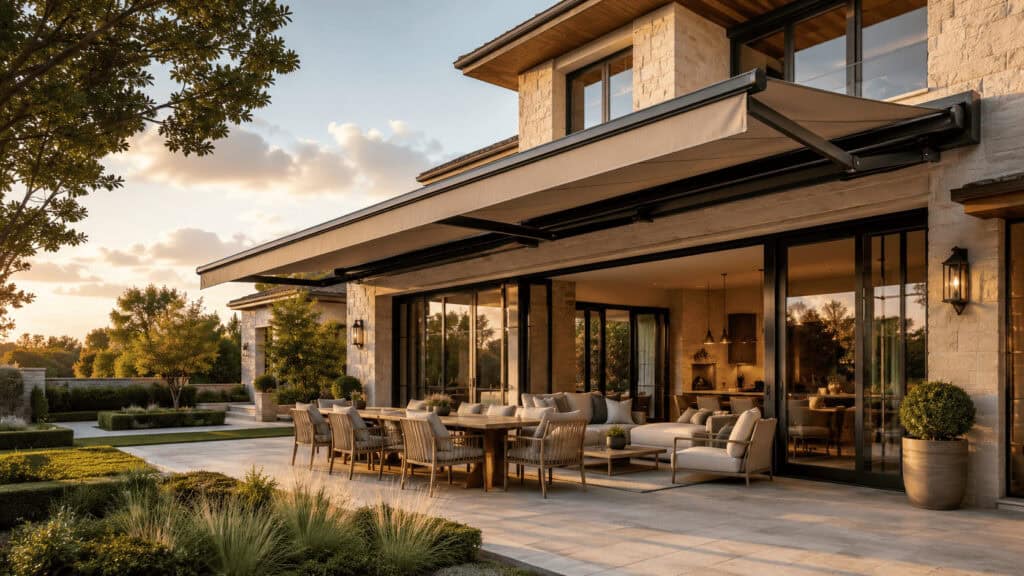
A retractable awning solves a problem that a permanent structure cannot: the ability to choose. A pergola creates shade on its terms — ideal when shade is the goal, less ideal when the moment calls for open sky, direct sun on a cool morning, or an unobstructed view of a sunset. A retractable awning provides the same shade coverage as a solid overhead structure on demand, and gives the sky back when the shade is not wanted. That flexibility is what makes retractable awnings a genuinely different product category from permanent shade structures — not a compromise version of a pergola, but a functionally distinct solution for the outdoor living space that values on-demand shade control.
This guide covers the complete decision set: how retractable awnings compare to and work alongside pergolas and motorized zip screens, what the different awning systems look like mechanically, what cassette housing does and why it matters, how motor and control systems function, what fabric specifications mean for long-term performance, what wind rating specifications mean in practice, what the installation process involves, what drives cost, and how the weather patterns across the markets Backyard Paradiso serves affect awning selection and performance priorities.
Retractable awning vs pergola vs motorized zip screen: three products, three purposes
These three product categories appear in the same conversations because they all address outdoor comfort — but they solve different problems. Understanding the distinction prevents the common mistake of buying the wrong product for the actual need.
Retractable awning: on-demand overhead shade
A retractable awning provides overhead fabric shade on articulated extension arms, deployed horizontally or at a slight pitch to shed light rain. When retracted, the fabric stores in a cassette housing against the wall — the patio returns to open sky with no permanent overhead structure. The awning does not provide side screening — the perimeter of the shaded area remains open to wind, insects, and direct side sun.
Best for: primary overhead shade on a patio or deck where overhead sun is the main comfort issue and where the homeowner wants the option of full open sky when shade is not needed.
Motorized zip screen: vertical side screening
A motorized zip screen is a vertical track-guided fabric panel that deploys from overhead down to floor level at the perimeter of an outdoor space. It blocks wind, insects, direct sun on the west or east elevations, and provides visual privacy from adjacent properties. It does not provide overhead coverage — it is a side element, not an overhead element.
Best for: pergola perimeter screening, privacy, insect protection, and side sun control.
Pergola with louvered roof: permanent adjustable overhead structure
An aluminum pergola with a motorized louvered roof is a permanent overhead structure with adjustable louver blades that open fully for light and sky, close fully for rain protection, and position at intermediate angles for shade and partial coverage. It provides both overhead coverage and integration with perimeter zip screen systems for full enclosure. Unlike an awning, it is a permanent architectural element that does not retract or disappear.
Best for: a permanent, multi-season outdoor room that integrates with the home’s architecture and with other outdoor living elements — outdoor kitchen, landscape lighting, fence perimeter.
How the three systems work together
These products are frequently combined rather than competing for the same role. A common residential configuration: a pergola with louvered roof covers the primary outdoor living zone with zip screens on the wind-facing sides, while a retractable awning covers the adjacent open patio section where the homeowner wants the option of full sun. The awning handles the overflow entertaining space, the pergola handles the core outdoor room, and the zip screens handle the perimeter. Each product does its job without asking the others to compromise.
Where retractable awnings work best: applications and sizing
Patio shade
The most common application — a retractable awning mounted to the rear wall of the home, extending over a paver patio or concrete surface to shade a dining table, seating area, or the transition zone between the house and the yard. The awning covers the space when the afternoon sun makes it uncomfortable, and retracts to restore open sky when the sun drops low enough or when the homeowner wants full sun exposure on a cool morning.
Deck shade
Retractable awnings work well on elevated decks where the mounting wall is at or above deck level. The awning extends over the deck surface, providing shade for the dining or lounging zone without the permanent overhead commitment of a pergola. On elevated decks with glass railings, the combination of unobstructed view through the railing and retractable shade overhead creates maximum flexibility — full view and full sun when wanted, shade on demand when not.
Outdoor kitchen and cooking zone shade
A retractable awning over or adjacent to an outdoor kitchen provides shade for the cook during afternoon grilling — a meaningful comfort improvement in San Antonio, Orlando, and Naples where summer sun makes unshaded cooking genuinely uncomfortable. The ability to retract the awning when the grill is not in use keeps the fabric away from residual heat and smoke that would otherwise accumulate on a permanently deployed shade surface.
Pool-adjacent shade
Retractable awnings provide shade for lounging areas adjacent to pool decks — the sunbathing zone gets full sun when the awning is open, and shade when extended. The retractability matters here because pool use is often about alternating between sun and shade rather than committing to one or the other permanently.
Sizing: width and projection
Awning width (parallel to the wall) and projection (distance from the wall) determine how much patio or deck area the awning covers. Standard residential awnings range from approximately 8 to 20 feet wide and 8 to 13 feet of projection. Larger coverage requires larger arm systems and motors sized to the load.
A useful design benchmark: the awning should cover the primary seating or dining area completely at full extension, without leaving part of the table in sun and part in shade. Measuring the area that actually needs coverage — rather than sizing to the smallest awning that fits the wall space — produces an installation that functions correctly day-to-day.
Pitch
Retractable awning arms can be pitched from nearly flat (5 degrees) to steeper angles (35 degrees and above). Steeper pitch improves rain runoff and increases headroom at the leading edge. Flatter pitch produces more shaded area per unit of projection but retains more water on the fabric surface during light rain. In markets with frequent afternoon showers — Orlando, Naples, Denver in summer — a moderate pitch (15 to 20 degrees) balances shade coverage with rain management.
How retractable awnings work: the mechanical system
The basic mechanism
A retractable awning consists of a fabric panel supported by a pair of articulated arms — folding extension arms that hold the leading edge of the fabric at a consistent projection distance and pitch. The arms are spring-loaded to maintain fabric tension across the full extension range. The fabric rolls around a tube (the front bar) as the awning retracts, with the leading edge attached to the front bar and the opposite edge attached to the roller tube at the rear.
The roller tube rotates to wind or unwind the fabric. In manual systems, a hand crank operates the rotation. In motorized systems, a tubular motor inside the roller tube drives the rotation on command from a remote, wall switch, or automation system.
Cassette housing: the feature that separates quality from entry-level
An enclosed cassette housing covers the fabric and rolling components completely when the awning is retracted, protecting the fabric from UV radiation, rain, bird debris, and dust during the substantial portion of its life when it is not deployed. In cassette-free designs, the fabric and roller tube are exposed to outdoor conditions when retracted — conditions that accelerate fabric degradation and contaminate the folded fabric surface.
The cassette’s protective role directly extends service life. Awning fabric in an enclosed cassette that is retracted when not in use can maintain its color and mechanical integrity for years longer than unprotected fabric exposed to outdoor conditions during storage.
Backyard Paradiso’s retractable awning installations use fully enclosed cassette designs as standard — the cassette housing is the baseline for a quality installation, not an upgrade option.
Motor systems and control options
Manual operation
Manual retractable awnings use a gear-driven hand crank that engages the roller tube directly. Manual operation is mechanically reliable and appropriate for smaller awning widths (under 12 feet) where spring tension in the arms does not create significant operating resistance. For larger widths, manual operation becomes laborious enough that motorization is worth the investment for daily comfort.
Tubular motors
Motorized awnings use a tubular motor — a self-contained motor and gearbox assembly installed inside the roller tube — to drive extension and retraction. The motor is controlled by a wall switch, remote, or smart home integration. Tubular motors are quiet (the motor noise is damped by the tube structure), reliable, and add no visible hardware — the motor is not visible from outside the cassette assembly.
Motor specification should match the awning’s physical size and weight. Undersized motors work harder than their design capacity, shortening service life. Properly specified motors in quality systems deliver long service lives under normal residential use patterns — a motor that is correctly matched to the awning it drives is not a frequent replacement component.
Smart home control and automation
Motorized awnings can be operated by handheld remote, wall-mounted control, or integrated with the major smart home automation platforms for schedule-based automation, smartphone app control, and integration with other outdoor living systems. Setting the awning to extend automatically at 2 p.m. every afternoon — or to retract when not in active use — extends the practical utility beyond what manual operation delivers. The same automation ecosystem that controls a motorized pergola louver roof and landscape lighting can operate the awning alongside them.
Wind sensors: the most important automation feature
A standalone anemometer that triggers automatic retraction when wind speed exceeds a set threshold is the single most important automation addition for retractable awning installations. Awnings are not designed for deployment in high wind — the fabric and arm system can be damaged by wind loads above their design rating, which is set by each product’s engineering rather than by any universal standard. A wind sensor that retracts the awning automatically before wind reaches damaging speed is a practical protection against storm damage in any market with unpredictable weather. It is not optional in the Colorado, Florida, or Illinois markets — it is a specification that pays for itself the first time it saves the awning from a storm the homeowner did not anticipate.
Fabric specifications: what matters for long-term performance
Solution-dyed acrylic: the quality standard
Solution-dyed acrylic is the standard fabric specification for quality retractable awnings. The solution-dyed process means color pigment is incorporated into the fiber at the time the fiber is formed — rather than applied as a surface dye after weaving — producing color that does not fade from UV exposure because the pigment is not a surface coating that UV can break down. Solution-dyed acrylic fabrics maintain their color and visual character for years of outdoor exposure. Surface-dyed fabrics, by contrast, fade progressively — showing noticeable color loss within a few seasons in high-UV markets like Colorado, San Antonio, and Naples.
UV protection
Beyond color stability, acrylic awning fabric blocks most of the UV radiation that would otherwise reach the shaded surface — providing meaningful UV protection for outdoor furniture, deck surfaces, and the people beneath the awning. That protection has practical implications for furniture longevity and comfortable extended use of the outdoor space during peak sun hours.
Water repellency
Quality awning fabric is water-repellent rather than waterproof — it sheds light rain and provides coverage under moderate precipitation but is not a permanent waterproof roof. The fabric should be retracted before heavy rain. Water-repellency treatment is either inherent to the fiber specification or applied as a finish that requires periodic reapplication as it weathers over time. The distinction between water-repellent and waterproof is worth understanding: an awning is a shade structure that handles light rain, not a roof that handles all weather.
Fabric color and heat management
Lighter colors reflect more solar radiation and keep the space beneath the awning cooler than darker colors, which absorb more heat. In high-sun markets — Naples, Orlando, San Antonio, Colorado — lighter neutral fabrics (sand, beige, light gray) produce the most comfortable shaded environment for afternoon use. Darker colors (charcoal, navy, forest) provide a richer visual character but absorb more heat, which radiates into the space below. The fabric selection is both aesthetic and functional — and in the hottest markets, the functional consideration should lead the decision.
Backyard Paradiso’s awning range covers the full color and pattern spectrum — solid colors in warm neutrals, deep tones, and bright primaries, as well as stripe patterns that suit traditional and coastal architectural styles.
The retractable awning installation process
Site assessment and measurement
Accurate measurement of the available wall mounting span, the patio or deck area to be covered, the mounting height, and the clearance from the mounting point to any obstructions below is the foundation of a correct installation. The mounting structure — typically the home’s exterior wall — must be capable of supporting the awning’s dead weight plus the wind load the system’s design rating requires.
For deck installations, the wall mounting point is evaluated relative to the deck surface height to ensure proper headroom at both the wall and the leading edge. For installations adjacent to a pergola, the awning position is coordinated with the pergola structure to avoid interference during extension and retraction.
Mounting bracket installation
The awning is mounted to the wall through a series of brackets anchored into the home’s structural framing — typically the rim joist, wall studs, or blocking installed specifically for the awning. Anchor location into structural members (not just siding or sheathing) is essential for adequate load transfer. Masonry walls (brick, block, stucco over concrete) require appropriate masonry anchors. Wood frame walls require lag bolt connections into framing members. The bracket installation is the structural work that determines whether the awning stays securely attached through years of extension and retraction cycling and through wind events up to the rated threshold.
Cassette and arm installation
The cassette assembly is set on the mounting brackets and secured. Extension arms are attached and adjusted for correct pitch. Fabric tension is verified across the full extension range. The mechanical system is tested through multiple full extension and retraction cycles to confirm smooth operation before the motor and control system are commissioned.
Motor connection and control commissioning
For motorized systems, the tubular motor is connected to the electrical supply (a standard outdoor outlet or a dedicated circuit, depending on the installation). The control system is configured — remote pairing, wall switch installation, smart home integration, and wind sensor calibration. The wind sensor threshold is set based on the awning’s rated wind speed and the local wind conditions. The full system is tested with the homeowner present, including a demonstration of manual override, automatic retraction, and any scheduled automation.
Permits and HOA considerations
Permit requirements for retractable awnings are jurisdiction-dependent. Many jurisdictions require a building permit for a permanently attached motorized awning, particularly where new electrical work is involved, and electrical work for a new outlet or dedicated circuit requires an electrical permit in most jurisdictions. Some HOAs require approval for any structure attached to the home’s exterior — including retractable awnings — and may impose constraints on fabric color, cassette color, or placement. Backyard Paradiso confirms permit and approval requirements with the local authority as part of every project assessment.
What drives retractable awning cost
Retractable awning cost is primarily driven by width, projection depth, motor specification, cassette type, and fabric selection.
Manual systems
Installed cost for standard residential widths varies with quality tier, cassette design, and fabric. Manual systems are the entry point for quality retractable shade — appropriate for smaller patios where motorization is not essential for comfortable daily use.
Motorized systems
Motorized systems for standard residential widths with enclosed cassette and tubular motor carry a moderate premium over manual operation. Larger sizes (16 to 20 feet and wider) with premium fabric, wind sensors, and smart home integration occupy the top of the range. The motorization premium pays for itself in daily use convenience — the homeowner who has to crank the awning out manually will use it less than one who presses a button on a remote or schedules it to extend automatically.
Installation factors
Mounting height, wall construction type (wood frame vs masonry vs metal stud), electrical service for the motor, and access logistics affect the total installed cost. Second-story or elevated installations with access challenges carry a modest premium over ground-level wall-mounted installations.
Thinking about awning cost as an investment
A retractable awning is the lowest-cost shade solution in the Backyard Paradiso portfolio — significantly less than a pergola installation — while providing on-demand overhead shade that transforms the comfort of a paver patio or deck during peak sun hours. For homeowners who are not ready for the investment of a full pergola structure, or who specifically want the flexibility of retractable shade rather than permanent overhead coverage, the awning delivers a high ratio of comfort improvement to dollar spent.
How weather patterns shape awning specification across the markets served
Wind is the climate variable that matters most for retractable awning installations — more than UV, more than rain, more than temperature. An awning deployed in wind above its rating gets damaged. An awning with a wind sensor that retracts before that threshold is reached does not. What follows is how the weather patterns in each market type affect the specification conversation.
Afternoon convective storm markets: rapid wind development with little warning
Colorado Springs and Denver experience afternoon thunderstorms that develop rapidly during the summer months — clear sky at 2 p.m., gusty wind and heavy rain by 3:30 p.m. The wind onset can outpace a homeowner’s ability to remember, walk outside, and retract the awning manually. Wind sensor automation is not a convenience feature in the Front Range market — it is the specification that prevents storm damage to the awning on the one afternoon the homeowner is away from the house when the storm arrives.
Naples and Orlando share this pattern through Florida’s summer wet season (June through October) — afternoon convective storms that produce gusty wind and heavy rain with lead times measured in minutes rather than hours. The frequency of these events in Florida makes wind sensor automation the standard specification for any motorized awning installation in the Naples and Orlando markets. Tropical weather events during hurricane season require full retraction and, in severe cases, additional securing of the cassette hardware.
Consistent wind exposure: elevation and rooftop installations
Secaucus rooftop installations and properties at elevation in Colorado Springs and Denver experience higher baseline wind exposure than grade-level patios in sheltered positions. The consistent wind environment at elevation means the awning spends more of its operating time near its wind rating threshold than a ground-level installation does. Calibrating the wind sensor to a threshold well below the system’s rated maximum provides a larger safety margin at exposed locations. Motor specification also matters here — a motor that retracts the awning quickly when the sensor triggers is more valuable at elevation than at grade level where wind tends to build more gradually.
Seasonal frontal passage markets: predictable but intense wind events
Romeoville and northern Illinois experience strong frontal wind passages in spring and fall — weather systems that are generally forecast in advance but that produce wind speeds well above any retractable awning’s rated threshold. San Antonio’s spring severe weather season produces similar events. In these markets, wind sensor automation provides protection against the events that arrive faster than forecast or when the homeowner is not home to retract manually. The seasonal nature of the wind risk means the sensor earns its value on a handful of specific days each year — but those are the days that would otherwise damage an unprotected awning.
UV intensity: the fabric performance variable
While wind determines the hardware specification, UV intensity determines the fabric specification. Colorado’s altitude-amplified UV, San Antonio’s South Texas sun, and Naples’ subtropical UV exposure are the markets where solution-dyed acrylic fabric quality matters most. Surface-dyed fabrics that look identical to solution-dyed products at installation will show visible fading within two to three seasons in these high-UV markets. The fabric quality specification is invisible at purchase but obvious within a few years — and fabric replacement on an otherwise functioning awning is an unnecessary cost that the correct initial specification eliminates.
Retractable awning maintenance: what the ongoing commitment looks like
Retractable awnings require more ongoing attention than most other Backyard Paradiso products — but the maintenance is straightforward and the time investment is modest.
The most important maintenance habit: retract when not in use
The single most effective maintenance action for a retractable awning is retracting it when it is not actively providing shade. The cassette housing exists to protect the fabric from UV, rain, and debris during the hours (and seasons) when the awning is not deployed. An awning left extended overnight, left out in rain, or left deployed through a week of non-use is an awning that is aging faster than it needs to. This habit alone extends fabric life more than any cleaning or treatment regimen.
Fabric cleaning
Brush off loose debris (leaves, pollen, bird droppings) before retracting — retracting debris into the cassette compresses it against the fabric and can create stains that are harder to remove later. For periodic cleaning, a soft brush with mild soap and water removes surface soiling. The fabric should dry completely before retracting — storing damp fabric in a closed cassette promotes mildew growth.
Arm and frame inspection
Annually, the extension arms are inspected for smooth operation, the spring tension checked (arms should hold the fabric taut at full extension without sagging), and the pitch adjustment verified against drift. Pivot points and joints are lubricated per the manufacturer’s specification. The mounting brackets are inspected for any movement or loosening — particularly after a season of wind events.
Motor and control system check
For motorized systems, the full extension and retraction cycle is tested at the start of each season. The wind sensor is verified to trigger retraction at the correct threshold, and any smart home scheduling and remote pairing confirmed. Motor service is rarely needed within the first decade of a properly specified system — but confirming smooth operation annually catches any developing issue before it becomes a failure during use.
Fabric replacement
Quality solution-dyed acrylic fabric in an enclosed cassette that is retracted when not in use typically delivers a decade or more of service before replacement is needed. When the fabric reaches end of life — visible fading, loss of water repellency, or mechanical wear at the fold points — the fabric can be replaced on the existing frame and motor at a fraction of the cost of a new awning. The frame and motor components, properly maintained, outlast multiple fabric lifespans.
Frequently asked questions about retractable awning installation
How long do retractable awnings last?
With proper care — retracted when not in use and during high wind or heavy rain — quality retractable awnings with solution-dyed acrylic fabric and enclosed cassette housings typically deliver a decade or more of service before fabric replacement is needed. Frame and motor components often outlast the initial fabric and can be refabricked at a fraction of the cost of a new awning, extending the total system life across multiple fabric lifespans.
Can a retractable awning be left out during rain?
Light rain, yes — quality awning fabric is water-repellent and will shed light precipitation, especially at a moderate pitch angle. The awning should be retracted during heavy rain to prevent water pooling and load stress on the arms, and should always be retracted before any forecast high wind event. An awning is a shade structure that handles light weather, not a roof designed for all conditions.
What is the wind rating on a retractable awning?
Retractable awnings carry a product-specific operational wind threshold — commonly in the 20 to 35 mph range depending on awning size and mounting configuration — established by the manufacturer’s engineering rather than by any building code. It is a maximum, not a continuous operating condition. Above this threshold, the awning must be retracted to prevent arm and fabric damage. Wind sensor automation retracts the awning automatically as wind approaches the rated limit, which is why Backyard Paradiso specifies wind sensors as standard in the Colorado, Florida, and Illinois markets.
Do retractable awnings need a permit?
It depends on the jurisdiction. Many jurisdictions require a building permit for a permanently attached motorized awning, particularly where new electrical work is involved, and electrical work for a new outlet typically requires an electrical permit. Some HOAs require approval for any structure attached to the home’s exterior. Backyard Paradiso confirms permit and approval requirements with the local authority as part of every project assessment.
What is the best awning fabric color for keeping cool?
Lighter colors reflect more solar radiation and keep the space beneath the awning cooler. Sand, beige, light gray, and white fabrics produce the most comfortable shaded environment in high-sun markets. Darker colors absorb more heat that radiates into the space below. In Naples, Orlando, San Antonio, and Colorado, the functional comfort benefit of lighter fabric should lead the color decision.
How does a retractable awning compare to a pergola?
A retractable awning provides on-demand overhead shade that disappears completely when retracted — maximum flexibility between full sun and full shade. An aluminum pergola with a louvered roof is a permanent overhead structure that adjusts between open and closed but does not disappear. The pergola is a more substantial investment, provides rain protection the awning cannot match, and integrates with zip screens and other outdoor living systems. The awning costs less and provides the specific benefit of retractability — open sky on demand. Many properties use both: pergola over the primary outdoor room, awning over the adjacent open patio.
What is a cassette awning?
A cassette awning has a fully enclosed housing that covers the fabric and roller components completely when the awning is retracted. The cassette protects the fabric from UV, rain, bird debris, and dust during storage — significantly extending the fabric’s lifespan compared to open designs where the fabric is exposed to outdoor conditions when retracted. Backyard Paradiso uses enclosed cassette designs as the standard specification for every installation.
Can I automate my retractable awning?
Yes. Motorized awnings can be integrated with the major smart home automation platforms for schedule-based automation, smartphone app control, and voice control. Wind sensors add automatic retraction when wind exceeds a set threshold. Sun sensors can extend the awning automatically when sun intensity reaches a specified level. The combination of schedule, wind, and sun automation makes the awning functionally hands-free.
How often does awning fabric need to be replaced?
Quality solution-dyed acrylic fabric in an enclosed cassette, retracted when not in use, typically lasts a decade or more before replacement is needed. The frame and motor outlast the fabric and do not need replacing when the fabric is changed. Fabric replacement on an existing frame costs a fraction of a new awning installation — it is a refurbishment, not a reinstallation.
Service areas
Backyard Paradiso installs retractable awning systems across the markets it serves. Motor specification, wind sensor configuration, fabric selection, and mounting design are adapted to the weather patterns and outdoor living conditions of each market. The full list is on Markets We Serve.
The shade that gives the sky back
A permanent overhead structure provides shade on its terms. A retractable awning provides shade on the homeowner’s — full coverage when the afternoon sun makes the patio uncomfortable, full open sky for the morning sun, the evening light, or the stars. A site assessment is the right starting point: it measures the space, evaluates mounting conditions, covers fabric and motor options, and produces a complete specification and quote. Consultations are available by appointment.