What Are the Pros and Cons of Artificial Grass for a Residential Yard?
Artificial Grass Trade-Offs for a Residential Yard
Artificial grass carries meaningful trade-offs for residential yards, and whether its advantages outweigh its drawbacks depends on how the installation is specified and what surface conditions the site presents. Some drawbacks—heat retention and finite service life—are properties of the material itself, while others—poor drainage, odor, and visible seams—are installation outcomes. Artificial grass is a synthetic surface system of manufactured fiber, backing, and infill laid over a prepared aggregate base.
What Artificial Grass Does Well
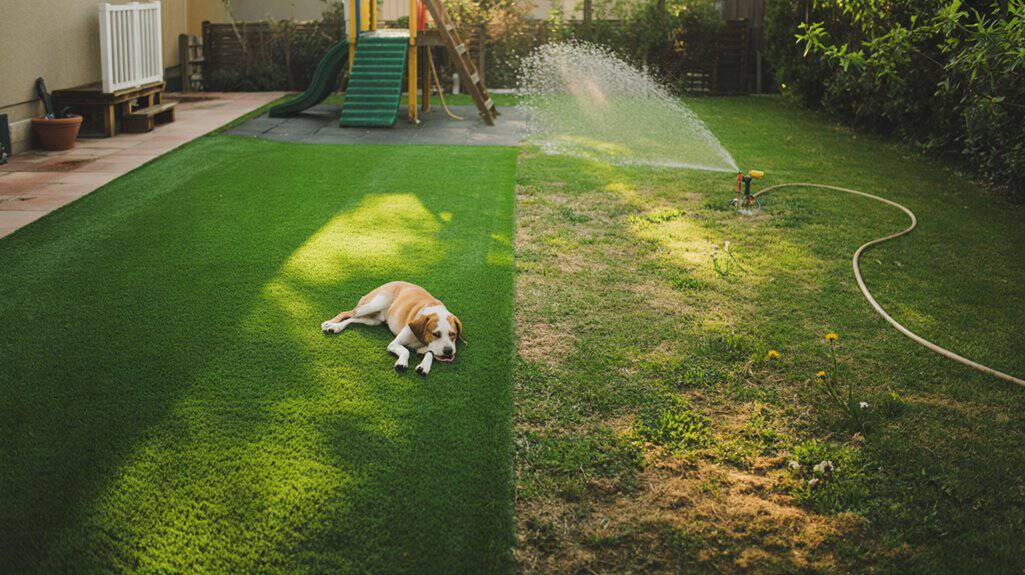
Artificial grass eliminates the three recurring demands of natural turf maintenance — mowing, irrigation, and chemical inputs — while keeping the surface functionally consistent across seasons when dormancy or wear recovery would otherwise render grass unusable. It performs where grass structurally cannot: under dense canopy shade, in high-traffic pet runs, and in play areas where compaction and urine saturation cycle through faster than turf can recover. The absence of pesticide and fertilizer application also removes a category of chemical input from the site entirely, which matters in installations near drainage features or hardscape.
No mowing, watering or lawn chemicals, and a surface that stays usable
Artificial grass eliminates irrigation as a maintenance input entirely, removing the scheduling, infrastructure, and resource demand that overhead or drip systems require on natural turf. That is the specific, substantiated form of the claim; the FTC Green Guides caution against broader labels such as “eco-friendly” that the product cannot support. Where natural turf goes dormant under heat stress or requires recovery periods after heavy use, a properly installed synthetic surface remains dimensionally stable and visually consistent year round. Fiber systems designed for infill compaction resistance also perform in deep shade conditions where grass species fail to establish or sustain density. Because the surface contains no living plant material, it requires no fertilizer applications and no pesticide or herbicide programs, removing those chemical inputs from the maintenance cycle entirely.
Shade, pets, play and the uses where natural turf struggles
Synthetic turf over a shock pad can be specified to the impact attenuation criteria of ASTM F1292 for play areas, a level of fall protection that compacted natural turf under heavy use cannot reliably sustain. In deep shade, where most turfgrass species fail to maintain adequate density, synthetic fiber requires no light to hold its structure or appearance. For pet applications, the critical performance variable is infill selection and base drainage design; sand, zeolite, or organic infill materials avoid the chemical concerns associated with SBR crumb rubber, and a properly graded open-stone base per ASTM D448 allows urine to pass through rather than pool. Where natural turf experiences wear-pattern thinning from concentrated play traffic, the synthetic surface remains dimensionally consistent, eliminating the recovery periods that restrict usable time on living turf.
The Drawbacks That Belong to the Product
Some drawbacks of artificial grass aren’t installation failures waiting to be corrected—they’re inherent to what the material is. Synthetic fiber absorbs and re-radiates solar energy in ways natural turf never would, with recorded surface temperatures reaching levels that suspend safe use during peak sun hours; irrigation reduces that heat load, but only for a window of twenty to sixty minutes before temperatures climb again. The product also carries a finite service life, typically spanning eight to fifteen years depending on manufacturer specifications, after which it enters the waste stream as a multi-material composite that current recycling infrastructure handles poorly, compounded further by infill chemistry concerns that apply specifically to SBR crumb rubber and its documented presence in stormwater runoff.
Surface heat and the limits of cooling it
Research cited by the Penn State Center for Sports Surface Research, originating at Brigham Young University, sets 120°F as the surface temperature above which artificial turf use should be restricted, a limit that direct-sun installations routinely approach on warm days. The Penn State Center for Sports Surface Research has documented surface temperatures far exceeding ambient air temperature under typical outdoor conditions, a gap driven by the absence of evapotranspiration cooling that natural turf provides continuously through its root-and-soil system. Irrigating the surface does reduce temperature, but the effect dissipates within 20 to 60 minutes, offering relief rather than a solution. Surface heat is a property of the material under radiative conditions, not an artifact of how the turf is installed, and no base preparation method or infill selection eliminates it entirely.
Finite service life, end-of-life disposal and infill chemistry
UV degradation of synthetic fiber is governed by the depletion of HALS (hindered amine light stabilizer) chemistry, a process tested under ASTM G154 and ASTM G155, and that depletion sets a hard boundary on service life regardless of how well the system is installed. Residential installations typically reach end of service between eight and fifteen years, a range that reflects manufacturer formulation differences rather than a universal standard. At that point, the composite structure—fiber, backing, infill, and geotextile—presents a multi-material recycling challenge; the Synthetic Turf Council publishes end-of-life guidelines because no single-stream solution currently exists. Where SBR crumb rubber infill has been selected, the EPA’s Federal Research Action Plan and emerging data on 6PPD-quinone in stormwater add a further dimension to disposal planning—one that sand, zeolite, TPE, EPDM, or organic infill alternatives avoid from the outset.
The Drawbacks That Belong to the Installation
A second category of complaints traces not to the material but to how it’s installed—and that distinction matters for anyone evaluating long-term satisfaction. Settlement, standing water, persistent odor, visible seams, edge lift, and even weed growth (which establishes in accumulated debris on top of the backing, not through it) are, in most cases, consequences of an inadequate base, improper compaction, or poor seam and anchoring practice. Regulatory variables compound the picture further: stormwater authorities classify synthetic turf as pervious or impervious on a jurisdiction-by-jurisdiction basis, and HOA restrictions remain common, though several states have moved to preempt outright bans.
Settlement, drainage, odor and seams as base-preparation outcomes
Settlement, drainage failure, odor, and visible seams in artificial grass installations trace to base preparation deficiencies that are entirely separable from the turf material itself. When compaction does not meet the density standard established under ASTM D1557 or drainage capacity is not verified against ASTM F2898, the sub-base shifts after installation, pulling seams apart and pooling water that extends the dwell time in which bacteria turn pet waste into odor. Geotextile separation fabric specified per AASHTO M288 and open-graded aggregate conforming to ASTM D448 are the mechanical foundation that prevents these outcomes. Weeds, commonly cited as a turf failure, germinate in organic debris that accumulates on the surface rather than through the backing — making them a maintenance consequence of debris removal habits, not a property of the material.
Regulations, HOA rules and stormwater classification
Stormwater classification of artificial turf installations — whether pervious or impervious — varies by jurisdiction, a determination that directly affects grading, drainage design, and permitting requirements before a single blade is laid. Where a jurisdiction classifies the surface as impervious, runoff calculations change and additional drainage infrastructure may be required as a condition of approval. Separately, some homeowners associations restrict or prohibit artificial turf, though several states have enacted legislation that preempts outright bans. Neither stormwater classification nor HOA policy is a property of the turf material; both are regulatory contexts that an installer or homeowner must research and resolve at the planning stage, making them installation-phase outcomes rather than inherent product liabilities.
Frequently Asked Questions
The questions homeowners ask most often about artificial grass cluster around four concerns: its core disadvantages, its environmental profile, what tends to generate regret after installation, and whether it’s a sound choice for a residential backyard. Those questions don’t have uniform answers, because surface heat, service life, and end-of-life disposal are properties of the material itself, while drainage failures, seam visibility, and odor trace directly to how the system was specified and built. What follows addresses each question with that distinction intact.
What are the main disadvantages of artificial grass?
Surface heat in direct sun, finite service life, end-of-life disposal difficulty, and the absence of evapotranspiration cooling or soil biology are inherent product properties. Penn State Center for Sports Surface Research documented surface temperatures well above ambient air temperature, with a 120°F use threshold identified by Brigham Young University research. Several additional drawbacks—poor drainage, odor, and visible seams—trace to base preparation and installation practice rather than the material itself.
Is artificial grass bad for the environment?
Artificial grass carries both environmental costs and benefits, and neither a blanket condemnation nor a clean endorsement is accurate. It eliminates irrigation and lawn-chemical inputs entirely, but it also removes evapotranspiration cooling, soil biology, and ecosystem function — properties no installation practice can restore. End-of-life disposal remains a genuine challenge, with guidance available through the Synthetic Turf Council.
What do homeowners regret about artificial turf?
The most common regrets center on under-built bases, black crumb rubber infill in sun-exposed yards, wrong infill selection for pet areas, and no debris management plan under trees. These are installation and specification outcomes, not inherent product flaws. Proper base and infill selection resolves most of them before installation begins.
Is artificial grass a good idea for a backyard?
Artificial grass suits many backyard applications well, particularly where shade, heavy foot traffic, or pet use makes natural turf impractical. Suitability depends heavily on base preparation, infill selection, and sun exposure, since these factors determine whether common regrets materialize. Heat buildup in direct sun remains a product property, not an installation variable.
Artificial Grass Installation Across Every Market Backyard Paradiso Serves
Residential artificial grass installations are governed by layered technical demands — open-graded aggregate base compaction verified against ASTM D1557, drainage capacity confirmed per ASTM F2898, geotextile separation specified to AASHTO M288, and infill selection informed by EPA FRAP findings on stormwater chemistry — that determine whether a finished surface performs as intended or becomes a source of the regrets the industry most commonly documents. Backyard Paradiso‘s work in residential artificial grass installation is built on fluency with exactly these requirements, translating specification decisions into surfaces that hold their drainage, seam integrity, and infill distribution over the full service life the material is capable of delivering. Consultations are available by appointment for homeowners weighing artificial grass against a living lawn for their yard and their use of it.