
Artificial Grass: The Complete Guide for Homeowners
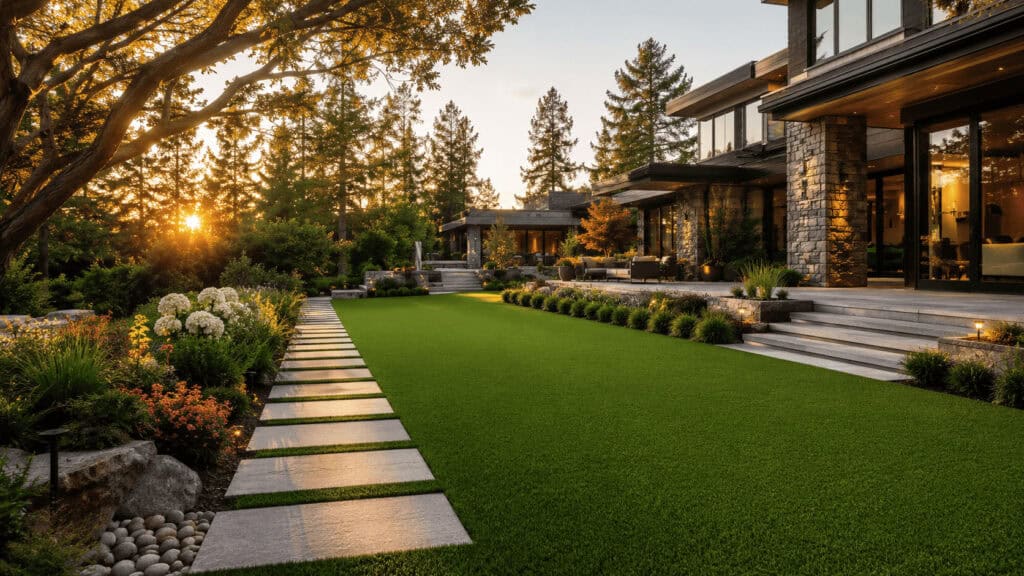
Artificial grass installation tends to enter the conversation once a lawn has lost the battle against drought, foot traffic, or a dog who treats every patch of dirt as a project. What surprises most homeowners is how far the product has come — and how much goes into getting it right.
This guide covers the full picture: how synthetic turf is made, how to match the product to the space, what installation involves, what drives cost, how climate affects the options, and what to weigh before committing. Whether the project is converting a full backyard lawn, building a pet run, installing a putting green, or replacing a patch of dirt that refuses to grow anything, the information here supports a decision that holds up for the life of the installation.
What follows is the same guidance Backyard Paradiso shares with every homeowner before anything is signed.
What is artificial grass and how does it work?
Artificial grass is a surface covering made from synthetic fibers engineered to replicate the look, texture, and function of natural turf. It is installed over a prepared base and held in place with securing materials, adhesive, and in many cases, a layer of infill that adds weight, stability, and cushioning.
The basic structure is consistent across most products: synthetic blades attached to a perforated backing material, which allows water to drain through. Infill — typically silica sand, crumb rubber, or a blended material — is brushed into the fibers to keep blades standing upright and to give the surface its underfoot feel.
How artificial grass is made: fibers, backing, and infill
The fibers in modern artificial turf are most commonly made from polyethylene, which offers the soft texture and natural appearance that most homeowners want. Higher-end products may blend in polypropylene or nylon for added durability or specific performance characteristics — nylon is the most resilient fiber type and holds its shape under heavy use, while polypropylene is the most affordable and is suited to decorative or low-traffic applications.
Backing materials are typically a two-layer system: a primary backing where the fibers are anchored, and a secondary coating — usually polyurethane or latex — that stabilizes the structure and maintains the perforations needed for drainage. The quality of the backing matters more than most buyers realize — it directly affects how the turf holds up under foot traffic, UV exposure, and temperature swings over time.
Infill serves several functions at once. It ballasts the turf so it does not shift underfoot, supports the blade structure, and adds the cushioning that makes synthetic grass comfortable to walk or sit on. For pet applications, specialized infill materials like zeolite and antimicrobial-coated sand also help manage odor. For playground installations, shock-absorbing rubber or foam infill provides fall protection that meets safety standards.
How modern synthetic turf differs from first-generation artificial grass
The artificial grass products of the 1970s and 1980s were rigid, hot, and looked nothing like real grass. They were designed for sports fields, not backyards, and the experience of walking on them made that obvious.
Today’s residential turf products are engineered for a completely different use case. Blade shapes are varied to mimic the uneven look of a natural lawn. Color tones include realistic browns and tans mixed into the green to replicate thatch. Pile heights range from short and dense to longer and more plush, depending on the aesthetic. The difference between a well-chosen, professionally installed modern turf product and a natural lawn is, in many cases, nearly undetectable from a normal viewing distance.
How artificial grass drainage works
Drainage is one of the more misunderstood aspects of artificial turf. Because the backing is perforated and the base beneath it is designed to be permeable, water moves through the system rather than pooling on the surface. A well-installed artificial grass system drains at a rate that exceeds what most natural lawns can manage, which is part of why it performs well in areas prone to heavy rain or irrigation runoff.
The base preparation — how the ground beneath the turf is graded, compacted, and layered — is where drainage performance is really determined. This is one of the strongest arguments for professional installation over a DIY approach.
Is artificial grass right for the yard? A candid assessment
Artificial turf is not the right solution for every situation, and any candid installer will say so. What follows is a clear-eyed look at where it excels and where it has real limitations.
The real benefits of switching to artificial turf
The most immediate benefit most homeowners notice is time. Mowing, edging, watering, fertilizing, aerating, overseeding — all of it disappears. For homeowners with busy schedules or large yards, that adds up to dozens of hours per year.
Water savings are substantial, particularly in warm climates where summer irrigation drives water use sharply higher. Artificial grass eliminates lawn irrigation entirely, beyond the occasional rinse-down for cleaning. In markets with water restrictions — parts of Colorado, Texas, and Florida increasingly among them — synthetic turf removes the conflict between maintaining a lawn and complying with watering limits.
The visual consistency is something natural grass cannot match. Artificial turf stays green through drought, heat, hard freezes, and heavy use. There are no brown patches, bare spots, or seasonal dormancy periods. For homes where curb appeal and outdoor aesthetics are a priority, the reliable appearance of synthetic turf has real value.
Durability is another real advantage. High-quality turf is designed to withstand heavy use without showing wear patterns. Playground areas, dog runs, and frequently used entertaining spaces that would reduce natural grass to dirt in a single season can be covered in turf that looks the same in year ten as it did in year one.
Limitations worth knowing before committing
Artificial grass gets warm in direct sunlight. During peak summer conditions the surface temperature of synthetic turf can reach 150°F or higher. Shade from a pergola or mature trees, quality infill products designed to reduce heat retention, and the ability to cool the surface quickly with a rinse of water all help manage this, but it is worth factoring in where the space will be used during the hottest parts of the day.
It is a long-term decision. Once turf is installed and the base work is done, it is not something to pull up and reconsider next year. Residential synthetic turf typically delivers 8 to 15 years of service life. That is an asset for a homeowner planning to stay, but worth weighing if the situation is uncertain.
Some maintenance is still required — it is simply different maintenance. Debris needs to be cleared, pet areas need regular rinsing, and the fibers benefit from periodic brushing to stay looking their best. “Zero maintenance” is marketing language. “Very low maintenance compared to natural grass” is accurate.
Reflected heat from low-emissivity (low-e) windows is a known cause of turf damage — the concentrated sunlight can melt fibers in a localized area. This is solvable with window films, shade structures, or sun-angle mapping during the design phase, but it needs to be addressed before installation, not after.
Who gets the most value from artificial grass installation
Homeowners with large yards they struggle to maintain consistently, families with dogs who destroy natural lawns, households in drought-prone areas with water restrictions, and properties where outdoor aesthetics contribute meaningfully to home value — these are the situations where artificial grass tends to deliver a return that far exceeds the upfront investment.
Pet owners in particular see some of the fastest payback. A single large dog can eliminate a natural lawn entirely within one season. Purpose-designed pet turf with the right infill and drainage turns that same space into something that looks good year-round and cleans up easily.
Artificial grass applications: where it works best
Part of what makes modern synthetic turf so versatile is the range of product grades and pile styles available. Not every application calls for the same product, which is why understanding the use case before selecting a turf type matters.
Backyard lawns and outdoor living areas
The most common application is replacing a full or partial backyard lawn, often in combination with other outdoor living features. Artificial turf integrates naturally with pavers, pergolas, decking, and planting beds. Where natural grass requires irrigation and borders that are constantly encroaching, synthetic turf holds its line and its color season after season.
For entertainment-focused yards, the surface is comfortable to walk on barefoot, easy to set up furniture on, and does not track mud into the house after rain. Combined with a composite privacy fence around the perimeter and landscape lighting along the border, artificial grass becomes the floor of a true outdoor room rather than a yard one happens to walk through.
Pet runs and dog-friendly yards
Pet-specific installations are one of the fastest-growing segments in residential artificial turf. Dogs that would destroy natural grass with digging, running, and bathroom use can be managed on purpose-designed synthetic surfaces with antimicrobial infill, enhanced drainage systems, and turf grades built to resist the specific wear patterns dogs create.
The key differentiators in a pet turf installation are drainage flow rate, infill composition, and pile height. A turf optimized for pets drains quickly enough that waste can be managed with simple rinsing and does not hold odor in the fibers between cleanings.
Play areas and kids' zones
Artificial grass paired with proper shock-absorbing infill creates a play surface that is safer than natural grass for falls and rough play. It eliminates the mud, uneven ground, and worn patches that natural lawn play areas develop quickly. Blade heights in the mid-range — not so short as to feel hard, not so long as to obscure footing — tend to work best for active children’s spaces. For playground equipment, fall-height-rated infill systems provide impact attenuation that meets ASTM F1292 safety standards.
Putting greens and sports surfaces
Residential putting greens are a specialized installation that combines a purpose-built turf grade — shorter pile, firmer surface, specific ball roll characteristics — with contouring work on the base to create realistic green undulation. A well-designed backyard putting green is a real practice environment, not a novelty.
Beyond putting greens, artificial turf is widely used for bocce courts, batting cage flooring, and multi-use sport surfaces where consistent footing and durability under heavy use are the priorities.
Commercial properties and high-traffic spaces
Commercial artificial grass installations are common in retail environments, hospitality spaces, rooftop amenity areas, and workplace landscaping. The combination of visual appeal and near-zero maintenance labor cost makes it particularly compelling for property managers who maintain large landscaped areas.
Rooftop terraces and balconies
Artificial turf installs readily on rooftop decks and balconies, where natural grass is impractical and where the weight loading of soil and sod is often not an option. The drainage-ready backing works well over membrane roofing surfaces when properly installed, and the visual result is a dramatically more livable outdoor space.
Integration with fencing and outdoor structures
Artificial grass installed up to the base of a composite fence eliminates the mowing strip and bare-soil gap that makes fence-to-ground transitions look unfinished. It also prevents the weed and moisture accumulation at fence bases that accelerates wood fence deterioration. Paired with pavers for walkways and entertaining zones, and bordered by landscape lighting or permanent lighting for evening use, turf becomes the connective surface that ties the entire outdoor living environment together.
How to choose the right artificial grass for the space
Product selection is where a lot of homeowners get overwhelmed. The terminology is inconsistent across manufacturers, and specs that sound similar can represent meaningfully different products. What follows is what actually matters.
Understanding pile height, density, and face weight
Pile height is the length of the synthetic blades above the backing. Putting-green turf uses a very short pile — roughly half an inch or less — to permit true ball roll. Residential landscape turf generally falls between about 1.2 and 2 inches: shorter piles in that range suit sports use, pet areas, and a neatly trimmed formal look, while taller piles give a lush, plush aesthetic suited to lounging areas and front-yard curb appeal.
Face weight refers to the weight of the fibers per square yard, not including backing or infill. Higher face weight generally indicates denser, more durable turf — but face weight alone does not tell the complete story. Fiber shape, material composition, and backing quality all contribute to how a product performs under real-world conditions.
Density is the number of blade tufts per square inch. Higher density produces a fuller, more natural appearance and generally holds up better to traffic.
Turf grades: what the tiers mean
Backyard Paradiso carries a full product ladder from value-focused landscape grades through premium residential and commercial grades. The tiers differ in fiber quality, density, blade construction, and backing, and each is matched to a use case rather than sold as a step up for its own sake.
Entry grades suit low-traffic areas, decorative use, and applications where budget is the primary driver. They deliver a clean, consistent appearance at an accessible price point. A step above, an enhanced entry grade improves fiber quality and density for homeowners who want the low-maintenance benefits of entry-tier pricing with better aesthetics.
General residential grades are the workhorses — well-rounded products that balance appearance, durability, and price across most lawn-replacement applications. A pet-optimized grade within this tier is designed for pet households, with enhanced drainage and an infill-compatible backing structure.
Premium grades represent the upper tier of performance and realism, with multi-tonal blade coloring, varied blade shapes, and density levels that produce a lawn appearance that holds up to close inspection. A plush grade in this tier prioritizes underfoot comfort — a softer, deeper pile suited to spaces designed for relaxation, outdoor dining, and barefoot use.
At the top of the range, the top-tier realism grade is the product for homeowners who want the most realistic appearance available, with the blade structure, color variation, and density that make synthetic turf difficult to distinguish from a high-quality natural lawn.
Color variation and blade shape: what makes turf look realistic
The visual realism of artificial grass comes from two factors that are easy to overlook in spec sheets: blade shape variation and color mixing. Natural grass is not a single blade shape or a uniform green. It has flat blades, curved blades, wide and narrow blades, and a color palette that includes multiple shades of green alongside tan, gold, and brown tones.
Quality turf products engineer for this variation deliberately. Products that use a single blade shape and a uniform color will look artificial, particularly in direct sunlight. Products that blend blade shapes and incorporate thatch-tone fibers into the pile produce something that reads as natural from a normal viewing distance.
Heat-resistant options for sun-exposed yards
UV exposure and surface temperature are real considerations in south-facing or open yards. Products in Backyard Paradiso’s lineup include UV-stabilized fibers that resist color fading, and infill options engineered to reduce heat retention. The combination of the right turf grade and a heat-management infill can meaningfully reduce surface temperatures compared to standard installations. In markets like San Antonio, Naples, and Orlando, heat-resistant product selection is part of every design conversation.
Pet-specific turf: what to look for
For pet households, drainage rate is the non-negotiable specification. Products should state a measured drainage rate — a high-quality pet turf installation drains at rates that exceed the output of even heavy rain. Antimicrobial infill options like zeolite and coated sand address odor at the source, and shorter pile heights simplify cleaning by reducing the surface area where waste can collect.
The artificial grass installation process, step by step
What separates a good installation from a great one is almost entirely in the preparation work. The turf itself gets the attention, but the base is where longevity is determined.
Site assessment and measurement
Every installation starts with a thorough review of the space: its dimensions, drainage characteristics, existing vegetation, soil composition, and intended use. This assessment informs every decision that follows — base depth, drainage design, product selection, and installation approach.
Accurate measurement also protects against waste and unexpected cost. Turf is sold by the square foot, and seaming strategy affects how much material is required and where cuts are placed to minimize visible joins.
Ground preparation and base layer installation
The existing surface is removed — typically natural grass, roots, and the top layer of soil — down to a stable subgrade. From there, a compactable base material (typically crushed rock or decomposed granite) is installed, graded to direct water toward drainage points, and compacted to a firm, level surface.
A geotextile weed barrier is placed between the base and the turf to prevent organic growth from pushing up through the perforations over time. In pet areas, additional drainage infrastructure may be installed beneath the base to manage high-volume liquid drainage.
Getting this phase right is what produces a surface that remains level and smooth for years. A turf installation on a poorly prepared base will develop soft spots, uneven areas, and drainage problems that no amount of surface maintenance can correct. This is the phase where the difference between professional installation and DIY is most consequential.
Turf cutting, seaming, and securing
The turf is cut to fit the space, with seams placed strategically to minimize their visibility. Seam placement follows the direction of the pile and, wherever possible, runs parallel to the primary viewing angle of the space. Well-executed seams in a quality installation are invisible under normal viewing conditions.
The perimeter is secured with nails, staples, or adhesive depending on the surface. Seams are joined with adhesive and seaming tape on the backing side. In high-traffic or commercial applications, additional securing along high-stress zones ensures the edges and seams remain stable under use.
Infill application and final grooming
Once the turf is secured, infill is applied using a drop spreader and worked into the pile with a power broom. The infill is applied in passes until the target depth is achieved, and the blades are groomed to stand upright and at a consistent angle.
Final grooming makes a significant difference in the finished appearance. A well-groomed installation looks natural and full. This is also the phase where any edge finishing, border installation, or integration with surrounding hardscape elements — pavers, decking, planting beds, fence lines — is completed.
How long installation takes
Most residential installations complete in one to two days for typical backyard lawn areas. Larger projects, installations with significant base work, or jobs involving putting green contouring or complex shaping take longer. A pre-installation site visit and measurement session produces a realistic timeline for a specific project.
Permits and HOA considerations
In most jurisdictions, residential artificial grass installation does not require a building permit. Some municipalities, HOAs, or specific project scopes — particularly those involving drainage work, grading, or hardscape integration — may have requirements. In HOA-governed communities, artificial turf is increasingly accepted, but some associations still restrict it or require architectural review approval for front-yard applications. Backyard Paradiso is familiar with local regulations across the markets it serves and advises on any approvals needed for a specific project.
What drives artificial grass installation cost
Cost is where a lot of homeowners get either a distorted picture from DIY content or sticker shock from the first quote they receive without context for what is included. What follows is a grounded breakdown of what moves the number.
Size, grade, prep work, and access
The primary cost drivers are the square footage of the area, the product grade selected, the amount of base preparation required, and site-specific factors like access, slopes, existing drainage challenges, or concrete and sod removal.
A simple, flat backyard replacement with standard base work and a mid-range turf product is the most straightforward cost scenario. Complex sites with drainage issues, steep grades, concrete removal, or intricate shaping require more labor and materials, which is reflected in the quote.
How turf grade affects the quote
Entry grades installed professionally represent the lowest total cost scenario, suited to decorative applications or lower-traffic areas. General residential grades occupy the middle of the range. Premium grades carry the highest per-square-foot cost, reflecting meaningfully better materials, more complex fiber structures, and the visual performance that comes with them.
Putting green installations carry a premium over standard lawn turf due to the specialized product, base contouring work, and precision required.
The right product for a project is not necessarily the most expensive one. Matching the product grade to the use case — pet area, lounging space, putting green, decorative border — produces the best value outcome.
Cost comparison: artificial turf vs natural grass over 10 years
Natural lawn maintenance costs are underestimated by nearly every homeowner who has not added them up. Annual mowing, irrigation, fertilizer, weed control, reseeding, and repair work accumulate quickly. In water-stressed areas, irrigation alone is a significant recurring expense. Lawn care services compound this further.
Artificial grass carries a higher one-time investment and a near-zero ongoing maintenance cost. The comparison is one-time versus recurring: over a 10-year horizon, most homeowners find that the total cost of ownership for a professionally installed synthetic turf system is comparable to or lower than a natural lawn, and that comparison does not account for the hours of labor that no longer need to be spent.
What is included in a professional installation quote
A complete quote from Backyard Paradiso covers site assessment and measurement, removal of existing vegetation and material, base preparation, drainage work, weed barrier, turf material, infill, installation labor, edge finishing, and integration with surrounding hardscape. Understanding what is included — and what assumptions the quote is based on — is the most important conversation to have before comparing quotes from different installers.
Thinking about artificial grass as an investment
In markets where water costs are high, where outdoor aesthetics matter to buyers, and where the maintenance-free aspect is valued, artificial grass adds to perceived property value. The quality of the installation and the product selection matter — a well-installed premium product reads as a feature. A cheap installation reads as a compromise. The daily return — no weekends spent on lawn care, no climbing water bill, no brown patches — is the real payback.
Climate considerations by market
Artificial grass installation requirements and product recommendations differ across the markets Backyard Paradiso serves in ways that affect product selection, infill choice, base preparation, and heat management.
Colorado Springs and Denver: UV intensity at altitude is the dominant product selection driver — UV-stabilized fibers are not optional in this market. Freeze-thaw cycling affects base layer performance, requiring proper compaction and drainage grading to prevent heaving. Water restrictions along the Front Range make artificial turf an increasingly popular lawn replacement. Wind exposure on some Front Range properties affects infill retention and perimeter securing.
Naples: Collier County’s subtropical heat and humidity make heat-management infill and shade planning critical design considerations. Sandy soil provides excellent natural drainage but requires proper compaction to create a stable base. Afternoon thunderstorm drainage volume is high, making drainage flow rate a primary specification. HOA acceptance of artificial turf in master-planned communities varies; the approval process is handled as part of the project.
Orlando: Central Florida shares Naples’ heat and UV challenges with the added consideration of Orange County’s clay-heavy soils in some areas, which require more drainage infrastructure in the base layer. Mosquito and insect management make turf a practical alternative to standing-water-prone natural lawns. Permit requirements are minimal but HOA review is common in planned communities.
San Antonio: South Texas heat loads are the most extreme in the service area. Heat-reducing infill and product selection are standard parts of every San Antonio design conversation. Caliche soil conditions in Bexar County affect excavation and base prep — reaching proper depth requires equipment adapted to the material. Water scarcity makes turf conversion one of the most requested residential improvements in this market.
Romeoville: Illinois’s freeze-thaw cycle is the primary base preparation driver. Proper compaction and drainage grading prevent the frost heaving that causes surface irregularities in poorly prepared installations. Snow sits on the surface without damaging the turf — a quality installation performs identically after snowmelt as it did before. The growing season in northern Illinois is short enough that many homeowners find natural lawn maintenance effort disproportionate to the months of green they actually enjoy.
Secaucus: Hudson County’s dense lot conditions make artificial grass particularly appealing for small backyard spaces that receive limited sunlight — conditions where natural grass struggles to establish. Urban heat island effects make heat-resistant product selection relevant even in a northern market. Small-space installation precision matters more here than in larger suburban lots.
Artificial grass maintenance: what is actually required
The appeal of artificial turf includes its minimal maintenance requirements, but “minimal” still means something. What follows is a realistic maintenance routine.
Weekly and monthly upkeep tasks
The primary ongoing task is debris removal. Leaves, seeds, pet waste, and general organic material need to be cleared from the surface to prevent breakdown and odor. A stiff broom or a leaf blower handles most of this in a few minutes.
Monthly or as-needed, the surface benefits from a rinse with a garden hose to remove fine debris, dust, and light soiling. In pet areas, this rinse should happen more frequently — after each use where multiple animals are involved.
How to clean pet waste from artificial turf
Solid waste is removed the same way it would be from any surface: pick up, dispose, and rinse the area. Liquid waste passes through the drainage system in a well-installed pet area without pooling. A rinse with water clears residue and manages odor in most cases. Enzymatic cleaners are available for situations where odor buildup requires more targeted treatment — they are safe for synthetic turf and effective at breaking down the organic compounds that produce smell.
Brushing and grooming to keep blades upright
High-traffic areas can develop blade lay-down over time, where fibers compact in a single direction from consistent foot traffic patterns. Periodic brushing with a stiff-bristled broom against the direction of lay restores blade upright and refreshes the surface appearance. This is particularly relevant for pet areas and children’s play zones.
How to remove stains, odors, and debris
Most staining on artificial turf responds to diluted mild detergent and a scrubbing brush, followed by a thorough rinse. Gum and sticky materials can be removed by freezing with ice and then gently lifting. Oils and grease should be addressed quickly with an absorbent material followed by a diluted cleaning solution.
Persistent odor in pet areas is the main maintenance challenge in artificial grass. The combination of an antimicrobial infill, regular rinsing, and periodic enzymatic treatment keeps this manageable in virtually all residential situations.
What damages artificial turf and how to avoid it
Heat concentration from reflected sunlight (low-e windows) is the most common source of artificial turf damage. Heavy sharp objects, concentrated chemical exposure (solvents, harsh cleaners), and fire sources (grills, fire pits placed directly on turf) are other avoidable risks. Placing a Backyard Kitchen or grill on a paver pad rather than directly on turf eliminates the heat-source risk entirely.
Artificial grass and the environment
The environmental calculus on artificial turf is more nuanced than either its advocates or critics typically acknowledge. What follows is a balanced look.
Water savings
In climates where summer irrigation is necessary to keep natural grass alive, the water savings from switching to artificial turf are substantial. Synthetic turf eliminates lawn irrigation water use entirely; in arid and semi-arid regions, where irrigation accounts for a large share of residential water consumption, that elimination represents a meaningful reduction in household water demand.
Eliminating pesticides, herbicides, and fertilizers
Natural lawn maintenance relies on a cycle of chemical inputs that carry their own environmental footprint: runoff into stormwater systems, soil impact, and exposure risk for children and pets. Artificial grass eliminates this cycle entirely. No fertilizers, no pesticides, no herbicides, no pre-emergent weed control.
End-of-life disposal and recyclability
This is the most legitimate environmental concern about synthetic turf. Turf material is not universally recyclable in municipal programs, and end-of-life disposal has historically meant landfill. The industry is actively developing recycling infrastructure and bio-based fiber alternatives, and the picture is improving — but it is accurate to say that artificial turf is not a closed-loop product yet.
Is artificial grass eco-friendly? A balanced view
The candid answer is that it depends on the baseline being compared against and the environmental priorities that matter most. For water conservation in drought-affected regions, the case for artificial grass is strong. For those focused primarily on avoiding synthetic materials in their environment, the calculation looks different. Most homeowners in areas with real water scarcity find that the savings in water use, chemical inputs, and fuel consumption for mowing represent a meaningful net environmental benefit over the product’s lifespan.
Artificial grass for pets: a deep dive
Pet households are one of the strongest use cases for artificial turf, and also the application where product selection and installation quality matter most. A pet turf installation done well is low-maintenance and pleasant to use. One done poorly becomes an odor and sanitation problem quickly.
Best turf types for dogs and multi-pet households
For pet applications, drainage rate is the first filter. The turf backing and the base system beneath it need to handle the volume that multiple animals produce without retention. Pile height in the 1.5-inch range tends to work best — short enough to prevent waste from sitting deep in the fibers, full enough to feel natural underfoot.
The pet-optimized grade in the Backyard Paradiso lineup is designed specifically with these requirements in mind, with an infill-compatible backing structure and fiber composition that holds up to the specific wear patterns dogs create.
Odor control systems and antimicrobial infill options
Standard silica sand infill is effective for general use but does not address odor in high-use pet areas. Antimicrobial infill products — typically coated or mineral-based materials — inhibit the bacterial activity that produces odor, allowing the surface to stay fresh between cleanings.
Zeolite infill is a natural mineral option that absorbs ammonia compounds, the primary odor source from dog urine. It is regularly refreshed by rinsing and can be replenished when its absorptive capacity diminishes over time.
How to design a pet-friendly artificial grass yard
Beyond product selection, the design of a pet turf installation matters. Adequate slope for drainage, strategic placement relative to fencing and boundaries the dog runs along, and zones that allow the animal to behave naturally without creating concentrated wear points all contribute to an installation that stays looking good over time. Pairing turf with pavers or other hardscape can also define paths that reduce traffic concentration on any single area.
Artificial grass putting greens
A backyard putting green is one of the higher-end artificial grass applications, and one of the most rewarding for homeowners who play golf. Done right, it is a practice facility that improves the game and adds real value and visual appeal to the property.
Residential putting green design and sizing
Putting green design starts with the available space and the homeowner’s practice priorities. A simple flat green allows for distance putting practice. Contouring the base creates breaks and slopes that simulate real green conditions. Most residential greens range from 150 to 500 square feet, though the footprint can be adapted to almost any yard geometry.
The design phase also determines hole placement, fringe areas, and whether chipping functionality is part of the scope. Combining a primary putting surface with a fringe area and one or two chip-and-run approach zones creates a much more functional practice environment than a green alone.
Putting-green turf specs and performance
Putting-green turf is engineered specifically for golf applications: a very short pile for consistent ball roll, a firm surface for true putting feedback, and a surface density that replicates the feel of a well-maintained golf course green. Nylon fiber is typical here because it recovers its upright posture under repeated rolling pressure and foot traffic. It differs from general landscape turf in every meaningful specification — pile height, blade shape, face weight, and surface hardness — and should not be substituted with a general landscaping product.
Combining a putting green with a backyard living space
Putting greens integrate naturally with broader outdoor living designs. A green flanked by synthetic lawn panels, bordered by pavers, and connected to a pergola or covered entertaining area creates a backyard that serves both leisure and practice functions simultaneously. The visual continuity of turf across different zones — from lounge area to putting surface — produces a clean, designed aesthetic across the entire outdoor space.
Frequently asked questions about artificial grass installation
How long does artificial grass last?
Residential synthetic turf typically delivers 8 to 15 years of service life with a quality product and proper maintenance. UV exposure over time is the primary aging factor, which is why UV-stabilized fiber composition matters in product selection. The base work — if done correctly — lasts indefinitely.
Does artificial grass get hot in direct sun?
Yes. Surface temperatures on synthetic turf in direct afternoon sun run well above the surrounding air temperature and can reach 150°F or higher during peak summer conditions. Shade structures like pergolas, heat-reducing infill products, and the ability to cool the surface quickly with water all help manage this.
Can artificial grass be installed over concrete or pavers?
Yes, with appropriate preparation. Installing turf over concrete or pavers requires attention to drainage design since water cannot permeate a hard substrate. The result can be excellent, and in many cases an existing concrete surface can serve as the base layer without extensive preparation.
Is artificial grass safe for kids?
Yes. Modern residential turf products are non-toxic, lead-free, and splinter-free. For playground installations, shock-absorbing infill systems provide fall protection that meets ASTM F1292 safety standards.
Is artificial grass safe for dogs?
Yes. Pet-specific turf products are designed with drainage systems that handle waste, antimicrobial infill that manages odor, and fiber compositions that resist the wear patterns dogs create. The surface is non-toxic and comfortable underfoot.
Does artificial grass affect a home's resale value?
In markets where water costs are high, outdoor aesthetics matter to buyers, and the maintenance-free aspect is valued, artificial grass tends to add to perceived property value. The quality of the installation and product selection matter — a well-installed premium product reads as a feature.
Is a permit required for artificial grass installation?
In most jurisdictions, residential artificial grass installation does not require a building permit. Some municipalities, HOAs, or project scopes involving drainage work or grading may have requirements. The installer should be familiar with local regulations.
How is pet odor managed on artificial grass?
The combination of antimicrobial or zeolite infill, regular rinsing after pet use, and periodic enzymatic cleaner treatment keeps odor manageable in virtually all residential situations. Drainage quality is the foundation — a well-draining installation prevents the waste retention that causes odor buildup.
Can artificial grass be installed as a DIY project?
DIY installation is possible for small, simple areas, but the base preparation phase is where most DIY installations fail. An improperly compacted or graded base produces drainage problems, soft spots, and an uneven surface that degrades the appearance and lifespan of the turf. For any installation larger than a small decorative patch, professional installation produces a meaningfully better result.
Is artificial grass eco-friendly?
It depends on the environmental priorities that matter most. Artificial grass eliminates lawn irrigation water use, eliminates pesticide and fertilizer runoff, and eliminates fuel consumption from mowing. End-of-life disposal is the main environmental concern — the industry is developing recycling infrastructure, but turf is not yet a closed-loop product.
What is the difference between silica sand and zeolite infill?
Silica sand is the standard infill for general turf applications — it provides ballast and blade support. Zeolite is a natural mineral infill that absorbs ammonia compounds from pet urine, making it the preferred infill for pet-specific installations where odor control is a priority.
What does Backyard Paradiso's installation quote include?
A complete quote covers site assessment and measurement, removal of existing vegetation and material, base preparation, drainage work, weed barrier, turf material, infill, installation labor, edge finishing, and integration with surrounding hardscape.
Service areas
Backyard Paradiso installs artificial grass across the markets it serves. Product selection, infill specification, base preparation, and heat management recommendations are calibrated to the conditions of each market. The full list is on Markets We Serve.
Planning an artificial grass installation
Whether the project is replacing a struggling lawn, building a pet-friendly yard, creating a backyard putting green, or ending the weekend lawn-maintenance cycle, the starting point is the same: a site assessment that establishes dimensions, drainage, soil conditions, and intended use, and matches the turf grade and infill to the space. Consultations are available by appointment.