
Outdoor Fireplace Guide for Homeowners
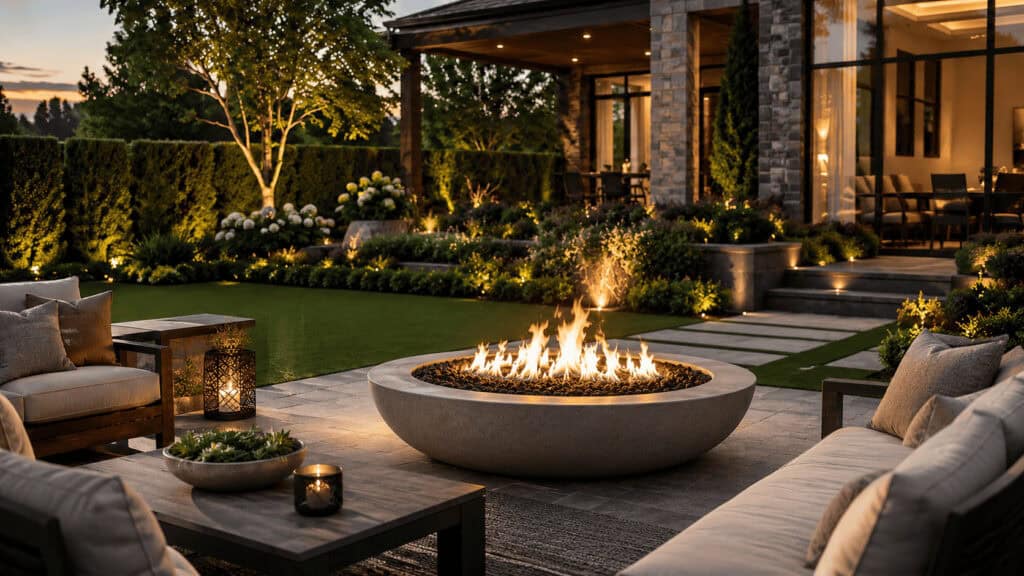
An outdoor fireplace is the improvement that keeps the backyard in use past the point where every other feature has gone dormant for the year. The patio, the kitchen, the pool — all of them stop earning their keep once the evening turns cool. A fire does not. It draws people outside on the nights they would otherwise have gone in, and it holds the center of a gathering the way nothing else in the yard can. It is also the most heavily code-governed structure most homeowners will ever add to their property, and the single decision that shapes almost everything downstream — cost, siting, maintenance, permitting, and how the finished feature actually performs — is the one buyers most often skip: which fuel it burns.
This guide covers the decisions that produce a fireplace worth the investment. It works through the three fuel paths and why the choice comes before anything else, the difference between a site-built masonry fireplace and a factory-built listed appliance, what the firebox and chimney are made of and why the specification matters, how the fireplace integrates with the rest of the outdoor living space, what combustion safety and the trade connections mean for permitting and timeline, how to think about cost without fixating on the wrong number, what maintenance each fuel type demands, and how the climates across the markets Backyard Paradiso serves shape the design. Whether the goal is a wood fire under an open sky or a gas flame at the turn of a valve, the information here supports a decision built to hold up across the decades a fireplace is meant to last.
The three fuel paths — and why the choice comes first
Most homeowners approach the fireplace as an aesthetic question first: stone, scale, placement. The consequential decision sits upstream of all of that — whether the fireplace burns wood, gas, or alcohol. These are not three finishes on one product. Each path engages a separate set of safety standards, a separate venting reality, a separate maintenance burden, and a separate installation scope. There is no single “fire code” that governs all three; regulatory authority is distributed across three distinct code paths, and treating them as one is the fastest way to a compliance gap. Choosing among them before anything else is what keeps the rest of the project coherent.
Wood-burning: the traditional fire
A wood fire delivers the highest peak radiant heat of the three, along with the flame, the sound, and the presence that no other fuel reproduces. It is also the most demanding path. Wood-burning fireplaces require a full solid-fuel flue — either a clay-lined masonry chimney or a listed Class A chimney — because exhaust temperatures are high and combustion produces creosote. The path is governed nationally by NFPA 211 (the consensus standard for chimneys, fireplaces, and solid-fuel appliances) and by IRC 2021 Chapter 10. Because the chimney has to be routed and draft has to be established, wood is the most site-specific fuel path — placement follows the flue, not the other way around. It also carries the highest maintenance load and is subject to local wood-burning and air-quality rules that can restrict when it may be used.
Gas: natural gas or propane
A gas fireplace trades peak intensity for control. Output is adjustable at the valve, ignition is instant, and there is no ash and no creosote — which collapses the maintenance burden relative to wood. The appliance itself is a listed outdoor decorative gas appliance under ANSI Z21.97/CSA 2.41, and it requires a fuel supply: a natural-gas line run from the home’s service, or a liquefied-petroleum (propane) container whose placement distances are set by code and the local authority having jurisdiction. The fuel supply is governed by the National Fuel Gas Code (NFPA 54), with NFPA 58 layering in for propane. Most outdoor gas fireplaces are unvented for open-air use — the open sky provides the dilution that makes that safe, which is also why a gas unit cannot simply be moved into an enclosed or screened space.
Decorative alcohol and ethanol
Unvented alcohol-fuel decorative appliances, governed by UL/ULC 1370, need no chimney, no gas line, and no piping — making this the most siting-flexible path and the lowest-maintenance one. The trade-offs are real: it produces the lowest absolute heat output of the three (its classification is decorative-primary), carries a higher per-hour fuel cost over extended use, and demands a refueling discipline. The dominant documented hazard is refueling while hot, which the listing standard specifically addresses with cool-down requirements. Even ethanol’s relatively clean combustion produces carbon monoxide and depletes oxygen, so the appliance must still meet minimum air-exchange requirements — it is not a license to enclose a flame.
Choosing among the three comes down to a short list of variables: whether a gas utility is available at the site, how much heat and how many annual use-hours are wanted, how constrained the siting is, and how much maintenance the owner is willing to take on. Everything later in this guide — construction type, clearances, cost, upkeep — flows from this decision.
Masonry versus factory-built: two ways to build a wood fire
Within the wood-burning path, there are two construction types that carry completely separate compliance obligations and should never be conflated. One is a site-built masonry structure governed by prescriptive dimensions in the building code; the other is a manufactured appliance governed by its own product listing. The distinction is not cosmetic — it determines what rules apply, what the clearances are, how long the fireplace lasts, and how quickly it goes in.
Site-built masonry
A masonry fireplace is constructed on site from brick, stone, or equivalent noncombustible masonry, and it is governed by the prescriptive dimensional requirements of IRC 2021 R1001. Those requirements are specific and universal within adopting jurisdictions: footings not less than 12 inches thick, extending at least 6 inches beyond each face and bearing below frost depth; a firebox depth of at least 20 inches; a hearth slab at least 4 inches thick with a hearth extension at least 2 inches thick; clearance to combustibles of at least 2 inches at the front and sides and 4 inches behind; and hearth extensions of 16 inches in front and 8 inches to each side for openings under 6 square feet (20 inches and 12 inches for larger openings). The firebox lining is refractory firebrick specified under ASTM C1261, set in refractory mortar, behind a clay flue liner meeting ASTM C315 and installed per ASTM C1283. In higher seismic design categories, R1001.3 requires the chimney to be reinforced. Built correctly, a masonry fireplace can serve multiple generations, and its implied permanence is the construction type appraisers most readily associate with higher comparables.
Factory-built (listed)
A factory-built fireplace is a manufactured appliance that must be listed and labeled to ANSI/UL 127 and installed strictly per that listing and the manufacturer’s instructions, as IRC 2021 R1004 requires. The critical regulatory point: the masonry prescriptive rules of R1001 do not apply to a factory-built unit — the listing governs clearances, hearth dimensions, and chimney selection. The firebox is high-temperature stainless steel (Type 304 for general use, Type 316 where coastal salt air is a factor), and the chimney is a matched, listed Class A all-fuel system under UL 103. Factory-built units install faster than masonry, come with verified performance data, and typically reach a service life of fifteen to twenty-five years with correct installation and maintenance.
Why "how far from the house?" has no single answer
The two construction types diverge most visibly on clearances. For masonry, the code supplies the numbers — 2 inches to the front and sides, 4 inches behind, per R1001.11. For a factory-built appliance, there is no universal number: the listing establishes model-specific clearances, and they vary by design. This is why a clearance question can only be answered once the fuel path and the specific product are settled. It is also why a general remodeling crew, working from a rule of thumb rather than a listing, is exactly the wrong party to set a fireplace’s position relative to a wall, a pergola post, or a deck rail.
Design, siting, and integration with the outdoor living space
A fireplace is rarely a standalone object. It anchors a defined outdoor room — a hearth, a seating perimeter, a shoulder-season footprint — and the best installations are planned as part of that larger environment rather than dropped into it. Siting decisions are driven first by safety clearances, then by how the fireplace relates to the structures and surfaces around it.
Hearth, ember protection, and spark travel
For masonry fireplaces, hearth extensions are prescriptive — 16 inches in front and 8 inches to each side for openings under 6 square feet, larger for larger openings — and they exist to keep embers off combustible surfaces. Wood-burning fireplaces require a spark screen or listed glass front, and NFPA 211 inspections verify that spark-arrest devices are present and sound. Factory-built units handle the same concerns through their listing. Every siting decision that follows has to respect the ember and spark-travel envelope of the specific fireplace, which is a function of fuel type and, for listed units, the product itself.
Integration with an aluminum pergola or covered structure
A fire beneath an overhead structure is one of the most requested configurations and one of the most exacting. The chimney termination and combustion gases must clear the structure by the distances the appliance listing or NFPA 211 requires, and within the spark-travel radius the authority having jurisdiction may require the overhead members to be non-combustible or ignition-resistant. This is where an aluminum pergola holds a genuine material advantage: aluminum framing is non-combustible, which simplifies the clearance analysis that combustible timber complicates. Where motorized zip screens enclose the space, the screens must sit outside the spark envelope and must not obstruct the chimney’s draft — a coordination question that belongs in the design phase, not the field.
Integration with an outdoor kitchen
A fireplace and an outdoor kitchen can share a single hardscape, but the shared substrate has to carry the combined dead loads, and if both run on gas the supply must be engineered as one fuel-gas system under NFPA 54 with adequate pressure for simultaneous demand. All clearances from the fireplace to combustible kitchen surfaces still govern, whether set by the masonry code or the appliance listing. Planned together, the two features frame a complete entertaining zone; planned separately, they tend to collide over gas capacity and clearance.
Decks, patios, and surfaces
Masonry fireplace mass requires its own footing and cannot simply sit on a composite deck without structural provision; where a deck adjoins the fireplace, the framing has to stay clear of the firebox and chimney chase, and ledger connections into a masonry surround call for structural review beyond standard assumptions. At grade, the fireplace typically sits on a paver or concrete surround that defines the hearth zone and coordinates with the broader patio. Routing gas, electrical, and structural provisions belongs in the surface build, not after it.
Landscape lighting integration
Landscape lighting integrated at the fireplace surround follows NEC Article 411 for low-voltage systems and Section 210.8 for GFCI protection on outdoor circuits. Fixtures must be wet- or damp-location rated and positioned so radiant heat does not exceed their listed thermal rating, and any control unit near the combustion zone has to be evaluated for heat interference. Done well, lighting turns the fireplace into the anchor of a usable nighttime environment rather than an object that disappears after dark.
Combustion safety and the connections that make a fireplace permanent
A portable fire pit is a purchase. A permanently installed fireplace is a code-governed structure that — depending on the fuel — can involve licensed gas work, licensed electrical work, structural footing design, and a chimney or venting system, wrapped in a layer of combustion safety no other outdoor feature carries. Understanding that scope before construction is what prevents the surprises that derail budget and timeline.
The fuel-gas connection
A gas fireplace almost always requires a dedicated gas supply run from the home’s service — licensed gas-fitter or plumber work in every jurisdiction, not a general-contractor or DIY scope. The supply is governed by NFPA 54 for natural gas and NFPA 58 for propane, and correct execution means proper pipe material and sizing, a sediment trap, a pressure test, and inspection. Propane container placement distances are jurisdiction-variable and must be confirmed with the local authority rather than assumed.
Electrical: ignition, blowers, and lighting
Electronic ignition modules, blowers, and any decorative or landscape lighting on the fireplace circuit require GFCI protection under NEC Section 210.8 for outdoor residential branch circuits. Low-voltage lighting follows Article 411, and if the fireplace sits near a pool or spa, Article 680 clearance requirements apply. All wiring uses wet-location-rated cable or weatherproof raceway suited to the exposure.
Structural: footing and chimney
A masonry fireplace’s footing must bear below frost depth per R1001.2, and a tall masonry chimney is a wind-exposed vertical cantilever whose design pressure is calculated under ASCE/SEI 7-22 (Chapters 26 through 30). Estate-scale chimneys rising more than roughly 15 feet above grade warrant review by an engineer of record to confirm lateral stability, and seismic reinforcing is required in the higher seismic design categories. These are engineering determinations, not aesthetic ones.
Venting and carbon monoxide
The venting reality differs by fuel, and it is a safety matter, not a convenience. Wood requires a full solid-fuel flue. Outdoor gas fireplaces are typically unvented because open-air use supplies the dilution that lets the appliance meet its 800-ppm air-free carbon-monoxide limit under ANSI Z21.97/CSA 2.41 — a standard written for outdoor use and inapplicable to enclosed or semi-enclosed siting. Enclose or heavily screen a gas unit and that dilution disappears, creating an accumulation risk that may require CO detection at the AHJ’s discretion. Ethanol appliances are unvented but must still satisfy minimum air-exchange requirements. The through-line: outdoor-rated appliances are rated for the outdoors precisely because the open sky does the diluting, and any structure that changes the airflow changes the safety analysis.
Permits and inspections
A permanently installed outdoor fireplace requires a building permit under IRC 2021 Chapter 10 and IFC 2021 Section 307 in virtually all North American jurisdictions. The permit triggers structural and firebox plan review and AHJ inspections at the footing, liner, and final stages. Skipping it forfeits the code-compliance documentation that establishes a compliant installation and can invalidate fire-loss insurance coverage. Local burn restrictions and air-quality curtailment rules add a jurisdiction-variable layer for wood-burning units, and in governed communities HOA approval precedes the permit application. Backyard Paradiso manages permit coordination and the licensed-trade scheduling that a fireplace installation requires.
How much does an outdoor fireplace cost?
The candid answer is that “the cost of an outdoor fireplace” is not a single number, and fixating on one obscures the decision that actually drives it. Cost follows the fuel path and construction type chosen first, then the chimney or venting scope, the fuel connection, and the veneer. For a permanent estate feature meant to last decades, the more useful question is not what it costs to build but what it returns over its service life.
What actually drives the cost
The largest lever is the fuel path and construction type. A site-built masonry fireplace is the most labor- and material-intensive option, with footing, firebox, chimney, and veneer all built on site. A factory-built listed unit installs faster with more predictable pricing. A gas fireplace adds the cost of a fuel connection; an ethanol appliance eliminates both chimney and gas infrastructure entirely. From there, the chimney or venting scope is the next major variable — a full masonry or Class A chimney is a significant line item, while unvented gas and ethanol have none. The fuel connection (a gas line run from the home’s service, or a propane setup), the veneer and stone selection, and the structural footing for masonry mass round out the drivers.
Resale recovery: the value an appraiser recognizes
Permanently installed outdoor fireplaces appear in appraisal literature as capable of measurable resale recovery, particularly in climates that permit multi-season exterior use. Permit-pulled, AHJ-inspected installations built to IRC 2021 Chapter 10 represent the highest appraisal-defensibility tier, because the documentation substantiates the improvement. This is the resale-recovery dimension of value, grounded in published appraisal literature rather than a manufacturer claim.
Functional square-footage equivalence
A fireplace anchors a defined living zone — hearth, seating perimeter, and shoulder-season footprint — that appraisers may treat as functional-equivalent area. Code-compliant construction under IRC 2021 Chapter 10 and NFPA 211 strengthens the defensibility of that area claim, and the size of the zone activated scales with the radiant output of the fuel and appliance selected.
Time-in-use
Time-in-use analysis divides the total installed investment by the estimated annual productive-use hours, producing a per-hour figure that can be compared against other estate amenities. Because a fireplace extends outdoor use into the shoulder seasons — the cool evenings when a pool or a bare patio sits idle — it raises annual use-hours relative to a warm-weather-only feature, which is exactly the axis on which it outperforms. A continuously serviceable installation, free of forced downtime, maximizes that denominator.
Outdoor fireplace maintenance: what each fuel type demands
Maintenance burden tracks the fuel path directly, and it is worth weighing before the fireplace is built rather than after. Each fuel carries a different annual routine and a different off-season protocol.
Wood-burning: the highest burden
Wood-burning fireplaces require annual creosote and ash removal, flue-liner inspection, and spark-arrestor cleaning under NFPA 211 Chapter 15. Creosote is classified in three stages, and the heavier stages constitute a chimney-fire hazard that must be cleared before further use; burning dry, seasoned cordwood below 20% moisture — as the EPA BurnWise program recommends — is the primary way to hold creosote down. Refractory mortar joints showing cracks should be repaired before the next burn season, and crown and cap repointing prevents the moisture infiltration that accelerates freeze-thaw spalling. Annual professional inspection is the baseline for a unit in regular seasonal use.
Gas: moderate, and no chimney to sweep
Gas fireplaces require annual burner-port cleaning, ignition testing, and gas-connection verification aligned with NFPA 54 service intervals, plus container condition checks and AHJ-verified placement for propane units under NFPA 58. Decorative ceramic logs should be inspected yearly for fractures that skew flame distribution. There is no chimney to sweep and no creosote to manage.
Ethanol: the lowest burden
Ethanol appliances need only the fuel reservoir emptied and the burner pan wiped free of residue before each refueling, with cool-down verified first — the CPSC identifies refueling while hot as the dominant failure mode, and the listing standard mandates a cool-down step. There is no venting system to maintain.
Seasonal and off-season protocol
For off-season shutdown, a masonry fireplace should be cleaned, inspected, and covered against moisture; a gas unit should have its manual shut-off closed and its ignition wiring checked; and an ethanol appliance should be fully de-fueled and kept dry to prevent reservoir corrosion. In northern markets, snow and ice must be cleared from chimney caps before use, and cold-weather gas start-up should follow the manufacturer’s listed procedure, since condensation can affect ignition.
How climate and the length of the outdoor season shape fireplace design across the markets served
The fireplace conversation changes from market to market — not because the products differ, but because the length of the outdoor season, the local climate’s effect on masonry and metal, and the behavior of draft all shift with geography. The design responds to how much of the year the fire is doing work and to what the environment does to the assembly.
Year-round and coastal markets
In Naples and Orlando, the fireplace extends the mild winter evenings that are the peak of the outdoor season, and it is often specified under an aluminum pergola or pavilion for shade and rain protection. Naples installations carry the highest metal specification: salt air proximity drives 316L stainless steel for every salt-exposed metallic component, from factory-built fireboxes to fasteners and chimney caps. Humidity and intense UV also govern veneer selection and coating durability. Where wood-burning is chosen, local air-quality rules are a jurisdiction-variable layer to confirm before finalizing the fuel path.
Altitude, wind, and freeze-thaw
In Colorado Springs and Denver, the fireplace is frequently the feature that makes the shoulder seasons genuinely usable, and coverage from an aluminum pergola extends that window further. Freeze-thaw cycling on the masonry crown and mortar joints is the single fastest accelerant of premature masonry failure, which puts a premium on correct crownwork and repointing discipline. UV intensity at altitude is the highest among the markets served, and tall masonry chimneys must be evaluated as wind-exposed cantilevers under ASCE/SEI 7-22, with footings placed below frost depth.
Heat-driven markets
In San Antonio, the fireplace reads as an evening-comfort feature — the amenity that pulls a gathering back outside once the heat of the day breaks. Caliche and expansive soils affect footing design for any masonry mass, the same consideration that governs every below-grade installation in the market, and the AHJ retains authority to restrict outdoor burning during high-wind or elevated fire-danger conditions.
Snow-load and deep-frost markets
Romeoville concentrates fireplace use into a shorter Illinois season, which raises the value of a covered installation that widens the usable window. The deep frost line drives footing depth for masonry construction, freeze-thaw discipline on the crown and joints is essential, and chimney caps must be cleared of snow and ice before use. Factory-built units and gas fuel paths often suit the market where chimney routing on a smaller lot is constrained.
Compact urban markets
In Secaucus and the surrounding Hudson County lots, footprint is the governing constraint. Factory-built units and ethanol appliances offer the siting flexibility that a small property rewards, gas suits sites where a full masonry chimney is impractical, and equipment access and material delivery in dense-lot conditions need planning at the design stage — the same logistics that shape deck, fence, and paver work in the area.
Frequently asked questions about outdoor fireplace installation
Do I need a permit for an outdoor fireplace?
In virtually all North American jurisdictions, yes. A permanently installed outdoor fireplace requires a building permit under IRC 2021 Chapter 10 and IFC 2021 Section 307, triggering plan review and inspections at the footing, liner, and final stages. Skipping the permit forfeits code-compliance documentation and can invalidate fire-loss insurance. In governed communities, HOA approval precedes the permit application.
What is the difference between wood, gas, and ethanol outdoor fireplaces?
They differ in venting, heat, maintenance, and siting. Wood requires a full solid-fuel chimney under NFPA 211, delivers the highest radiant heat, and carries the most maintenance. Gas fireplaces listed to ANSI Z21.97/CSA 2.41 offer controllable output and low upkeep but need a fuel supply. Ethanol units need no venting or piping and are the most siting-flexible, but produce the least heat.
How far does an outdoor fireplace need to be from the house or other combustibles?
It depends on the construction type. Masonry fireplaces follow IRC 2021 R1001.11 — at least 2 inches from combustibles at the front and sides, 4 inches behind. Factory-built units have no universal figure; the clearances are set by the appliance’s UL 127 listing and vary by model. There is no single number that applies to every fireplace, which is why the fuel path and product must be settled first.
Can I build a pergola or overhead structure over an outdoor fireplace?
Yes, with clearance planning. The chimney termination and combustion gases must clear the structure by the distances the appliance listing or NFPA 211 requires, and within the spark-travel radius the AHJ may require non-combustible or ignition-resistant overhead materials. An aluminum pergola is a natural fit here because aluminum framing is non-combustible, simplifying the clearance analysis that timber complicates.
How long does an outdoor fireplace last?
A masonry fireplace built to IRC 2021 R1001 footing, firebox, and hearth specifications can serve multiple generations with continuous maintenance. A factory-built unit listed to ANSI/UL 127 typically achieves fifteen to twenty-five years depending on installation quality and upkeep. Gas fireplaces are engineered for seasonal use, with longevity tied to moisture exclusion and annual inspection of the gas connections.
Is it safe to use a gas outdoor fireplace in a covered or screened area?
Only with care. Outdoor gas fireplaces listed to ANSI Z21.97/CSA 2.41 are tested to an 800-ppm air-free carbon-monoxide limit that relies on open-air dilution. Enclosing or heavily screening the appliance removes that dilution and creates an accumulation risk, and the standard does not apply to enclosed siting. A covered outdoor structure may require carbon-monoxide detection at the AHJ’s discretion.
What maintenance does an outdoor fireplace require?
It varies by fuel. Wood-burning units carry the highest burden — annual sweeping, creosote removal, and flue-liner inspection under NFPA 211 Chapter 15. Gas units require annual burner-port cleaning, ignition testing, and gas-connection checks under NFPA 54, with no chimney to sweep. Ethanol appliances need only reservoir cleaning and burner-pan inspection, making them the lowest-maintenance path.
Service areas
Backyard Paradiso designs and installs outdoor fireplaces across the markets it serves, matching fuel path, construction type, and material specification to each market’s climate, soil, and code environment. The full list is on Markets We Serve.
The fire is where the evening stays outside
A well-built outdoor fireplace holds a gathering together on the nights everyone else has gone in, and it does the work only after the fuel path, the clearances, the venting, and the footing have all been reconciled correctly. That reconciliation is an engineering task, not an aesthetic one. Backyard Paradiso reviews the site, weighs the fuel-path decision against the property and how it will be used, and produces a complete design and quote. Consultations are by appointment.