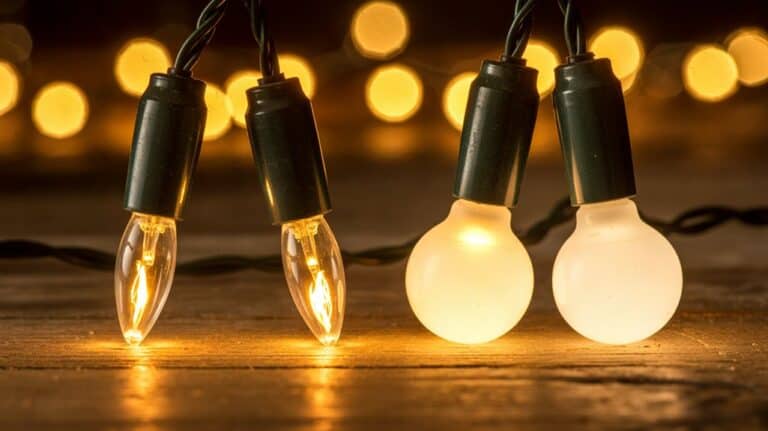
How Do Incandescent and LED Christmas Lights Compare?

Incandescent and LED Christmas Lights Compared
Both incandescent and LED Christmas lights are legitimate choices for residential roofline installations, with the best selection depending on circuit capacity, desired light quality, and service-life expectations. LED product reduces branch-circuit load markedly, requires compatible dimmers and controls, and demands careful connector sealing due to moisture-sensitive driver electronics. Christmas lights are externally mounted lamp strings used to illuminate building exteriors and landscaping during the holiday period.
Power, Heat and the Circuit
The choice between incandescent and LED Christmas lights carries immediate consequences for how a property’s electrical infrastructure is loaded and how heat behaves at every lamp on the roofline. An incandescent lamp converts most of its input to heat rather than light, and across several hundred lamps that thermal and electrical burden determines whether a single exterior receptacle’s branch circuit, governed under NEC Article 210 and Article 220, can carry the full run or whether additional circuits are required. LED lamps, drawing a fraction of the equivalent power and running cool at the lens, reduce both variables simultaneously – though the cooler operating temperature also means they lack the incidental frost-clearing effect that incandescent heat provides at each lamp housing.
Why LED changes how many lights a receptacle can carry
NEC Article 220 governs branch-circuit load calculations, and the gap in power draw between incandescent and LED Christmas lights is wide enough to change how many runs a single exterior receptacle can support. Incandescent lamps convert the majority of their input to heat rather than light, compounding both the electrical load and the thermal hazard near dry greenery or polymer clips. LED strings producing comparable visual output draw a small fraction of that power, which allows a greater number of runs per circuit before the branch-circuit limits established under NEC Article 210 are reached. On a roofline strung with several hundred lamps, that difference can determine whether the installation proceeds on existing circuits or requires additional wiring.
Heat at the lamp and what it touches
The Consumer Product Safety Commission’s hazard criteria for seasonal lighting, codified at 16 CFR 1120.3, address wire sizing, strain relief, and overcurrent protection precisely because heat at the lamp source creates measurable risk when Christmas lights contact dry greenery, fabric, or polymer mounting clips. Incandescent lamps convert the majority of their electrical input to heat rather than light, making contact with combustible materials a persistent installation concern. LED lamps run cool at the lens itself, substantially reducing that contact hazard, though the rectifier electronics embedded in LED strings introduce a different vulnerability: moisture sensitivity at the connector points. Proper connector sealing on LED product is hence not incidental but a code-adjacent requirement that follows directly from the technology’s construction.
How the Light Looks
Incandescent lamps produce a continuous warm spectrum that reads as the traditional roofline glow most owners recognize; LED lamps, by contrast, ship across a wide range of correlated color temperatures, and a selection above 3000 K is what produces the blue or clinical appearance that often draws complaints. Warm-white LED product specified at 2200 to 2700 K under ANSI C78.377-2017 closes that perceptual gap. Where adjacent runs do not match, the cause is almost always mixed tolerance bins – the MacAdam-ellipse bins governing allowable color deviation – or mixed technologies sharing the same roofline.
Color temperature bins and the incandescent match
ANSI C78.377-2017 defines correlated color temperature bins for LED light sources, with warm-white designations at 2200 K and 2700 K representing the closest spectral match to the continuous warm output of an incandescent filament. Complaints that LED holiday lights appear blue or clinical trace reliably to selections at 4100 K or above, which fall outside the warm-white range entirely. A separate but equally common complaint – that two runs of lights appear mismatched even when both are labeled warm white – results from mixing tolerance bins or combining LED and incandescent sources on the same roofline. Photometric claims on LED product packaging are verifiable only through ANSI/IES LM-79 test reports; specifying a single correlated color temperature and a consistent MacAdam-ellipse tolerance bin across the full installation eliminates both failure modes.
Why mixed runs read as mismatched
ANSI C78.377-2017 defines MacAdam-ellipse tolerance bins that govern how closely two LED light sources must match before the human eye perceives a difference. Even two strings both labeled 2700 K warm white can fall at opposite edges of a tolerance bin, producing a visible color shift when the runs meet at a ridge or corner. The problem compounds when LED and incandescent sources share the same roofline, because incandescent output is a continuous warm spectrum while LED output is a discrete approximation, and no tolerance bin eliminates that underlying spectral difference. Specifying a single correlated color temperature and a single MacAdam-ellipse bin across every run on the property is the only installation practice that eliminates both sources of mismatch.
| Attribute | Incandescent | LED |
|---|---|---|
| Power draw per lamp | High; mostly heat | Low; small fraction of incandescent |
| Heat at the lamp | Hot to the touch | Cool at the lens |
| Color | Continuous warm spectrum | Nominal CCT per ANSI C78.377; 2200 to 2700 K matches warm glow |
| Failure pattern | Filament fails outright; series shunts can darken a section | Gradual dimming (LM-80 / TM-21); driver or rectifier fails first |
| Moisture sensitivity | Socket and cord only | Socket, cord and rectifier electronics |
| Dimming and controls | Any dimmer | Compatible controls required |
| Retrofit | Original lamp type for screw-base cord | Retrofit lamps fit C7 and C9 sockets |
| Circuit planning | Fewer lamps per receptacle | Many more lamps per receptacle |
How Each One Fails and Converts
Incandescent mini-strings fail through a series circuit: when a lamp’s shunt stops conducting, the section goes dark rather than the lamp alone, and locating the fault means testing lamp by lamp. LED strings carry rectifier electronics at each connector that are moisture-sensitive, so inadequate sealing accelerates driver failure well before the diodes themselves degrade – and a failing driver often announces itself through visible flicker rather than a clean outage, a symptom that points to the driver rather than the diodes. Where an owner wants to convert an existing incandescent socket cord, screw-base C7 and C9 sockets accept LED retrofit lamps without rewiring, preserving the cord’s listing and spacing while reducing the branch-circuit load substantially.
Series shunts, drivers, moisture and flicker
Flicker in an LED string is a symptom of LED driver malfunction, distinguishing it from the outright filament failure that ends an incandescent lamp’s service life. In a series-wired incandescent mini string, a failed shunt – the bypass element seated inside each lamp base – darkens the entire section rather than extinguishing a single point; the string otherwise continues to function until shunt failures accumulate. LED strings carry rectifier electronics at the plug or inline, and those driver components are more vulnerable to moisture intrusion than the diode itself, making connector sealing a more consequential installation detail than it is with incandescent product. Where LED strings specify a maximum daisy-chain count, exceeding that figure stresses the driver and accelerates that failure mode.
Retrofit lamps in existing socket cord
Screw-base C7 and C9 socket cords accept LED retrofit lamps without modification to the cord’s listing, spacing, or attachment hardware, allowing an existing incandescent installation to convert to LED technology by lamp substitution alone. The cord’s listed configuration remains unchanged under this approach, and the branch-circuit load drops substantially because LED lamps of comparable visual output draw a fraction of the wattage of their incandescent counterparts – a difference that affects how many cord runs a single exterior circuit can serve under NEC Article 220 load calculations. Connector sealing and daisy-chain limits specified for the LED retrofit product still apply; those constraints follow the lamp, not the cord.
Frequently Asked Questions
Four questions resurface consistently in professional residential installations: whether LED holiday lights are categorically better, why LED strings sometimes read as blue rather than warm, whether existing incandescent socket cords can accept LED retrofit lamps, and whether LED lamps run hot enough to warrant the same clearance precautions as incandescent. Each question has a conditional answer that depends on specific product specifications, circuit conditions, or installation variables rather than a single universal rule. The answers that follow draw on the same standards framework governing the broader incandescent-versus-LED decision.
Are LED Christmas lights better than incandescent?
LED Christmas lights outperform incandescent in three measurable categories: circuit load, heat output, and service life. The advantage depends on selecting 2200 K to 2700 K correlated color temperature to replicate the traditional incandescent glow. Where existing circuits can carry the load, incandescent remains a legitimate choice.
Why do LED Christmas lights look blue?
Color temperature selection, not the LED technology itself, produces the blue appearance; product rated at 4100 K or higher reads as cool or clinical against a home’s exterior. ANSI C78.377-2017 establishes warm-white classifications at 2200 K to 2700 K as the range that replicates incandescent character. Specifying product within that range eliminates the complaint.
Can incandescent Christmas lights be replaced with LED bulbs?
Screw-base C7 and C9 socket cords accept LED retrofit lamps directly, allowing an existing incandescent string to convert without rewiring. The cord’s listing, spacing, and connector sealing requirements remain unchanged, while the branch-circuit load drops substantially. Load recalculation under NEC Article 220 should confirm the revised circuit capacity.
Do LED Christmas lights get hot?
LED Christmas lights run cool at the lens, distinguishing them sharply from incandescent lamps, which convert most input energy to heat. Heat at the lamp remains a consideration with incandescent strings placed near dry greenery, fabric, or polymer clips. The Consumer Product Safety Commission’s hazard criteria under 16 CFR 1120.3 address this risk for both technologies.
LED and Incandescent Christmas Lighting by Backyard Paradiso
Residential Christmas light installations must account for branch-circuit load calculations under NEC Article 210 and 220, GFCI protection requirements for exterior receptacles, connector-sealing demands that increase with precipitation exposure, and wind-load conditions addressed under ASCE 7 that govern how attachment hardware is selected. Backyard Paradiso works within these constraints routinely, applying familiarity with exterior circuit capacity, LED polarity and daisy-chain limits, and color temperature specification to Christmas light installations where technical decisions have lasting consequences for safety and appearance. Consultations are available by appointment for residential properties. Load calculations, non-penetrating attachment, and matched 2200 to 2700 K product across the full roofline are the three specifications that separate a professionally planned display from one assembled string by string.