What Base Material or Gravel Is Best for Turf?
Open-Graded Crushed Stone Is the Right Base for Artificial Turf
Open-graded crushed stone, ASTM D448 No. 57, is the correct base material for artificial turf installations. Performance depends on proper compaction to 95 percent of maximum dry density per ASTM D1557, with layer depth adjusted for intended use and subgrade conditions. Open-graded crushed stone is angular aggregate sized to maintain structural interlock while transmitting water vertically through its void structure.
Why Crushed Stone and Not Gravel, Sand or Road Base
Angular crushed stone holds a base together in ways that rounded aggregate simply can’t. Pea gravel and sand lack the interlocking particle geometry that resists lateral displacement under load, so they migrate rather than consolidate, leaving the turf surface unstable over time, for the same reasons turf cannot go directly over dirt. Open-graded crushed stone, by contrast, maintains continuous void space that transmits water vertically at rates a dense-graded road base—laden with fines that slow drainage and infiltrate backing perforations—can’t reliably sustain.
Angular interlock versus rounded aggregate
Rounded aggregate, including pea gravel and washed sand, lacks the angular face-to-face contact that generates particle interlock under compaction load, making it structurally unsuitable as a base for artificial turf. Angular crushed stone, by contrast, develops mechanical interlock as particles seat against one another during compaction, resisting lateral displacement under foot traffic and infill load. Dense-graded road base materials introduce a high fines content that impedes vertical drainage, allowing water to pond within the profile rather than transmitting it at the 30 to 50 inches per hour drainage rates measured per ASTM F2898 in properly built systems. Decomposed granite shares the fines liability and is acceptable only as a thin leveling course placed over structural crushed stone, never as the load-bearing base layer itself.
Open gradation, drainage and fines migration
Open-graded crushed stone, specified as ASTM D448 No. 57, transmits water at drainage rates of 30 to 50 inches per hour when measured per ASTM F2898, a threshold that dense-graded road base and sand cannot consistently meet. Road base materials carry a high fines content that restricts vertical water movement, allowing saturation to develop within the profile and fines to migrate upward into the perforations of the turf backing over time. Sand lacks the structural voids that make open gradation effective, and its loosely confined particles shift laterally under repeated load. No. 57 stone preserves interconnected void space through its angular, single-size gradation, keeping the drainage path open while the particle interlock established during compaction resists displacement at the surface plane.
The Base Layers From Subgrade to Turf
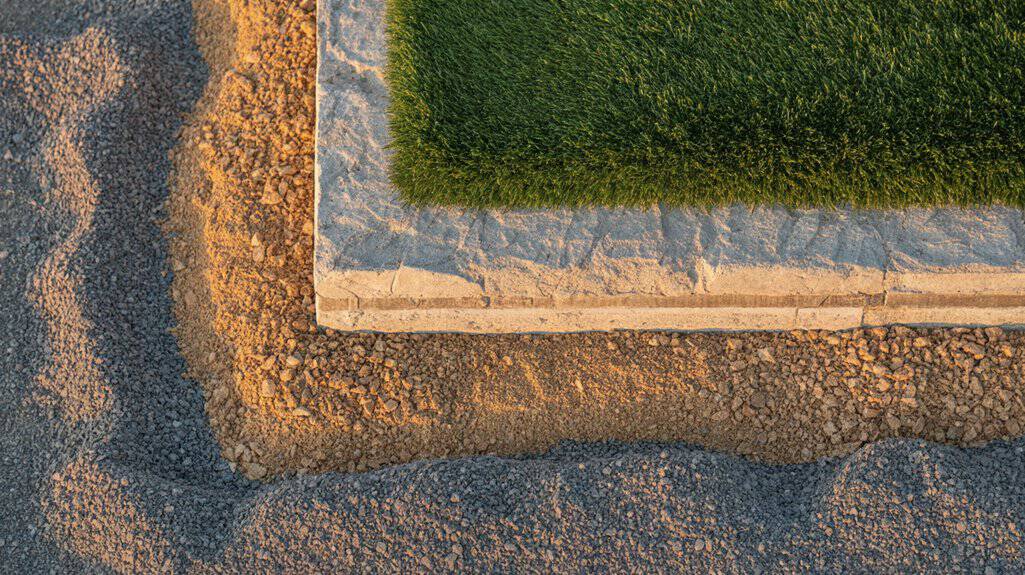
Every well-performing artificial turf installation begins at the subgrade, which must be stripped, proof-rolled, and graded to a cross-slope between one and two percent to direct water away from adjacent structures. A nonwoven geotextile meeting AASHTO M288 Class 2 requirements then separates the native soil from the structural stone layer above it, preventing fines migration while maintaining the permittivity the drainage system depends on. The structural stone itself — ASTM D448 No. 57 crushed aggregate — runs three to four inches deep under standard lawn installations and six to eight inches where pet traffic, play areas, or putting surfaces impose greater demand, with a fine leveling course of No. 8 or No. 89 aggregate placed on top and the entire assembly compacted to ninety-five percent of maximum dry density per ASTM D1557, verified by density testing rather than pass counts.
Subgrade preparation, slope and geotextile separation
IRC 2021 Section R401.3 requires finish grade to slope away from a foundation a minimum of six inches within the first ten feet, a drainage standard that governs subgrade preparation wherever artificial turf is installed adjacent to a residential structure. Proof-rolling the stripped subgrade before any aggregate is placed exposes soft or yielding zones that would allow differential settlement beneath the finished surface. A nonwoven geotextile meeting AASHTO M288 Class 2 is then placed directly on the prepared subgrade, selected for apparent opening size per ASTM D4751 and permittivity per ASTM D4491 to match the native soil; woven slit-film fabrics are not permitted in this separation role. The geotextile prevents fines migration upward into the aggregate base while allowing vertical water transmission to continue unobstructed.
Structural stone depth, leveling course and compaction targets
Standard residential practice, consistent with the Synthetic Turf Council’s base-system guidelines, places a structural layer of ASTM D448 No. 57 open-graded crushed stone at a depth of three to four inches for lawn installations and six to eight inches for pet runs, play areas, and putting greens; the exact depth is a site decision. Angular crushed particles interlock under compaction and resist lateral displacement in a way that rounded aggregates cannot, making gradation and particle shape functional requirements rather than preferences. A finer crushed aggregate, No. 8 or No. 89, is then placed over the structural stone as a leveling course, closing the surface sufficiently to support the turf backing without blocking vertical drainage. Compaction of each lift is verified against 95 percent of maximum dry density per ASTM D1557, with field density confirmed per ASTM D2922; pass counts alone are not an accepted substitute for density testing.
When the Standard Base Changes
The standard crushed-stone base holds for most residential installations, but certain conditions disqualify it as sufficient on its own. Pet runs and play areas demand a deeper structural layer because concentrated load cycles and drainage volume exceed what a lawn-depth section can sustain without settlement, while play areas carrying fall-height requirements introduce a shock pad between the backing and base to meet ASTM F1292 performance thresholds. Rooftop and over-slab installations shift the structural question entirely—concrete carries the load, drainage mat or pedestal systems replace the stone section, and cement-treated bases enter where heavy use or confined geometry makes an unbound aggregate layer impractical.
Pet runs, play areas and putting greens
Pet runs, play areas, and putting greens require a No. 57 crushed stone base layer of 6 to 8 inches, compared with the 3 to 4 inches adequate for standard residential lawn installations. The increased depth addresses the compounding demands of concentrated animal traffic, repetitive impact loading from play, and the precision surface tolerance that a functional putting green requires. Play areas carry an additional structural obligation: where fall-height performance is a design criterion, a shock pad installed between the turf backing and the compacted stone surface must meet the impact attenuation thresholds established under ASTM F1292. Without the deeper base and, where applicable, the shock pad, the system lacks the structural reserve to maintain grade and performance across the service life of the installation.
Cement-treated bases, shock pads and installations over concrete
Rooftop and heavy-use installations may call for a cement-treated base engineered on ACI 230.1R principles, where a slab carries structural load and drainage channels must be designed into the system rather than achieved through aggregate void space. In this configuration, the base material question shifts: concrete provides the structural plane, and the design obligation moves to managing water movement across and off the surface. A drainage mat or pedestal system placed over the slab replaces the open-graded stone column, transmitting surface runoff laterally to designed outlets. Where a shock pad is incorporated in these assemblies, it must still satisfy the impact attenuation thresholds established under ASTM F1292 for any installation where fall-height performance is a governing criterion.
Frequently Asked Questions
Several questions about artificial turf base materials resurface consistently across residential installations, and they tend to cluster around the same misunderstandings. Angular crushed stone graded to ASTM D448 No. 57 is the correct structural layer; decomposed granite, road base, and rounded gravels each fail on at least one critical performance criterion, whether structural interlock, drainage rate, or fines migration. Base depth isn’t a fixed value—it scales with use intensity, running shallower under ornamental lawns and considerably deeper beneath pet runs and play areas where load demand and drainage volume are higher.
What kind of gravel goes under artificial turf?
Open-graded angular crushed stone, ASTM D448 No. 57, is the correct gravel for beneath artificial turf. A finer No. 8 or No. 89 crushed aggregate leveling course is placed on top to produce a smooth, closeable surface. Rounded pea gravel and sand lack the particle interlocking required for structural stability and must not substitute for crushed stone.
Can decomposed granite be used as a turf base?
Decomposed granite is not an acceptable base material for artificial turf. It may serve as a thin leveling course placed over structural crushed stone, but it lacks the load-bearing capacity and interlock required of a base layer. Used alone, it will shift, compact unevenly, and compromise long-term drainage performance.
How deep should the base be under artificial grass?
Standard residential lawn installations require three to four inches of compacted No. 57 crushed stone base, while pet runs, play areas, and putting greens require six to eight inches. Subgrade conditions and anticipated load determine where within those ranges a given installation falls. Compaction of each lift is verified by density testing against ASTM D1557, not by pass count alone.
Is road base good for artificial turf?
Road base is not recommended as a primary base material for artificial turf. Its high fines content compacts well structurally but drains poorly, risking moisture retention and fines migration into turf backing perforations. Open-graded crushed stone, such as ASTM D448 No. 57, is the specified alternative.
Serving Every Market With Artificial Grass Installation
Residential installations generally must reconcile frost-susceptible subgrade soils, variable drainage gradients, and the compaction verification standards established under ASTM D1557 and ASTM D2922 to assure base systems perform across seasonal loading cycles without ice-lens formation or surface displacement. Backyard Paradiso works within these conditions daily, applying the layered base configurations — nonwoven geotextile separation, open-graded No. 57 crushed stone, and fine leveling aggregate — that govern durable artificial turf installations across residential properties. Consultations are available by appointment for homeowners evaluating base depth requirements, drainage rate targets, or shock-pad integration for play areas. The base is the part of the installation no one sees and the part that decides whether the surface stays flat and drains for its full service life.