Can Artificial Turf Go Directly Over Dirt?
Why Synthetic Turf Needs a Prepared Base Instead of Bare Soil
Synthetic turf requires a prepared aggregate base beneath it rather than bare soil to function as a stable, draining residential surface. Soil type, freeze-thaw exposure, and proximity to foundation framing all affect how severely an unprepared subgrade will fail over time. Synthetic turf is a surface layer engineered to perform atop a compacted structural base, not a self-supporting system.
What Happens When Turf Is Laid on Dirt
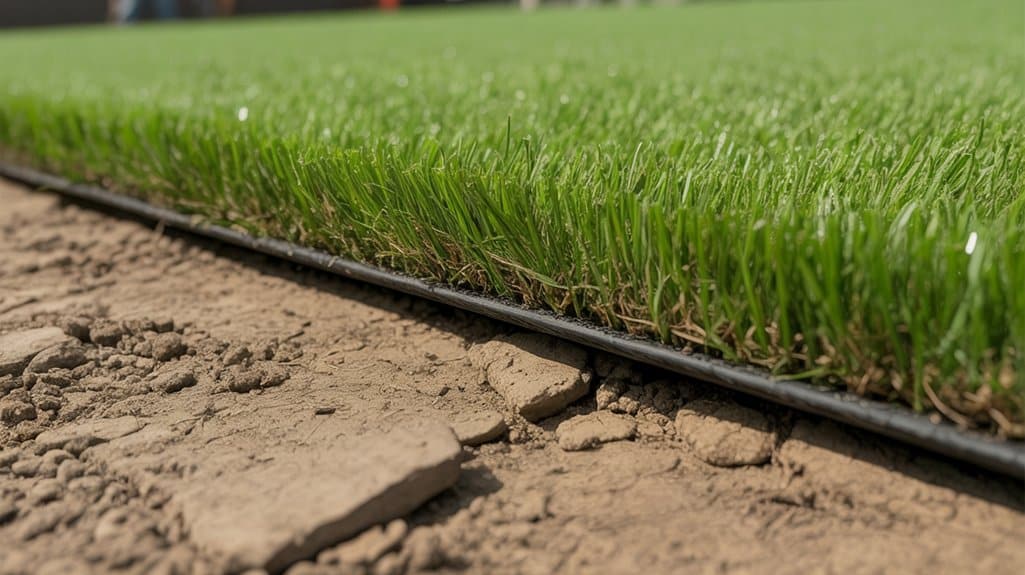
Native soil fails as a turf substrate through several compounding mechanisms, none of which announce themselves immediately. Organic matter in topsoil decomposes and settles unevenly under foot traffic, producing surface dips and waves within the first season, while clay and silt soils drain too slowly to prevent ponding against the backing after rain. Over time, fine soil particles migrate upward through drainage perforations, frost-susceptible subgrades heave and collapse with seasonal cycling, and root intrusion from weeds lifts edges and distorts the field plane in ways that no amount of re-nailing corrects.
Settlement, dips and drainage failure on native soil
Organic matter present in native topsoil decomposes progressively under load, producing the uneven settlement and surface waviness that renders a synthetic turf installation structurally unreliable within a single season. As organic material breaks down, the underlying soil column compresses at different rates across the installation area, creating dips and ridges that the turf backing cannot bridge without distorting. Clay and silt soils compound the problem by draining slowly, allowing water to pond against the backing after rain events and accelerating algae growth, odor accumulation in pet areas, and long-term backing degradation. Fine soil particles smaller than 0.075 mm migrate upward through an unprotected subgrade, clogging the drainage perforations that residential installations depend on to achieve the 30 to 50 inches per hour drainage rate confirmed under ASTM F2898 flood testing.
Fines migration, weeds and frost heave over time
Frost-susceptible silty soils form ice lenses under cyclic freeze-thaw loading that heave synthetic turf installations vertically in winter and leave subsurface voids on thaw, permanently disrupting surface planarity. These ice lenses develop when capillary water migrates upward through fine-grained soils toward the freezing front, a mechanism that repeats with each freeze-thaw cycle and progressively worsens surface deformation over successive winters. Beyond frost damage, fine soil particles smaller than 0.075 mm migrate upward through an unprotected subgrade and clog the drainage perforations in the turf backing, reducing drainage performance below the 30 to 50 inches per hour threshold confirmed under ASTM F2898 flood testing. Weed roots and organic growth pressing against an unsupported backing lift edges and seams, while anchoring nails driven into soft native soil lose lateral resistance and back out as the subgrade shifts beneath them.
What a Properly Built Base Looks Like
A properly built base begins with stripping organic topsoil and proof-rolling the exposed subgrade to identify soft zones that would otherwise settle unevenly under load. The subgrade is then graded to a 1 to 2 percent cross-slope, and where the installation falls within 10 feet of a foundation, IRC 2021 Section R401.3 governs the required fall. A nonwoven geotextile meeting AASHTO M288 Class 2 separates the subgrade from the aggregate layers above, which are compacted to 95 percent of maximum dry density per ASTM D1557 and verified in place per ASTM D2922.
Excavation, proof-rolling and subgrade slope
IRC 2021 Section R401.3 requires finished grade to fall a minimum of 6 inches within the first 10 feet measured away from a residential foundation, a threshold that directly governs how the subgrade beneath adjacent turf installations must be shaped. Before any aggregate is placed, organic topsoil is stripped to a depth of 4 to 6 inches, exposing native subgrade that is then proof-rolled to identify soft or unstable zones requiring removal and replacement. The exposed subgrade is graded to a cross-slope of 1 to 2 percent toward perimeter drainage to assure surface water exits the system rather than accumulating beneath the backing. Each compacted lift must reach 95 percent of maximum dry density as defined by ASTM D1557 Modified Proctor, with in-place density confirmed under ASTM D2922.
Geotextile, aggregate depth and compaction targets
AASHTO M288 Class 2 nonwoven geotextile is placed directly on the compacted subgrade to prevent soil fines from migrating into the aggregate layers above and to keep coarse particles from displacing downward into native soil. Without this separation layer, fine particles smaller than 0.075 mm travel upward through foot-traffic vibration, eventually clogging the drainage perforations punched into the turf backing. Above the geotextile, a 3 to 4 inch layer of open-graded crushed stone conforming to ASTM D448 No. 57 provides both vertical load distribution and primary drainage capacity; pet runs, play areas, and putting greens require 6 to 8 inches of that same material. Each compacted lift must achieve 95 percent of maximum dry density per ASTM D1557 Modified Proctor, with in-place verification conducted under ASTM D2922, and completed systems are confirmed via the ASTM F2898 flood test, which well-built residential installations pass at 30 to 50 inches per hour.
Exceptions and Edge Cases
Sand alone doesn’t qualify as a base, regardless of depth or compaction effort, because it shifts under load, retains moisture against the backing, and migrates upward into the pile over time. Temporary event turf laid loose over existing ground for a short-term occasion operates under an entirely different set of performance expectations and shouldn’t be evaluated by the same structural standards that govern permanent residential installations. Where a concrete slab already exists, the base question changes fundamentally, since the slab provides the structural layer and attention shifts instead to drainage continuity and underlay selection.
Can sand alone serve as a base?
Sand alone does not meet the structural or drainage requirements of a compliant synthetic turf base, because it shifts under load, retains moisture against the backing, and migrates upward into the pile and drainage perforations over time. Industry base practice distinguishes between a leveling course and a structural base; a thin layer of decomposed granite or fine aggregate placed over properly compacted crushed stone qualifies as the former, while sand placed directly on native soil qualifies as neither. ASTM D448 No. 57 open-graded crushed stone, compacted to 95 percent of maximum dry density per ASTM D1557, is the documented structural layer. Sand applied without that foundation beneath it reproduces the same failure modes as bare dirt: uneven settlement, poor drainage, and loss of anchor grip.
Temporary event turf versus a permanent installation
Temporary event turf is a distinct product category, engineered for short-duration, loose-lay deployment rather than the permanent anchoring and load-bearing service that residential base systems are designed to support. Where a permanent installation requires stripping topsoil, compacting crushed stone to 95 percent of maximum dry density per ASTM D1557, and verifying drainage at 30 to 50 inches per hour under ASTM F2898, a temporary surface laid over existing grass for a weekend event operates under entirely different performance expectations and carries no equivalent structural obligation. Conflating the two categories leads to misapplied standards: specifying a temporary product for a permanent residential application, or condemning a permanent installation because a temporary product placed on bare ground performed poorly. Base-system standards apply to permanent installations and do not govern temporary event surfaces.
Frequently Asked Questions
Can artificial grass be laid directly on soil?
Artificial grass should not be laid directly on soil in permanent residential installations. Native soil compacts unevenly, drains poorly, and allows organic matter to decompose beneath the backing, producing surface failure within the first season. A properly engineered aggregate base is required to carry load and drain water reliably.
What goes under artificial turf?
A properly engineered base system goes under artificial turf, consisting of a geotextile separation layer, compacted crushed stone aggregate, and a fine leveling course. The specific depth and material specifications vary by intended use, with pet runs and play areas requiring deeper aggregate than standard residential lawn applications. The Synthetic Turf Council’s base-system guidelines define these layered requirements.
Does artificial turf need a compacted aggregate base or a concrete foundation?
Residential synthetic turf installations require a compacted aggregate base, not a concrete foundation, in nearly all standard applications. Over an existing concrete slab, the base requirement changes, since the slab already provides structural support and drainage becomes the primary concern. Without a proper aggregate base on native soil, uneven settling and drainage failure are predictable outcomes.
How can a homeowner tell whether the base was built properly?
Several observable indicators reveal whether a base was constructed to specification. A properly built system drains at 30 to 50 inches per hour, verifiable through the ASTM F2898 flood test, and the surface should remain flat without visible waves or soft spots after the first season. Compaction records referencing ASTM D1557 and ASTM D2922 provide documentary confirmation.
Artificial Grass Installation by Backyard Paradiso
Residential artificial turf installations require subgrade compaction verified to 95 percent of maximum dry density per ASTM D1557, geotextile separation meeting AASHTO M288 Class 2, finished grading compliant with IRC 2021 Section R401.3, and drainage performance confirmed at 30 to 50 inches per hour under ASTM F2898 flood-test protocols. Backyard Paradiso brings that full engineering sequence to artificial grass installation, addressing each base-system requirement as a matter of practice rather than exception. Consultations are available by appointment, allowing site conditions, drainage demands, and subgrade characteristics to be assessed before material or layout decisions are made. An installation built to these specifications holds its surface flat and draining across its full service life, which an under-engineered base cannot. Backyard Paradiso serves residential clients across its markets with consistent attention to the base-system standards that determine whether a turf surface performs across seasons or fails within the first.