
Outdoor Living in Romeoville, IL
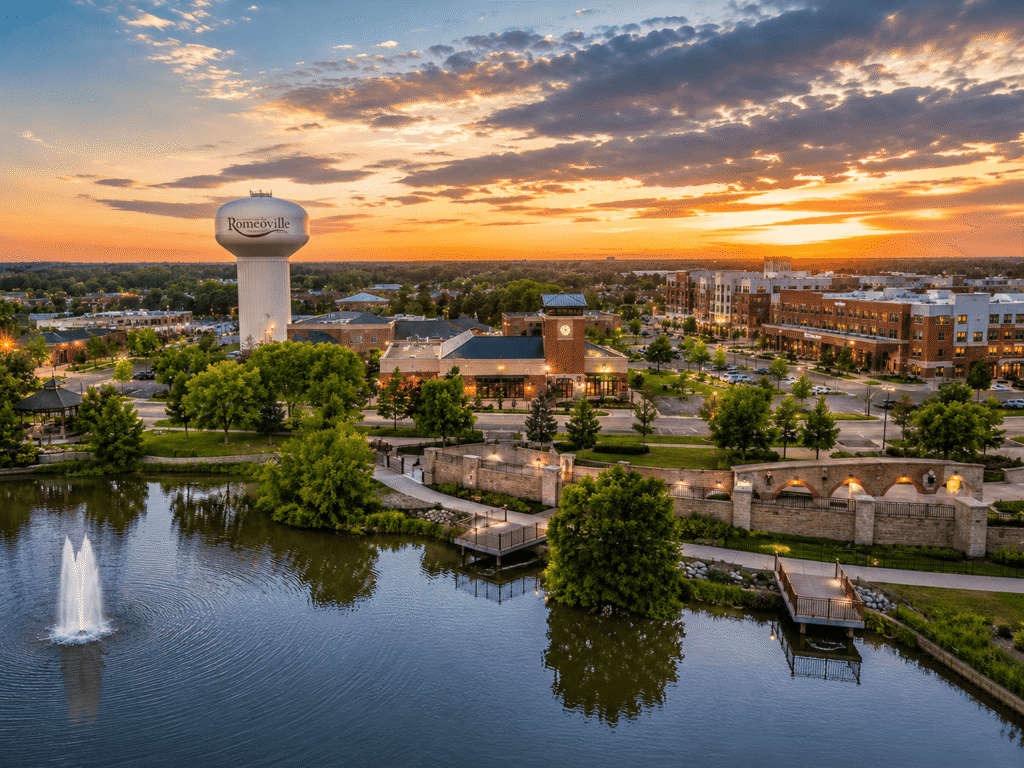
Backyard Paradiso designs and installs complete outdoor living environments throughout Romeoville and the surrounding southwest Chicago metro area.
Engineered to Will County’s 42-inch frost line, clay soil conditions, and the freeze-thaw cycling that determines whether an outdoor structure performs for two decades or starts shifting within four winters.
Backyard Paradiso designs and installs complete outdoor living environments across Romeoville and the surrounding southwest Chicago metro. From the Romeoville office — one of seven service locations — our service footprint extends across multiple counties and municipalities: throughout Will County across Bolingbrook, Plainfield, Joliet, Crest Hill, Lockport, Shorewood, and New Lenox; into DuPage County across Naperville, Woodridge, Downers Grove, Warrenville, and West Chicago; into Cook County across Lemont and Orland Park; and into Kane County across Aurora. The conditions that shape outdoor living installation here — a 42-inch frost line, predominantly clay soil with limited natural drainage, freeze-thaw cycling across the long northern Illinois winter, and 2018 IRC-based building codes with engineered footing requirements — are consistent across the region. The specific permit authority and inspection process vary by municipality.
This is the complete outdoor living approach applied to northern Illinois conditions: motorized louvered pergolas with footings poured to 42-inch minimum depth and engineered for snow load; composite decks built on substructures specified for clay soil drainage and freeze-thaw cycling; paver patios installed over the deeper aggregate base that Will County’s frost depth requires; outdoor kitchens that handle the seasonal range from sub-zero winter to humid summer; and the full outdoor living service range across the broader southwest Chicago corridor.
The conditions that shape outdoor living in northern Illinois
Four regional inputs define how outdoor living projects are engineered across the southwest Chicago metro. They show up in every specification we write for a Romeoville-area property, and in this market they are the specifications that distinguish a structure that performs for the long term from one that begins failing within a handful of winters.
The 42-inch frost line and pier specifications
Northern Illinois carries a 42-inch frost depth — the deepest in the seven-market portfolio Backyard Paradiso serves nationally, deeper than Colorado’s 36 inches, deeper than New Jersey’s 36 inches, and substantially deeper than the Florida and Texas markets where frost is essentially not a structural variable. Every permanent outdoor structure footing in this market — pergola posts, deck piers, freestanding outdoor kitchen slabs, fence posts where a permanent post is specified — must be poured to a minimum 42 inches below grade to prevent the freeze-thaw cycling that would otherwise lift, shift, and progressively damage the structure.
The Village of Romeoville’s deck permit application specifies the requirement explicitly: concrete piers shall be not less than 42 inches below grade, with a pier diameter of not less than 12 inches, and the holes shall have no water in them at the time of inspection. That last requirement — dry holes at inspection — reflects how heavily clay soil holds water in this market and how often a hole that wasn’t dewatered before the inspector arrived simply fails the inspection. Will County, Joliet, Bolingbrook, Naperville, Plainfield, and the surrounding municipalities each enforce comparable depth and diameter requirements based on the 2018 International Residential Code and local amendments, with consistent enforcement across the region.
The pier specification looks like a small detail. It is not. It is the single component of an outdoor structure most commonly under-specified in northern Illinois — and it is the single component most commonly responsible for structural failure when a pergola begins listing within a few years of installation, when a deck develops uneven board lines that no amount of surface re-leveling fixes, when a fence shows post heave through successive winters. We pour every footing in this market to the depth and diameter the code requires, and we don’t begin a project before JULIE — Illinois 1-Call — has marked the underground utility lines that any 42-inch dig in this region has to navigate.
Clay soil and base drainage
Northern Illinois soil leans heavily toward clay across the southwest Chicago metro. Clay holds water, expands when it absorbs moisture, contracts when it dries, and transmits those movement forces to anything sitting on or in it. For paver installations, the consequence is straightforward: an aggregate base of inadequate depth or inadequate compaction will move with the clay it sits on, and the paver surface will follow — heaving in some areas, sinking in others, opening joints, creating tripping hazards, and eventually requiring full base reinstallation. The base depth standard for a paver patio in this market is meaningfully greater than what’s required in the sandy-soil markets of Florida or the well-drained soils of the Front Range.
For deck and pergola substructures, the clay context affects substructure framing protection — flashing, joist tape, and clearance from the soil to prevent moisture wicking into wood components — and the foundation pier design discussed above. The drainage configuration around any outdoor structure is part of the install scope rather than an afterthought: routing surface water away from the structure footprint and into appropriate dispersal areas is what prevents the saturation conditions that accelerate freeze-thaw damage.
Freeze-thaw cycling across the northern Illinois winter
The northern Illinois climate doesn’t simply freeze and stay frozen. It cycles — multiple freeze-thaw events per winter, sometimes several within a single week during shoulder seasons — and that cycling is what mechanically damages materials and connections that aren’t specified for it. Composite decking with co-extruded polymer shells handles freeze-thaw cycling without the surface checking and edge degradation that affects mono-extruded composite and untreated softwood. Aluminum pergola frames with UV-rated and freeze-thaw-rated powder coatings hold their finish through twenty-plus winters; lower-grade powder coats begin chalking within five. Concrete pavers and porcelain pavers are appropriate for this market; travertine and softer natural stones require careful sealing because water infiltration into surface voids becomes a freeze-thaw expansion problem rather than just a staining problem.
Snow load is also a relevant structural consideration in this market — covered pergola configurations with louvre roofs and full enclosures need to be engineered for the snow accumulation that Will County winters can deliver, and the structural rating on the louvre system has to reflect that.
HOA and homeowner association context
The southwest Chicago metro has a meaningful HOA and homeowner association presence, particularly across the master-planned subdivisions of Naperville, Plainfield, Bolingbrook, Romeoville’s newer developments, and the active-adult and family-oriented communities throughout the region. Most associations operate architectural review processes with documented standards for material, color, scale, placement, and lighting. Review timelines run one to four weeks depending on the community. We prepare ARC submission documentation as a standard part of project scope across governed neighborhoods. Filing for ARC approval before finalizing engineering prevents rework after the community requires a change.
The southwest Chicago service footprint
Backyard Paradiso’s Romeoville office serves a regional footprint across Will County and the adjacent DuPage, Cook, and Kane County submarkets. The footprint sorts naturally into three commute-and-character corridors that describe how the markets within the metro actually relate to each other.
The Will County core — Romeoville, Bolingbrook, Plainfield, Joliet, Lockport
The core service area covers the Will County corridor along I-355 and I-55, anchored by Romeoville at the office and extending through Bolingbrook five miles north, Plainfield seven miles southwest, Joliet ten miles south, Crest Hill nine miles south, Lockport eight miles southeast, and Shorewood and New Lenox further into the southern Will County submarkets. This corridor carries the highest project density for our office and is the most frequently served market across all 13 service categories. Project character runs from established suburban outdoor living upgrades on existing lots to new outdoor living installations on the newer master-planned subdivisions across the south Will County growth corridor.
The DuPage corridor — Naperville, Woodridge, Downers Grove, Warrenville, West Chicago
North and east of Romeoville, the DuPage County corridor anchors the Chicago metro’s affluent suburban core. Naperville (twelve miles, consistently ranked among the most affluent suburbs in the broader Midwest), Woodridge, Downers Grove (eighteen miles), Warrenville, and West Chicago each carry their own municipal building departments and their own established residential neighborhoods. Project scope here leans toward established-property outdoor living upgrades — replacement of deteriorating wood decks with co-extruded composite, addition of motorized louvered pergolas to existing patios, paver-driveway and paver-patio installations on properties where the existing concrete has cracked through several northern Illinois winters.
The southern and eastern submarkets — Aurora, Orland Park, Lemont, New Lenox
The wider regional footprint extends to Aurora (twenty miles, the major regional city west of the metro across Kane County), Orland Park (twenty miles, the retail-hub suburb in southwest Cook County), Lemont (ten miles, residential along the Des Plaines River corridor in southwest Cook), and New Lenox (fifteen miles into south Will County’s commuter belt). Each carries its own jurisdictional permit authority and its own project mix. The engineering specifications calibrated to northern Illinois conditions remain consistent across the entire footprint.
Nearby markets and approximate distance from the Romeoville office
The full regional reach, with each surrounding market’s typical character. Distance is measured from the Romeoville office.
| Market | Distance | County | Character |
|---|---|---|---|
| Bolingbrook, IL | 5 mi | Will / DuPage | Adjacent suburb |
| Plainfield, IL | 7 mi | Will / Kendall | Growth suburb |
| Lockport, IL | 8 mi | Will | Residential market |
| Crest Hill, IL | 9 mi | Will | Residential market |
| Joliet, IL | 10 mi | Will / Kendall | Regional city |
| Lemont, IL | 10 mi | Cook / DuPage / Will | Residential suburb |
| Naperville, IL | 12 mi | DuPage / Will | Affluent suburb |
| Shorewood, IL | 12 mi | Will | Suburban market |
| New Lenox, IL | 15 mi | Will | Commuter suburb |
| Woodridge, IL | 15 mi | DuPage / Will | Residential suburb |
| Downers Grove, IL | 18 mi | DuPage | Affluent suburb |
| Aurora, IL | 20 mi | Kane / DuPage / Will / Kendall | Major regional city |
| Warrenville, IL | 20 mi | DuPage | Residential market |
| Orland Park, IL | 20 mi | Cook | Retail hub suburb |
| West Chicago, IL | 25 mi | DuPage | Outer suburb |
All of these markets are inside the service footprint. Engineering specifications (42-inch minimum pier depth, 2018 IRC base requirements, clay soil base preparation, freeze-thaw-rated material selection, JULIE locate before any below-grade work) are consistent across the list; the specific permit authority varies by municipality.
The complete outdoor living approach in Romeoville
The projects we install across the southwest Chicago metro cover the full service range: composite decks, motorized louvered pergolas, paver patios and walkways, outdoor kitchens, landscape lighting, fencing, glass railings, motorized zip screens, retractable awnings, permanent architectural lighting, artificial turf, batting cages, and expandable home structures. The projects we see most frequently in this market:
Composite deck replacement and ground-up deck installation. Decks are the signature outdoor living service in this market — northern Illinois has decades of pressure-treated softwood deck inventory that’s reaching the end of its serviceable lifespan, and replacement with co-extruded WPC composite is one of the most common projects we complete in the Romeoville-Bolingbrook-Naperville corridor. The substructure engineering matters more here than in most markets: 42-inch pier depth, properly flashed ledger connections to handle freeze-thaw moisture cycling, joist tape to isolate composite from substructure framing, and proper drainage clearance beneath the deck surface to prevent moisture accumulation in clay soil. A composite deck installed correctly in this market should perform through the 2040s with cleaning as the only ongoing maintenance.
Motorized louvered pergola installation, often integrated with deck or patio scope. Pergolas extend the seasonal outdoor living window meaningfully in northern Illinois — the louvered roof manages the sun on hot summer afternoons that this latitude does deliver, and the closed louvre position with appropriate drainage handles the spring and fall rain that would otherwise end an evening early. Snow load engineering on the structure and the louvre system is a relevant northern Illinois consideration that doesn’t apply in the southern markets. We integrate pergolas with deck installations and with paver patio installations as a coordinated single-project scope rather than as sequential separate installations.
Paver patios and walkways with northern-Illinois base specifications. Paver installations in this market require deeper aggregate base preparation than the southern markets — the 42-inch frost line, the clay subgrade, and the freeze-thaw cycling all push the base specification toward more material and more compaction labor. The investment in the base is what produces a paver surface that stays level through twenty winters rather than developing the heaving, sinking, and joint-erosion problems that characterize underspecified installations. Concrete pavers and porcelain pavers are the most appropriate material choices for this climate; brick is acceptable with appropriate base depth; travertine requires careful sealing and isn’t typically the right choice for areas that collect standing water.
Outdoor kitchens designed for the seasonal range. Outdoor kitchens in northern Illinois see the broadest seasonal use range in the seven-market portfolio — sub-zero winter through humid summer afternoons, with the practical use season concentrated April through October. Cabinet and counter material selection accounts for that range, utility routing accommodates winterization, and integration with the deck or paver patio surface coordinates the structural and finish work as a single project.
Landscape lighting and the long-evening northern Illinois summer. Northern Illinois summer evenings — long, mild, and frequently the best outdoor hours of the year — reward landscape lighting that defines a property after sunset. We design lighting around the actual evening use patterns of the property rather than around generic specifications, and we coordinate lighting controls with any pergola-integrated lighting and any HOA-required lighting standards.
Permits, codes, and the jurisdictional landscape
Two regulatory tracks run through most outdoor living projects in this market. One is the municipal or county permit appropriate to the jurisdiction. The other is the underground utility locate that Illinois law requires before any below-grade work — a step specific to the dig-intensive engineering this climate’s frost line demands.
Municipal and county permits
Pergolas, decks, outdoor kitchens with utility connections, paver patios above certain size thresholds, and most permanent structures require building permits across the southwest Chicago metro. The specific permit authority depends on where the property sits. Village of Romeoville Building Department (1050 West Romeo Road; 815-886-7200) handles permits within the Romeoville village limits. Will County Land Use Department, Building Division (58 East Clinton Street, Suite 100, Joliet; 815-727-8634) handles unincorporated Will County and operates the SmartGov public portal for permit applications and inspections. City of Joliet Building & Inspectional Services (150 West Jefferson Street; 815-724-4070) handles Joliet city permits, with a typical processing time of approximately 15 business days for decks, gazebos, covered patios, and pergolas. Bolingbrook, Plainfield, Naperville, Lockport, Crest Hill, Shorewood, New Lenox, Lemont, Woodridge, Downers Grove, Warrenville, Aurora, Orland Park, and West Chicago each operate their own municipal building departments. DuPage County and the other surrounding counties handle their respective unincorporated areas.
Will County and most of the surrounding municipalities operate under the 2018 International Residential Code and 2018 International Building Code with local amendments, which establishes the framework for the 42-inch footing requirement, the snow load and structural specifications, and the inspection sequence. Plat-of-survey documentation is required for permit applications across most of the region — Joliet, Romeoville, and the DuPage municipalities all require an accurate plat of survey marked with the proposed work location. We prepare the documentation and manage the permit review across each jurisdiction where we work.
JULIE — Illinois 1-Call utility locate before digging
Illinois law requires a utility locate request through JULIE — Illinois One-Call System — before any below-grade work. For outdoor living installation in this market, that means before any 42-inch pier hole is dug, before any paver excavation begins, before any fence post is set. The locate request is free, the response time is typically 48 to 72 hours, and the marked utility lines on the property determine where digging can safely proceed and where it can’t. We file the JULIE request as a standard pre-construction step on every project; we do not begin digging until the locate is complete and the utility marks are visible on the site.
Construction hours and neighborhood considerations
Romeoville and most surrounding municipalities limit construction work hours by ordinance — typically 7 a.m. to 8 p.m. Monday through Friday and 8 a.m. to 6 p.m. Saturday and Sunday in Romeoville, with similar windows across the rest of the metro. We schedule installation work within these windows and coordinate with HOAs and adjacent properties when site conditions or project scope require neighbor notification.
The value of a complete outdoor living investment in Romeoville
Rather than publishing a dollar range that would only be meaningful in the context of a specific project scope, it is more useful to understand how outdoor living investment returns value in this market — because the return calculation in northern Illinois reflects a combination of resale recovery, seasonal-use additions to the home’s functional footprint, and the long-term protection that correct engineering provides against the freeze-thaw damage that under-specified installations accumulate.
Romeoville sits in a meaningful place in the Chicago metro. Median household income across the village is in the $95,000-plus range, the median age sits in the mid-to-late thirties, and household composition skews family-forward with average household size above three people. Owner-occupancy runs above 80 percent. This is a market where homeowners stay in their houses, raise families in them, host extended family in them, and plan for the kind of multi-decade ownership horizon that justifies engineering an outdoor space for twenty-plus year performance rather than for short-term cosmetic effect.
Resale recovery in the Chicago metro market. Research from the National Association of Realtors finds that outdoor living improvements recover 50–100% of their investment at resale, with patios, decks, and landscape improvements consistently at the upper end. In the Chicago metro specifically, the resale calculation favors composite decking heavily over wood — buyers in this market understand that a maintained wood deck carries an obligation forward and that a co-extruded composite deck does not. The same applies to engineered paver installations versus stamped or poured concrete that has cracked through northern Illinois winters: the paver surface that’s still flat at year fifteen reads as a feature; the cracked concrete reads as deferred maintenance.
Seasonal-use additions in a four-season market. Northern Illinois delivers genuinely outdoor seasons — late spring through early fall — alongside winters where the outdoor space is in storage. A well-designed outdoor living environment extends the usable seasonal window meaningfully through both shoulder seasons: motorized louvered pergolas with appropriate drainage, motorized zip screens that retain warmth on cool spring and fall evenings, and outdoor kitchens that work for grilling earlier and later in the year than uncovered patios support. The season-extension math is one of the strongest value cases for outdoor living investment in this market.
Engineering quality as long-term protection. The return profile most specific to northern Illinois involves freeze-thaw survival. A structure engineered and built to Will County’s specifications — 42-inch piers, properly flashed ledger connections, freeze-thaw-rated materials, drainage configured to move water away from foundations and bases — performs through the cycling that destroys under-specified installations. The incremental cost of correct specification is a small fraction of the cost of replacement after structural failure, and in a market where homeowners plan for long ownership, the math works strongly in favor of correct engineering at the front of the project rather than repair work several years later.
What shapes the investment in this market specifically. Three regional factors affect how Romeoville-area projects are specified and priced:
- Footing and base depth driven by the 42-inch frost line — pier depth, paver aggregate base depth, and the additional excavation labor that northern Illinois conditions require add meaningfully to material and labor cost relative to southern markets. This is a legitimate cost difference, not a contractor margin variable.
- Plat-of-survey and JULIE coordination as standard pre-construction work — these aren’t expensive line items individually, but they’re consistent project-management overhead that doesn’t appear in most other markets in the same form.
- Multi-municipality permit complexity — projects across the Will / DuPage / Cook / Kane footprint route through different building departments with different application portals, fee schedules, and inspection workflows. We absorb this into project management; it affects scheduling more than price.
Accurate project investment figures for a specific scope come from a site assessment rather than a published range. The site assessment is free and produces a complete project quote based on the actual scope.
Frequently asked questions about outdoor living in Romeoville
How deep do pergola and deck footings need to be in Romeoville?
The Village of Romeoville’s deck permit application specifies that concrete piers shall be not less than 42 inches below grade, with a pier diameter of not less than 12 inches, and the holes shall have no water in them at the time of inspection. The 42-inch depth corresponds to the northern Illinois frost line and prevents the freeze-thaw cycling that would otherwise lift the structure out of plumb over successive winters. Will County, Joliet, Bolingbrook, Naperville, Plainfield, Lockport, and the surrounding municipalities each enforce comparable requirements based on the 2018 International Residential Code and local amendments. We pour every footing in this market to the depth and diameter the code requires.
Do I need a permit for a deck or pergola in this area?
Yes, in essentially every case. Decks of any size, pergolas of any size, outdoor kitchens with utility connections, paver patios above certain size and configuration thresholds, and most permanent structures require building permits across the southwest Chicago metro. The specific permit authority depends on where the property sits — Romeoville Village handles village permits, Will County handles unincorporated Will, Joliet handles Joliet city, and Bolingbrook, Plainfield, Naperville, Lockport, and the rest of the regional municipalities each operate their own building departments. Most jurisdictions in this market require a plat of survey with the permit application showing the proposed work location. We prepare the documentation and manage the permit review across each jurisdiction.
What is JULIE, and why does it matter for outdoor living installation?
JULIE is Illinois One-Call System, the state’s underground utility locate service. Illinois law requires a JULIE request before any below-grade work, and at the depths required for 42-inch pier holes, paver excavation, and fence post installation, that means before any digging begins on essentially every outdoor living project in this market. The locate request is free; the response time is typically 48 to 72 hours; and the marked utility lines on the property determine where digging can safely proceed. We file JULIE requests as a standard pre-construction step on every project and do not begin work before the locate is complete and the utility marks are visible.
Why does composite decking matter more in northern Illinois than in other markets?
Northern Illinois delivers two of the most demanding climate variables for deck materials: high-humidity summers that accelerate decay and mold development on softwood decking, and freeze-thaw cycling across the long winter that mechanically damages materials with surface vulnerabilities. Co-extruded WPC composite — with its continuous polymer shell encapsulating the composite core on all four sides — handles both variables in a way that pressure-treated softwood does not. The performance advantage is most pronounced in this market: a maintained wood deck in northern Illinois reaches end-of-serviceable-life faster than the same deck would in milder climates, and the cycle of staining, sealing, and board replacement adds up substantially over a 20-year ownership horizon. Composite decking installed correctly in this market should perform through the 2040s with cleaning as the only ongoing maintenance.
Does Backyard Paradiso work in Naperville, Joliet, Bolingbrook, and the rest of the southwest Chicago metro?
Yes. The Romeoville office serves a regional footprint across Will County (including Bolingbrook, Plainfield, Joliet, Crest Hill, Lockport, Shorewood, New Lenox), DuPage County (Naperville, Woodridge, Downers Grove, Warrenville, West Chicago), Cook County (Lemont, Orland Park), and Kane County (Aurora). Engineering specifications calibrated to northern Illinois conditions remain consistent across the entire footprint; the permit authority and inspection process vary by municipality. We confirm the appropriate permit authority at the initial site assessment based on the specific property address.
What’s the right paver material for a patio in this climate?
Concrete pavers and porcelain pavers are the most appropriate material choices for the northern Illinois climate. Both handle freeze-thaw cycling well, both perform reliably on the deeper aggregate base that the 42-inch frost line requires beneath them, and both are available in design ranges that suit the residential vocabulary of the southwest Chicago metro. Brick pavers are acceptable for smaller-scale traditional applications with appropriate base preparation. Travertine and softer natural stones are not typically the right choice for this climate at grade — water infiltration into surface voids becomes a freeze-thaw expansion problem rather than just a staining problem, and the resulting surface damage is difficult to manage over time. The material conversation is one we have in detail at the initial design visit.
What maintenance do outdoor living materials require in northern Illinois?
Less than the climate suggests, provided the materials were specified correctly for it. Co-extruded WPC composite decking requires washing with soap and water once or twice per year — no sealing, staining, or refinishing. Powder-coated aluminum pergola frames need periodic cleaning and occasional lubrication of the motorized louvre mechanism. Concrete and porcelain pavers require periodic polymeric-sand joint top-up and occasional cleaning. The motorized components — louvre motors, zip screen motors, lighting controllers — benefit from a winter shutdown procedure on outdoor structures and a spring startup check, both of which we walk through at the post-installation walkthrough. The freeze-thaw-rated specification across the product range is what keeps the maintenance load modest across northern Illinois winters.
Backyard Paradiso — Romeoville Office
Phone: (331) 224-4426
Hours: By appointment
Email: office@backyardparadiso.com
Serving: Romeoville, Bolingbrook, Plainfield, Lockport, Crest Hill, Joliet, Lemont, Naperville, Shorewood, New Lenox, Woodridge, Downers Grove, Aurora, Warrenville, Orland Park, West Chicago, and the broader southwest Chicago metro
The design conversation for your Romeoville outdoor project
Every Backyard Paradiso project in the Romeoville area starts with a free site assessment at the property. The assessment covers the home’s orientation and existing outdoor footprint, the lot’s drainage and soil conditions, the applicable jurisdictional permit authority, the HOA framework for the specific community where applicable, the homeowner’s design priorities and material preferences, and the realistic phasing of a project that fits budget and timeline. We produce a design concept and project quote based on the actual scope — including the engineered footing specification, the JULIE coordination, the plat-of-survey documentation, and the permit application — rather than on a square-footage formula.