
Patio Umbrellas: The Complete Guide for Homeowners
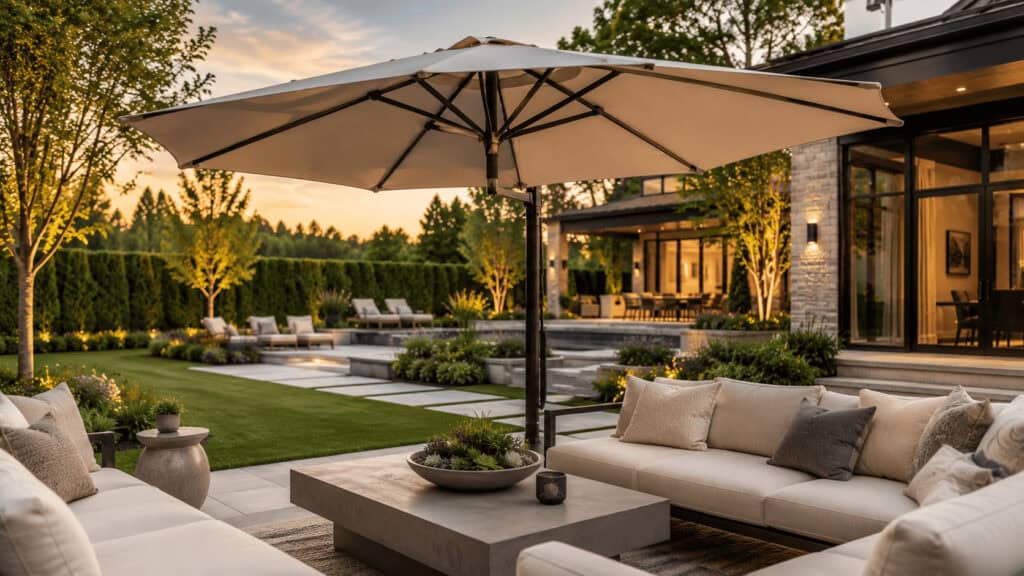
A patio umbrella is the piece of outdoor equipment most people treat as furniture and most underestimate as a result. It gets bought by canopy color and pole finish, set into whatever base the box came with, and opened on the first warm afternoon — and then, on the first gusty one, it becomes the thing that catches the wind and goes over. The truth is that a correctly specified umbrella is a small engineered structure. Its governing physics is not shade; it is overturning stability — the resisting moment of its base and anchoring set against the wind pressure on its canopy. Get that relationship right and an umbrella earns back the middle of the day and the edge of the season. Get it wrong and it is a liability waiting for weather.
This guide covers the decisions that produce an umbrella worth installing rather than merely buying. It works through why an umbrella behaves as a wind-loaded structure and what that means for stability, the difference between center-pole and cantilever geometry, the three ways to anchor it and when each is right, what the frame and canopy should be made of, how the umbrella integrates with the rest of the outdoor living space, the tip-over and pinch-point safety record and how to design around it, how to think about cost through value rather than a sticker number, what maintenance the canopy and mechanisms actually need, and how the wind, sun, and coastal exposure across the markets Backyard Paradiso serves shape the specification. Whether the goal is a market umbrella over a dining table or a cantilever shading a pool deck, the information here supports a decision that stays standing.
A patio umbrella is a wind-loaded structure, not furniture
Every decision about an umbrella circles back to one physical fact: wind acting on the canopy creates an overturning moment about the base, and the installation only stays up when the resisting moment equals or exceeds it. That is the whole game. It is also why there is no single “right” base weight and no universal safe wind speed — both the wind demand and the resistance are specific to the site, the geometry, and the exposure. The governing standard for the calculation is ASCE/SEI 7-22, the wind-load standard adopted through the building code across North America, and it provides a method, not a magic number.
The overturning moment, in plain terms
Picture the canopy as a sail. Wind pushes on it with a force that acts at the canopy’s center, some height above the ground, and that force times its height is the overturning moment trying to tip the umbrella over the edge of its base. Resisting it is the weight of the base acting across the base’s width. When the resisting side wins, the umbrella stands; when the wind side wins, it goes over. Neither side is a fixed figure — the wind force depends on canopy area, local wind speed, and how exposed the site is, and the resistance depends on base mass and how it is anchored. An engineer or specifier computes both from the actual project, which is exactly why a base sized by guesswork is the most common precursor to a tip-over.
Center-pole versus cantilever geometry
The second decision that shapes everything is geometry. A center-pole (market) umbrella puts the pole in the middle of the shaded zone — simple, stable, and efficient, but the pole occupies the table. A cantilever or offset umbrella swings the canopy out on an arm so the shaded area is clear of any pole, which is a real advantage over a dining table, a spa, or a lounge grouping. The trade-off is structural: offsetting the canopy from the base lengthens the moment arm, so a cantilever umbrella generates a substantially larger overturning moment than a center-pole umbrella of the same canopy area, and its base and anchoring have to be sized up accordingly — often non-linearly with the offset distance. Cantilever units built for permanent use should be anchored in-ground or through-deck rather than left to ride on a freestanding base alone.
What a manufacturer "wind rating" tells you — and what it does not
A product wind rating describes the conditions under which a specific umbrella was tested to stay stable. It is useful for comparing relative stability between products, but it is not a code threshold and it does not substitute for site-specific anchoring. The CPSC recall record includes tip-overs that occurred within a manufacturer’s stated rating because the base ballast was insufficient or the unit was improperly assembled. Treat the rating as one input; let the site-specific anchoring analysis govern.
Anchoring: the decision that determines whether the umbrella stays up
If wind is the load, anchoring is the answer, and it is the component homeowners think about last and should think about first. Every other choice — canopy color, frame finish, tilt mechanism — can be reconsidered later. The anchoring is what keeps the whole assembly from becoming airborne, and it is the part most often undersized. There are three methods, each resisting the overturning moment through a different mechanism.
In-ground sleeve and footing
A sleeve cast into a concrete footing below the surface, with the pole dropped in and locked at a collar, provides the highest moment resistance of the three options, transferring the overturning load directly into the ground. Footing depth and diameter are sized to the design overturning moment and the bearing capacity of the soil, with anchor rods to ASTM F1554 where a base plate connects to the footing. This is the preferred method for permanent estate installations and for any cantilever unit in an exposed location. It is not the method to choose if the umbrella may need to move.
Through-deck and surface-mount
A base plate mechanically fastened to a deck or slab — through-bolted, expansion-anchored, or adhesive-anchored — is the right answer where a below-grade footing is impractical. The essential rule on a wood deck is that the connection must engage a structural framing member (a joist, doubled joist, or blocking), not the decking boards, which transfer no meaningful resistance. A permanently anchored base is a concentrated load that the deck framing has to be checked against rather than assumed within the prescriptive live-load tables, and an engineered detail is common for larger canopies. On concrete, the slab’s thickness, strength, and edge distance govern the anchor selection; decorative overlays and pavers are generally not adequate anchor substrates.
Freestanding weighted base
A weighted base resting at grade resists overturning through mass alone, which makes it the most flexible and portable option and the one that requires the most weight, because no mechanical connection contributes any resistance. It is also the option most sensitive to geometry: because a cantilever canopy sits off-axis, its moment arm is larger, and the required ballast climbs quickly. A freestanding base has to bear on a solid, level surface — an uneven paver field lets the base rock and walk itself toward a tip-over under repeated gusts.
Why cantilever changes the math
It is worth stating plainly because it is the most common sizing error: a cantilever or offset umbrella cannot be anchored to a base sized for a center-pole unit. The offset adds a gravity moment to the wind moment, and the combination demands materially more resistance. CPSC incident data specifically include cantilever tip-overs traced to ballast sized for center-pole geometry. The two configurations require independent calculations.
Frame, finish, and canopy: what to specify and why
An umbrella is specified, not fabricated, which means the performance is decided at the point of selection. Four material choices govern how the umbrella holds up: the frame alloy, the finish class, the canopy fabric, and the hardware grade.
Aluminum alloy and temper
Aluminum dominates umbrella poles and ribs. Alloy 6063-T5 is the standard for residential center-pole frames — good extrusion surface quality, good corrosion resistance, and adequate strength for single-post geometries. Alloy 6061-T6 is the higher-performance selection, carrying substantially greater yield strength and fatigue resistance, and it is the appropriate specification for cantilever geometries and larger spans where bending stress at the hub and collar is higher. Rib count matters too: more ribs mean more load paths and smaller fabric panels, which lowers the peak wind pressure any single panel has to carry. Fiberglass ribs are a lighter, more flexible alternative used in mid-grade products.
Finish class
The finish is the primary determinant of how long the frame looks and performs correctly outdoors, and it is governed by the FGIA/AAMA tiered specifications. AAMA 2603 is the economy tier — roughly a one-year weathering standard, adequate for sheltered installations with recoating expected. AAMA 2604 raises that to a five-year standard, and AAMA 2605 to a ten-year architectural standard with the most stringent color and film-integrity requirements, typically a fluoropolymer system. Estate installations should specify AAMA 2604 at minimum, with AAMA 2605 preferred for south-facing, unshaded, or coastal siting. Anodized finishes under AAMA 611 are an alternative with excellent abrasion resistance for high-contact areas like crank and tilt collars.
Canopy fabric
Solution-dyed acrylic is the canopy material of choice for estate applications. Because the pigment is worked into the fiber before it is spun rather than applied to the surface, UV degrades only the fiber surface instead of stripping color from within, which gives solution-dyed fabric a real colorfastness advantage over piece-dyed or printed alternatives. Fabric performance is characterized by a hierarchy of test methods — AATCC light and weathering methods for color and strength retention, ASTM grab and strip tests for breaking strength, and ASTM D1683 for sewn-seam strength, since seams are load-bearing under wind and are a common first failure point. Fabric weight separates residential from commercial grades; estate specifications should align to the heavier, higher-strength thresholds, especially for cantilever units where canopy area and wind load are larger. A durable water-repellent finish sheds rain and reduces the saturated dead weight that stresses the ribs, and it needs periodic reapplication.
Hardware and coastal exposure
Fasteners and connection hardware are where corrosion starts, particularly where an aluminum member meets a steel fastener and a galvanic cell forms in trapped moisture. Stainless steel hardware is the mitigation, and in coastal or poolside conditions Type 316 — with its molybdenum addition for chloride-pitting resistance — is the preferred grade over Type 304. The same coastal logic pushes the finish specification toward AAMA 2605 and the fabric toward the heaviest, most weather-tested grade.
Design and integration with the outdoor living space
An umbrella is rarely the only thing in the yard, and every adjacent structure changes the wind it sees. The recurring theme across integration is that anything nearby — a pergola, a fence, a glass railing — reshapes the local wind field, and the umbrella has to be anchored for the most demanding conditions that field produces.
Siting and canopy scale
Canopy diameter should be proportioned to the feature it shades — enough overhang past a table edge to shade seated occupants at low sun angles, no more. An oversized canopy is not a free upgrade; it imposes larger wind loads for no functional gain, while an undersized one leaves people in the sun. Sightlines from interior windows and kitchen views to the pool are worth checking during siting, so the pole and canopy do not obstruct the views that matter.
Integration with an aluminum pergola
An aluminum pergola creates a partially enclosed overhead environment that modifies local wind — air accelerating around and through the bays can raise gust intensity on a canopy placed within the footprint, which the anchoring design has to reflect. Where the umbrella base fastens to the pergola deck or framing, the load path must engage the pergola’s structural members, and the framing has to be checked for the added concentrated load. Adequate vertical clearance between the raised canopy (including its tilt range) and the pergola beams prevents contact damage in gusts.
Decks, patios, and surfaces
Decks are the most common — and highest-coordination — substrate, because the base transfers both a concentrated dead load and a cyclic wind load into the framing; the deck design and the umbrella anchoring plan should be reviewed together, not in sequence. On paver and concrete patios, slab-anchored bases need the slab’s strength and edge distance evaluated, and freestanding bases need a solid, level bearing surface. Over artificial grass, neither the turf nor its aggregate base contributes meaningful bearing, so a heavy freestanding base will punch and displace the turf over time — a flush concrete or paver landing set at the base location before the turf is laid is the correct detail.
Lighting and powered options
Where the umbrella carries integrated LED lighting, or shares a circuit with landscape lighting, the low-voltage system follows NEC Article 411 and the 120-volt supply requires GFCI protection under Section 210.8. Cable routing has to avoid the base footing and anchor hardware and must be wet-location rated where it passes under paving. Running the conduit sleeves before finishes are applied is the difference between a clean install and a retrofit.
Awnings, zip screens, and glass railings
Shade systems that share a space have to share a wind protocol. A retractable awning and an umbrella both have wind-stow thresholds, and the operations plan has to prevent the scenario where one is deployed while the other is stowed, leaving the deployed system exposed. Motorized zip screens reduce wind pressure on an umbrella inside the screened zone when closed, but they retract in high wind — so the umbrella must still be anchored for the unscreened condition. Glass railings can create a venturi effect that accelerates wind at canopy height just above the glass, so an umbrella near a railing line may see higher effective pressures than open-terrain data would predict, and the pole placement should preserve the railing’s sight-line transparency.
Safety: tip-over, pinch points, and the CPSC record
An umbrella carries a safety layer no other shade feature does, and it is worth designing around explicitly rather than discovering it. The Consumer Product Safety Commission is the documented authority for the injury patterns, and its recall record is specific about where the risks concentrate.
Tip-over: the dominant failure
Tip-over under wind is the primary safety failure mode for freestanding umbrellas and umbrella bases, and the CPSC recall record — including a documented offset-umbrella recall for the risk of the pole and canopy tipping and striking people — establishes the pattern. The mechanism is the overturning moment exceeding the resisting moment, and the aggravating conditions are consistent: insufficient ballast, leaving the umbrella open in gusty conditions, a worn base collar that lets the pole play, and deteriorated base legs. The single most common precursor in the record is an open umbrella left unattended in wind. The design answers are correct anchoring sized to the site and a discipline of closing the canopy when the umbrella is not in use.
Finger-entrapment and pinch points
The CPSC also documents finger-entrapment and pinch injuries in fold-and-adjust mechanisms. On umbrellas the hazards cluster at three places: the auto-tilt and offset mechanisms inside and around the crank housing and, on cantilevers, the horizontal arm pivot that swings through an arc; the crank aperture itself during direction reversal; and the openings in a cross-base hub, where a child’s fingers can enter and be crushed if the pole is rocked. Keeping children clear of the base hub and crank during operation, and keeping protective covers and collars intact, is the mitigation.
Mechanism failure
Crank gearboxes, collar-tilt clamps, and auto-tilt cams are all wear-prone. A crank that spins without lifting, that needs rising force, or that grinds is at end of life; a tilt collar that drifts back toward vertical has lost clamping friction; an auto-tilt that engages before the canopy is fully open or relaxes under load has worn cam surfaces. A mechanism that binds, rattles, or shows cracking should be taken out of service pending evaluation rather than forced.
When to close and stow
Closing the canopy is the highest-leverage user-controlled safety measure there is, because furling reduces the wind-exposed area — and therefore the overturning demand — by orders of magnitude. An umbrella should be closed whenever wind exceeds the point at which its anchoring can reliably resist overturning, which is a function of site and anchor rather than a single universal number, and it should be stowed when conditions are unattended in climates prone to sudden convective gusts. For the season, full canopy removal and dry storage protects against both freeze damage and year-round UV dose.
What drives patio umbrella cost
The honest framing is that “the cost of a patio umbrella” is the wrong question — the range runs from a disposable big-box unit to an engineered estate installation, and the number on its own says nothing about whether it will still be standing and holding color in five seasons. For a permanent feature, the more useful lens is what it returns over its service life, which is how Backyard Paradiso frames value on every informational page.
What actually drives the cost
The main levers are grade, geometry, and anchoring. Frame grade (6063-T5 versus 6061-T6), finish class (AAMA 2603 versus 2604 versus 2605), and canopy fabric weight set the durability tier and the cost with it. Geometry is a lever because a cantilever’s larger structural demand pulls up both the frame and the base. And anchoring — often treated as an optional accessory — is properly part of the installation cost, because an under-anchored umbrella imposes unbudgeted cost through property damage, liability, and replacement when it goes over.
The covered-area value an appraiser recognizes
Outdoor living improvements recover a meaningful fraction of installation cost in assessed resale value, and covered or shaded areas score higher than bare hardscape under outdoor-room valuation methodologies. A patio umbrella is one of the lowest-installation-cost ways to add that appraiser-visible covered-area attribute to an outdoor living zone — the resale-recovery dimension of value, grounded in how appraisers score outdoor rooms rather than in a manufacturer claim.
Functional shaded-area equivalence
A large market or cantilever umbrella can shade a usable area comparable to a small pergola or an awning panel at a fraction of the structural complexity, footings, and permitting. Comparing shaded usable area per unit of installation complexity positions the umbrella favorably against more capital-intensive shade structures, which is the functional-square-footage dimension of the value framework.
Time-in-use
Shade converts peak-sun hours that would otherwise be unusable into comfortable occupied time, effectively lengthening the functional day and season of an outdoor room. Dividing the installed and maintained cost by the incremental comfortable-use hours it enables yields a per-hour metric that strongly favors shade in warm and high-UV climates — the time-in-use dimension of value.
Maintenance and seasonal care
An umbrella rewards a light, consistent routine and punishes neglect through the canopy and the mechanisms. None of it is demanding; all of it extends service life.
Canopy cleaning and water repellency
Solution-dyed acrylic cleans with a mild soap-and-water brushing and thorough rinsing, which lifts surface soiling without harming the UV-stable pigment. Water that soaks in rather than beading up signals that the durable water-repellent finish has worn and warrants re-treatment — worth doing, because a functioning DWR sheds rain quickly and shortens the wet cycles that feed mildew. Persistent staining that survives cleaning may mean the antimicrobial treatment has been breached and the canopy is due for replacement rather than more scrubbing.
Frame and fastener care
Powder-coated aluminum finished to AAMA 2604 or 2605 resists chalking and fade without routine recoating, but periodic washing removes deposits that trap moisture at scratch sites, and any impact breaking through to bare aluminum should be cleaned, primed, and touched up promptly to stop corrosion propagating. Fasteners work loose under wind and open/close cycling and should be re-torqued each season; corroded or damaged hardware should be replaced in kind, upgraded to Type 316 stainless in coastal or poolside settings.
Mechanism lubrication
Crank gears, tilt cams, and rib-pin pivots benefit from a dry or silicone-based lubricant to reduce wear and prevent corrosion-locking; petroleum-based lubricants should be kept off plastic gear components, which they can swell or crack. An auto-tilt cam that no longer snaps positively into its detent should be serviced before use to avoid a spontaneous collapse of the tilt under load.
Seasonal stow and storage
Closing the canopy whenever the umbrella is idle is the single most effective operational practice for both wind safety and UV longevity. For winter in freeze-prone markets, removing the canopy and storing the pole dry prevents freeze damage from water trapped in a hollow pole or base — water that expands on freezing and can crack castings or force welds, often revealing the damage only under the next season’s wind. The canopy must be fully dry before folding; a damp canopy sealed in a bag is the ideal environment for mildew.
How wind, sun, and coast shape umbrella specification across the markets served
The umbrella conversation shifts from market to market because the two variables that govern its performance — wind demand and UV dose — vary sharply with geography, and coastal chemistry adds a third. The products do not change; the specification does.
Coastal and high-humidity markets
In Naples and Orlando, salt air and intense sun drive the specification to its top tier: Type 316 stainless hardware for every corrosion-critical connection, AAMA 2605 frame finish, and the heaviest, most weather-tested canopy fabric. Coastal Florida also sits under High-Velocity Hurricane Zone and product-approval wind amendments that raise the design demand, which makes engineered in-ground or through-deck anchoring — not freestanding ballast — the default for any permanent unit. Humidity raises the premium on canopy mildew resistance and thorough drying before storage.
Altitude, wind, and freeze-thaw markets
In Colorado Springs and Denver, UV intensity at altitude is the highest across the markets Backyard Paradiso serves, which pushes the finish and fabric specifications up for color and film longevity. Wind exposure makes overturning analysis the governing constraint, and freeze-thaw introduces a second failure path: water trapped inside a hollow pole or base expands on freezing and can crack the assembly, so seasonal stow-and-dry discipline is not optional. Frost-depth footings govern any in-ground anchor.
Heat-driven markets
In San Antonio, the umbrella earns its keep as heat mitigation — the shade that converts a punishing afternoon into usable outdoor time — and the design priority is coverage geometry and a light-reflectance canopy that lowers the radiant temperature beneath it. Sudden convective gusts make the close-and-stow discipline and correctly sized anchoring the safety essentials, and expansive and caliche soils affect footing design for any in-ground installation.
Snow-load and deep-frost markets
Romeoville concentrates umbrella use into a shorter Illinois season, which raises the value of full off-season removal and dry storage. The deep frost line governs footing depth for permanent anchors, and freeze protection for water trapped in poles and bases is the maintenance priority that prevents a hidden crack from surfacing as a wind failure the following spring.
Compact urban markets
In Secaucus and the surrounding Hudson County lots, footprint is the constraint. A cantilever umbrella that clears the pole from a small dining zone, or a freestanding unit that can be relocated and stored, often suits the space better than a permanent footing — with the reminder that the cantilever’s flexibility comes at the cost of a heavier, larger base sized to its offset geometry.
Frequently asked questions about patio umbrella installation
How heavy does a patio umbrella base need to be?
There is no universal weight. The required base mass is set by the overturning moment the umbrella must resist, which depends on canopy size, the site’s basic wind speed, and its exposure category under ASCE/SEI 7-22 — then matched by the base weight acting across its footprint. A cantilever umbrella needs substantially more ballast than a center-pole unit of the same canopy area because its offset geometry lengthens the moment arm. Sizing by guesswork is the most common cause of tip-over.
What is the difference between a center-pole and a cantilever umbrella?
A center-pole (market) umbrella supports the canopy from a pole in the middle of the shaded area — simple and stable, but the pole occupies the table. A cantilever umbrella swings the canopy out on an arm, clearing the pole from the space, which suits dining tables and pool decks. The trade-off is structural: the offset canopy creates a larger overturning moment, so a cantilever requires a heavier base and, for permanent use, engineered anchoring rather than ballast alone.
Do I need a permit to install a patio umbrella?
A portable, freestanding umbrella on a weighted base almost never requires a permit. A permanently anchored unit is different: an in-ground concrete footing or a through-deck anchor that modifies structural framing can trigger a permit, and adding integrated electrical service routinely triggers at least an electrical permit. Requirements are set locally and are jurisdiction-variable, so the authority having jurisdiction should be confirmed before a permanent installation.
Can I anchor a patio umbrella to my deck?
Yes, with the right detail. The base plate must be fastened to a structural framing member — a joist, doubled joist, or blocking — not to the decking boards, which provide no meaningful overturning resistance. A permanently anchored base is a concentrated load that the deck framing has to be evaluated against rather than assumed within standard live-load tables, and larger canopies commonly need an engineered connection. The deck and the anchoring plan should be reviewed together.
How long does a patio umbrella canopy last?
Canopy life is a function of cumulative UV dose, moisture cycling, and the colorant system rather than a fixed number of years. Solution-dyed acrylic — with pigment worked into the fiber before spinning — retains color markedly better than piece-dyed or printed fabrics under the AATCC light and weathering test methods. Closing the canopy when not in use and off-season storage extend service life by reducing the UV exposure that drives fading and fiber degradation.
What canopy fabric is best for an outdoor umbrella?
Solution-dyed acrylic is the estate-grade standard for its colorfastness, water resistance, and weathering performance. For durability, specify heavier, higher-strength fabric grades — evaluated by ASTM grab, strip, and sewn-seam tests — rather than economy weights, especially for cantilever units where canopy area and wind load are larger. A durable water-repellent finish sheds rain and cuts the saturated weight that stresses the ribs, and it should be reapplied periodically.
When should I close or take down my umbrella in wind?
Close the canopy whenever wind exceeds the point at which the base or anchor can reliably resist overturning — a threshold specific to the site’s exposure and anchoring, not a single universal wind speed. Furling reduces the wind-exposed area, and the overturning demand, by orders of magnitude. In climates prone to sudden gusts, stow the umbrella when it is unattended regardless of the current conditions; CPSC data consistently link tip-overs to open, unsecured umbrellas.
Service areas
Backyard Paradiso specifies, sites, and anchors patio umbrellas across the markets it serves, matching frame grade, finish class, canopy fabric, and anchoring method to each market’s wind exposure, UV intensity, and coastal or freeze conditions. The full list is on Markets We Serve.
Shade is what makes the middle of the day usable
A patio umbrella earns back the hours the sun would otherwise take — but only when the anchoring is sized to the wind the site actually sees, not to whatever base came in the box. That sizing is an engineering task, and it is the difference between a shade structure and a liability. Backyard Paradiso reviews the site, matches geometry, frame, canopy, and anchoring to the exposure, and produces a complete specification and quote. Consultations are available by appointment.