What Are the Layers Under a Paver Patio, and What Does Each One Do?
Seven Layers, Bottom to Top
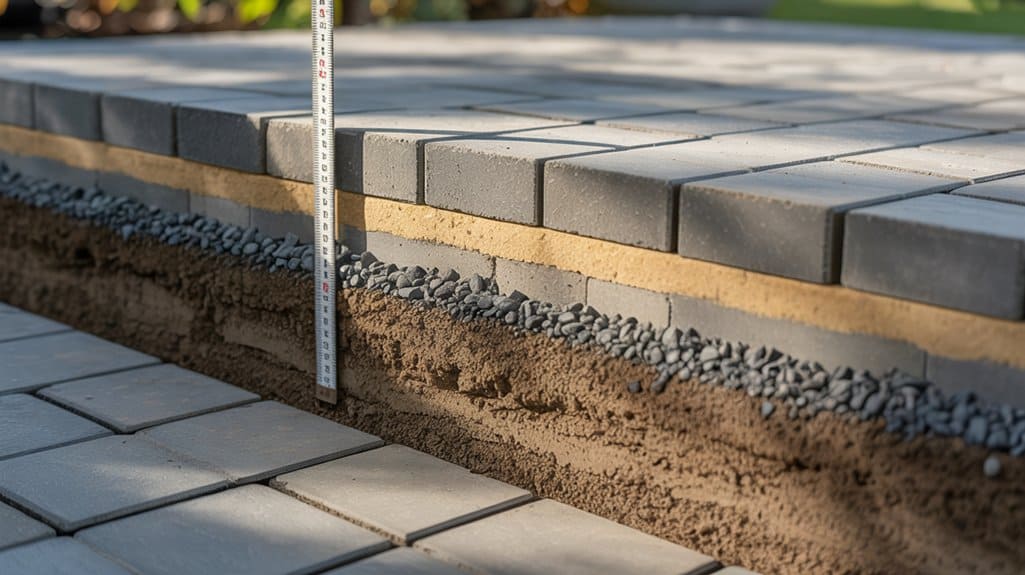
A properly built paver patio rests on seven distinct layers, moving from compacted native soil through aggregate base, bedding sand, and concrete pavers to joint sand at the surface. Soil strength, climate, and drainage conditions influence how each layer is specified, as the companion post on sinking pavers addresses. Each layer performs a discrete structural or seating function that the layers above and below depend on entirely.
The Ground and What Separates It From the Stone
The subgrade – native soil stripped of topsoil, graded, and compacted to at least 98 percent of standard Proctor density per ASTM D698 – is the foundation on which every layer above either succeeds or fails. Its bearing capacity, measured by a soaked California Bearing Ratio, sets the structural ceiling for the entire assembly; the Concrete Masonry and Hardscapes Association (formerly the Interlocking Concrete Pavement Institute) establishes a design minimum around 3, below which stabilization becomes necessary rather than optional. Where the subgrade is fine-grained, weak, or prone to saturation, a geotextile separator meeting AASHTO M288 goes down before any aggregate, not to suppress weeds, but to keep soil fines from migrating into the base and compromising the drainage and load-distribution properties that the base exists to provide.
Subgrade preparation and the bearing it has to supply
The International Residential Code Section R401.3 requires finished grades to slope at least two percent away from the foundation, a minimum that governs subgrade layout before a single layer of aggregate is placed. Beneath that graded surface, native soil must be compacted to at least 98 percent of standard Proctor density as defined by ASTM D698, because every structural demand from above – load, freeze-thaw cycling, drainage – ultimately resolves into the subgrade. The Concrete Masonry and Hardscapes Association (CMHA, which absorbed the Interlocking Concrete Pavement Institute) sets a design minimum of a soaked California Bearing Ratio of approximately 3; soil falling below that threshold, or soil that is saturated, requires stabilization under CMHA guideline PAV-TEC-004. Proof-rolling identifies soft spots that compaction testing alone can miss, and those spots must be corrected before any subsequent layer begins – a point developed further in the companion post on why pavers sink.
Geotextile: what it does and what it does not do
Geotextile fabric specified to AASHTO M288 serves as the separation layer between native subgrade soil and the aggregate base above it, preventing fine soil particles from migrating upward into the stone and preventing aggregate from punching downward into soft ground. Both migration pathways degrade the base over time – the first by contaminating the drainage matrix, the second by allowing differential settlement of the kind addressed in the companion post on why pavers sink. CMHA specifies a minimum 12-inch overlap at fabric joints to maintain continuous separation across the installation area. The geotextile is appropriate on fine-grained, weak, or wet soils; on clean granular subgrade it remains optional. Its function is structural separation, not weed suppression, and conflating the two leads to selecting the wrong material.
The Structure
The aggregate base is where structural capacity is either established or forfeited: crushed graded stone, compacted to 98 percent of standard Proctor density in lifts, must finish within three-eighths of an inch across any ten-foot span, because surface irregularities in the base translate directly into surface irregularities in the finished pavement. Thickness varies by application and site conditions – the Concrete Masonry and Hardscapes Association (CMHA, which absorbed the Interlocking Concrete Pavement Institute) sets post-compaction minimums at four inches for patios on well-drained soil and six inches for residential driveways, with weak or saturated soils and freeze-thaw exposure requiring additional depth as a site-specific design judgment. The bedding sand screeded above it – nominal one inch, uncompacted – serves only to level and seat the pavers; it carries no load, which is precisely why exceeding that thickness undermines rather than improves the system.
Aggregate base thickness, compaction and tolerance
The Concrete Masonry and Hardscapes Association specifies a minimum compacted aggregate base depth of four inches for patios on well-drained soil and six inches for residential driveways, with greater depth required on weak, wet, or freeze-thaw-affected sites as a site-specific design judgment rather than a universal figure. That base must be placed in lifts and compacted to 98 percent of standard Proctor density per ASTM D698, the same threshold applied to the subgrade below it. Every inch of base thickness and every pass of the compactor exists to carry and distribute load while shedding water laterally. Final tolerance is tight: CMHA holds the finished base surface to plus or minus three-eighths of an inch under a ten-foot straightedge, because dimensional error at this layer transfers directly to the paver surface above.
Bedding sand: a leveling course, not a load path
ASTM C33 limits the fines content of concrete sand used as paver bedding to no more than one percent passing the No. 200 sieve, a threshold codified in CMHA guideline PAV-TEC-017 to prevent migration and settlement under load. That specification matters because bedding sand serves a leveling function, not a structural one: screeded at a nominal one inch uncompacted, it seats the pavers against the aggregate base and absorbs minor surface variation left within the base tolerance. Thicker applications do not improve performance; they introduce compressibility into a system designed to transfer load directly through the paver into the base. Stone dust and screenings are prohibited substitutes, and the screeded surface must remain untrafficked until pavers are placed.
The Surface and Its Confinement
Concrete pavers conforming to ASTM C936 form the visible surface, laid in joints of one-sixteenth to three-sixteenths of an inch in patterns that determine how well the field resists horizontal movement – herringbone providing the greatest interlock, running and stack bond reading more linearly and serving pedestrian areas with lower lateral demand. Edge restraint, spiked into the compacted base along every free edge before bedding sand is screeded, prevents the field from migrating outward under load; without it, the entire assembly gradually unravels, a failure mode addressed in the companion post on what happens when base layers are omitted. Joint sand, swept in and vibrated full after compaction, is what locks the units into collective vertical action – and because it is a maintenance item, its condition over time determines whether the surface continues to perform as a system or begins to settle and shift.
Pavers, pattern and joint width
Concrete pavers used in segmental paving must meet ASTM C936, which sets a minimum average compressive strength of 8,000 psi, a maximum absorption of 5 percent, and mandatory freeze-thaw performance under ASTM C1645. Those thresholds exist because a paver under load behaves not as an isolated unit but as one node in an interlocked field, transferring stress laterally through edge contact and vertically through joint sand. Units for residential patio applications are specified at 60 millimeters thick. Joint width, held between one-sixteenth and three-sixteenths of an inch, governs how effectively that interlock develops; herringbone patterns maximize horizontal interlock and are preferred where load distribution is a priority, while running and stack-bond patterns read more linearly and remain appropriate for pedestrian-only surfaces.
Edge restraint, joint sand and what goes in before compaction
Edge restraint must bear on at least the bottom inch of the paver’s side face, as specified in Concrete Masonry and Hardscapes Association guideline PAV-TEC-003, to prevent lateral migration of the field under load. Concrete curb and aluminum, steel, or heavy plastic edging spiked into the compacted base qualify; soil and landscape edging do not, because neither provides the rigid resistance that keeps units from spreading. Restraint is installed before bedding sand is screeded, so that the sand layer is bounded from the outset. Joint sand – either unbonded or polymeric, the latter binding when wetted per PAV-TEC-005 – is swept into the joints and vibrated full after laying, completing the vertical interlock that makes discrete units behave as a unified surface.
Frequently Asked Questions
A few questions recur across nearly every residential paver project, and the answers converge on the same structural logic the layers themselves follow. What sits under pavers is a compacted aggregate base, a thin bedding sand course, and – on qualifying soils – a geotextile separator, each with a distinct mechanical role that the others cannot substitute for. Edge restraints are not optional on free edges, base thickness varies with soil strength, load type, and freeze-thaw exposure rather than defaulting to a single number, and bedding sand seats the pavers while the base carries the load – a distinction with real consequences when either layer is misapplied.
What goes under pavers?
A properly built paver patio rests on compacted native subgrade, a crushed aggregate base, a one-inch bedding sand layer, and the pavers themselves, with edge restraints and joint sand completing the system. Soil conditions, climate, and intended load determine base thickness and whether a geotextile separator is required. Each layer’s performance depends on the one beneath it.
How thick should the base be under a paver patio?
The Concrete Masonry and Hardscapes Association sets minimums of four inches for residential patios on well-drained soil and six inches for driveways. Weak, wet, or freeze-thaw-prone sites require additional depth, a determination governed by site conditions and applicable design standards rather than a universal figure. The aggregate base layer is covered in full in the anatomy discussion above.
What is the difference between paver base and bedding sand?
The aggregate base is a compacted structural layer that carries and spreads load; bedding sand is a thin leveling medium that seats the pavers but bears no load itself. CMHA specifies a nominal one-inch uncompacted sand layer, because excess thickness destabilizes the surface rather than strengthening it. Thicker sand does not compensate for a deficient base.
Does a paver patio need edge restraints?
Every free edge of a paver field requires a restraint. CMHA guideline PAV-TEC-003 specifies that restraints must bear on at least the bottom inch of the paver side and be installed before bedding sand is screeded. Without containment, the field migrates outward and joint sand is lost.
Paver Patio Construction by Backyard Paradiso
Residential segmental concrete pavement installations must satisfy ASTM C936 unit specifications, CMHA guideline minimums for base depth (PAV-TEC-002), bedding sand gradation limits under PAV-TEC-017, and edge restraint placement requirements under PAV-TEC-003 before a single paver is set. Backyard Paradiso brings that full technical framework to every paver patio project, coordinating subgrade compaction verification, aggregate base tolerances, and edge restraint sequencing with the same rigor the standards require. As companion posts on why pavers sink and what happens without a proper base make clear, the structural outcome is determined well before the surface pattern is chosen. Consultations are available by appointment for homeowners evaluating new installations or assessing existing flatwork. Every one of the seven layers is invisible once the joint sand is swept in, which is exactly why the order and specification of each one has to be right the first time.