
Motorized Zip Screens: The Complete Guide for Homeowners
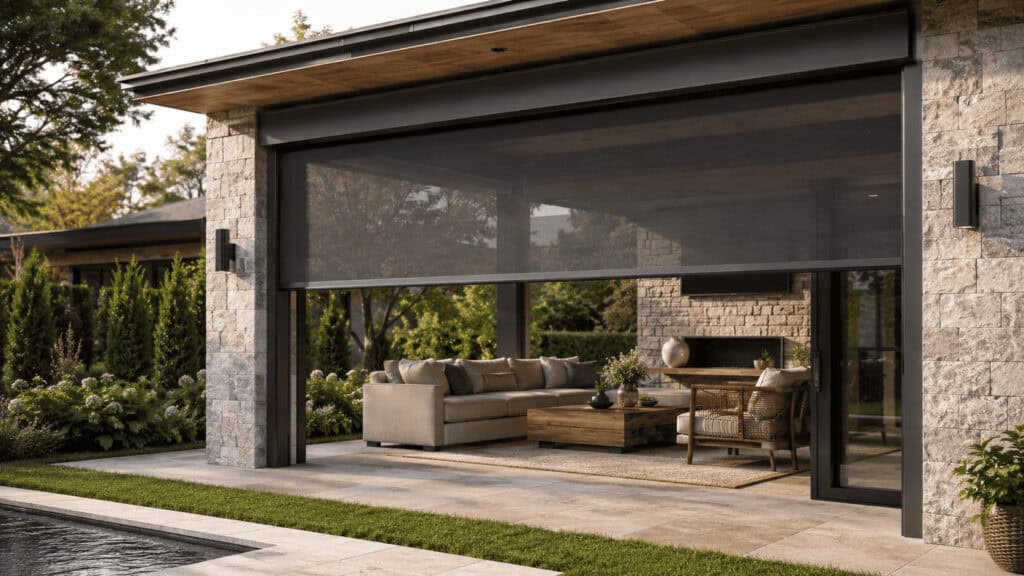
There is a specific moment that happens on an evening in July, usually around 7pm, when the decision of whether to stay outside or go in becomes a negotiation. The light is good. The temperature has dropped to something bearable. But the mosquitoes have arrived, or the west wind has picked up, or the neighbor’s yard is too close for comfort. Most outdoor spaces offer one option at that point: go inside.
A pergola with motorized zip screens offers a different option. At the press of a button — or a voice command — the screens descend quietly on all four sides. The insects stay out. The wind is blocked. The view stays. The evening continues.
That is the functional core of what motorized zip screens do: they give outdoor spaces the ability to respond to conditions rather than surrender to them. It sounds like a small thing until a summer has been spent in a space that can do it, and then it is the first thing wanted in any outdoor space designed after that.
This guide covers what a homeowner needs to make a considered decision about zip screens: how the track-guided system works and why it holds up where other screening approaches fail, what fabric options actually mean for how the space is used day to day, which sides of an enclosure should get which fabric and why, how motorization and smart home integration change the experience, what the installation involves, and what drives cost across the markets Backyard Paradiso serves.
How zip screens work: the track-guided system
The zip track mechanism
Most outdoor shades and screens share a fundamental design weakness: their side edges are not held in place. When a breeze comes through — or when it does what breezes do in the afternoon and becomes something more assertive — an unguided shade panel turns into a sail. It billows inward and outward, disrupts any screening function it was providing, wears at the edges from repeated flexing, and generally becomes more of an annoyance than an amenity.
The zip track solves this at the engineering level. The fabric panel’s side edges are fitted with a continuous coil or bead profile. On each side of the screen opening, a recessed aluminum track channel is mounted. As the screen deploys, those edge profiles zip into the track channels and are held there under continuous tension for the full length of the panel. The fabric is guided — mechanically captured on both sides — throughout the entire range of travel from fully retracted to fully extended.
The result is a fabric panel that stays flat and taut in wind conditions that would send a standard shade panel into motion. The screening function — insect exclusion, solar control, wind reduction, privacy — is maintained because the panel maintains its geometry. This is the meaningful distinction between a zip screen and a standard roller blind, and it is why zip screens are the right specification for any outdoor enclosure intended for regular use rather than occasional, calm-weather shade.
There is also a secondary benefit to the track guidance worth mentioning: insect exclusion. A standard shade panel with unguided side edges has gaps at the margins — it is shade, not a barrier. The zip track’s edge-captured closure means there are no side gaps for insects to pass through. In Florida markets and anywhere with a meaningful mosquito season, this distinction between “shade” and “screen” is the difference between a space that gets used and a space that is avoided after 6pm.
Motorized operation
Motorization is standard for zip screen installations, not an upgrade option. The reason is mechanical: the track-guided fabric produces more friction than a standard unguided shade, and the bottom bar weighted for tensioning adds meaningful load. Operating a zip screen by hand across a typical residential opening height — 8 to 12 feet — is possible but not comfortable or practical for regular use. A system people find physically awkward to operate is a system they do not use. Motorization removes the friction from the decision to deploy or retract.
The tubular motor sits inside the overhead roller tube and drives the fabric down on command and back up on retraction. Motor sizing matters: wider screens (over 14 feet) and taller screens (over 10 feet) require higher-torque motors — rated in Newton-meters (Nm) — than smaller openings. Under-specified motors strain against the load, wear faster, and eventually stall. Over-specified motors run quietly and outlast the screen fabric they are driving. When comparing installation quotes, motor torque rating, cycle life, and warranty terms are worth asking about explicitly.
For multi-screen pergola enclosures — two, three, or four screens around a pergola perimeter — group control allows all screens to deploy or retract simultaneously from a single command. The alternative is operating each screen individually, which works in theory but in practice means the screens do not get used together the way the system is designed to be used. Group control is part of how a multi-screen enclosure functions as a room rather than a collection of individual shades.
Manual systems
Manual zip screens operated by hand crank or spring mechanism are available for smaller openings. They work sensibly at widths under 10 feet and heights under 8 feet. Above those dimensions, the physical effort of operation makes motorization a meaningful quality-of-life investment rather than an optional add-on. For a borderline-sized opening, the useful question is whether the screen will actually be retracted when the weather changes, or whether it will stay deployed because that is easier. For most households, the answer determines whether motorization is worth it.
Using the conditions matrix: when to deploy what
Motorized zip screens are most useful when they are part of how the outdoor space is actually thought about — not something deployed once when it gets windy and then left down permanently. The value is in the flexibility: a space that responds to what is happening outside rather than being locked into a single configuration.
The matrix below maps the conditions encountered most often across an outdoor entertaining season to the screen configuration that addresses them and the fabric type that performs best in each scenario. It is a decision-making reference, not a rigid rule — much depends on the specific site, orientation, and how the space is used.
| Outdoor Condition | Screen Configuration | Best Fabric for This Condition | Notes |
|---|---|---|---|
| Calm evening, no insects | All screens retracted — fully open | N/A | No screening needed. The pergola roof handles whatever overhead protection is required. This is the default warm-evening configuration. |
| Insects active (mosquitoes, gnats) | All screens deployed | Open mesh (5–10% openness factor) | Mesh keeps insects out while maintaining airflow. The zip track’s edge closure eliminates the margin gaps that standard shade panels leave. Effective in warm, still conditions where insect pressure is the primary issue. |
| Afternoon west sun / glare | West-facing screen(s) deployed; others retracted or at partial height | Solar screen fabric (3–5% openness) | Solar screen on the sun-exposed side blocks the large majority of direct solar radiation and significantly reduces glare without closing the other sides. The space stays bright and ventilated; the western wall is managed. |
| Light to moderate wind (10–20 mph) | Windward screen(s) deployed; leeward side(s) open or at partial height | Open mesh — reduces wind speed without full blockage | Deploying only the windward screens maintains good airflow through the space while cutting direct wind. Full enclosure in light wind produces a still, warm interior — partial deployment is usually the better configuration. |
| Strong wind (20+ mph) | All screens retracted above the system’s wind rating | N/A — retract in high wind regardless of fabric | Zip screens are wind-stable within their design rating, but they are not rated for storm-force wind. When wind sensors trigger (or the call is made manually), retract all screens. A wind sensor automation that retracts automatically is worth the investment in high-wind markets. |
| Light rain | Roof providing overhead cover; screens deployed as needed for wind and insect management | Mesh or solar screen shed light rain adequately | The pergola roof handles rain overhead. Side screens in mesh or solar fabric handle light rain without issue — they drain quickly and are unaffected by wetting. The space stays usable in light rain with proper overhead coverage. |
| Driving rain with wind | Clear vinyl on the weather-exposed side deployed; other sides as needed | Clear vinyl (PVC view panel) | Clear vinyl provides a fully weather-sealed wall — wind-driven rain does not penetrate. Best used on the predominant weather exposure for the site. The view is maintained through the clear panel, but ventilation is eliminated on that side. |
| Privacy needed (adjacent properties, street visibility) | Privacy-facing screen(s) deployed | Low-openness mesh (1–3%) or blackout fabric | Low-openness mesh reduces through-screen visibility while maintaining interior view-out and airflow. Blackout fabric provides full privacy but eliminates the view. Most residential applications are better served by low-openness mesh than blackout — airflow matters more than total privacy in most contexts. |
| Cold-season shoulder use (spring/fall) | Full enclosure deployed to retain heat | Clear vinyl on all sides for maximum heat retention | Clear vinyl on all sides of a covered pergola creates a greenhouse effect that extends comfortable outdoor use into cooler temperatures. Pair with an outdoor heater for evening shoulder-season use when temperatures drop below 55°F. |
The pattern across these scenarios: a well-designed zip screen enclosure is rarely in a fully-open or fully-closed binary state. Most of its real value comes from partial configurations — one or two screens deployed to address a specific condition while others remain open. That configurability is what makes it a different product category from a permanent screen enclosure, which is either there or it is not.
Fabric selection as a system design problem
The preliminary question most buyers ask about zip screen fabric is “which fabric is best?” That is the wrong question. The right question is “which side of this enclosure gets which fabric, and why?” A four-sided pergola enclosure with the same fabric on all four sides is almost always under-specified for some uses and over-specified for others.
Fabric selection is a design decision about the enclosure as a system, driven by the site’s orientation, the primary exposures, and how the space is used.
The four fabric types and what they actually do
| Fabric Type | Openness Factor | What It Delivers | What It Does Not Deliver |
|---|---|---|---|
| Open mesh | 5–14% open area | Insect exclusion, airflow retention, partial solar reduction, view-through from inside. The most livable fabric for all-day use. | Significant solar heat blocking (limited by the openness). Full privacy. Weather sealing in driving rain. |
| Solar screen | 1–5% open area | Solar heat reduction and glare control — the two co-primary functions. Blocks the large majority of direct solar radiation and significantly cuts visual glare from low sun angles. Outward view maintained at most openness levels. Insect exclusion. | Full airflow (dense weave restricts ventilation noticeably). Full weather sealing. The space feels more enclosed than open mesh. |
| Clear vinyl (PVC) | 0% (solid) | Full weather sealing — rain, wind. Full insect exclusion. Unobstructed view maintained. | Ventilation (none). Solar heat blocking (vinyl can trap heat). Best used on weather-exposed sides only, not as the primary fabric on all sides. |
| Blackout fabric | 0% (solid, opaque) | Complete privacy and light blockage. Maximum wind reduction. Weather resistance. | View-through (none). Ventilation (none). Tends to make the enclosed space feel small and enclosed rather than outdoor. Appropriate for specific applications; rarely the right choice for a primary living enclosure. |
How to assign fabric by orientation
The most functional approach to a four-sided enclosure is to treat each side independently based on what it faces and what is needed from it.
The sun-exposed side (typically west or southwest). This is the side that drives afternoon heat load. Solar screen fabric on the west-facing side is one of the highest-value specification decisions in the whole system — it reduces afternoon solar radiation dramatically, makes the space usable during the hottest part of summer afternoons, and does it without sealing the space off from airflow the way a solid fabric would. In high-UV markets like Colorado, Florida, and Texas, solar screen on the primary sun exposure is the decision with the most measurable impact on how much the space actually gets used.
The weather-exposed side (typically the windward or rain-prevailing direction). Clear vinyl on this side provides full weather protection when conditions deteriorate. Because the clear vinyl maintains visibility through the panel, the enclosed space does not feel like it has been sealed into a box — the rain hitting the panel is visible from inside, which is actually quite pleasant in the right context. Clear vinyl on one side combined with mesh on the others is a common and well-performing configuration for spaces that see meaningful weather.
The privacy-sensitive side (adjacent property lines, street, neighboring buildings). Low-openness mesh at 1–3% openness factor provides meaningful privacy screening — visibility into the space from outside is substantially reduced — while maintaining some airflow and the outward view from inside. Full blackout is rarely necessary for a residential outdoor living space and makes the space feel oppressive; low-openness mesh is usually the right compromise.
The view side or the primary open side. Standard open mesh at 5–10% openness allows the best view-through, the most airflow, and the most outdoor feeling when the screen is deployed. If the enclosure has a side with a desirable view — a garden, a pool, a landscape — this is the side for open mesh rather than solar screen or clear vinyl.
Most four-sided pergola enclosures end up with something like: solar screen west, open mesh north and east, clear vinyl south (the weather exposure for many US markets), and open mesh on the view side. The mix is driven by the specific site, not a formula — but the principle is consistent: different sides face different conditions and benefit from different specifications.
Applications: where zip screens are installed
Pergola perimeter enclosure
The primary application and the one this guide is primarily written around. An aluminum pergola provides the overhead structure — fixed or motorized louvre roof — and zip screens close the perimeter walls on two, three, or four sides. With all screens deployed the space is a fully enclosed outdoor room. With all screens retracted it is an open-air pavilion. In between, any combination of deployed screens addresses the specific conditions at a given moment.
For pergolas with motorized louvre roofs, the combination of overhead and perimeter control is impressive. Open louvers and retracted screens on a pleasant evening. Louvers tilted for partial shade and the west screen deployed during afternoon sun. Louvers closed and all screens deployed during a summer storm — the space stays usable. Whether the pergola houses a seating area, a dining table, or a full Backyard Kitchen, the integration of two motorized systems gives that room a range of operational configurations that no fixed structure can match.
Patio and deck perimeter screening without a pergola
Zip screens can be mounted to a home’s exterior wall — using the roofline or a mounted header beam as the overhead attachment point — to enclose a patio or deck that does not have a dedicated pergola structure above it. This is a cost-effective approach to adding insect screening and wind protection to an existing outdoor space without the full investment of a pergola build. The overhead coverage relies on the existing roofline or eave; the zip screens define the side walls of the screened area.
This configuration works particularly well for covered patios and attached porches, where the overhead is already provided by the home and the main value needed is perimeter protection. It is also a practical intermediate step for homeowners who plan to add a freestanding pergola eventually — the zip screens can mount to the pergola when it is built.
Pool area enclosures
In Florida markets — Naples and Orlando — pool area enclosures are a specific and common application. The mosquito and biting insect environment in Florida during warm months makes an enclosed pool area substantially more comfortable for evening use. The zip screen approach allows the enclosure to fully open on pleasant days and fully close for insect management in the evenings, which a permanent screen cage structure cannot do.
Pool enclosure installations have specific requirements: fabric must be compatible with pool chemical exposure, particularly chlorine and the UV-reflective environment near a water surface. Hardware in pool proximity requires corrosion-resistant specification. These are not complications that prevent pool area installation — they are specifications that inform the product selection during the design consultation.
Commercial applications
Restaurants, bars, covered terraces, and hospitality venues use zip screens to extend outdoor seating into shoulder seasons and weather conditions that would otherwise push guests inside. A covered terrace with motorized zip screens on the perimeter becomes a usable space during a light rain or a breezy evening rather than an outdoor area that is closed on sight of clouds.
Commercial applications use the same track-guided technology as residential installations, specified to commercial-grade motor and hardware ratings that are sized for higher daily use cycles. A residential zip screen might operate five to ten times per week; a restaurant terrace zip screen might cycle twenty to thirty times per day. Motor and hardware specification reflects that difference, and the installation quote for commercial applications should specifically address use-cycle ratings.
Zip screens vs the alternatives at the perimeter
Versus standard roller blinds or drop shades
This is the most common comparison because unguided roller shades are the lower-cost alternative that looks similar in photographs. The functional difference shows up in any real-world wind — an unguided shade panel billows, losing its screening geometry and becoming a distraction rather than an amenity. For occasional calm-weather use, roller blinds are a reasonable choice. For regular use as part of an outdoor room system that needs to perform in actual outdoor conditions, the zip track is the specification that makes the product work as designed. The cost difference between a standard roller blind and a zip screen is real; so is the performance difference.
Versus fixed insect screen panels
Fixed screen panels — permanent mesh stretched over a framed opening — provide insect exclusion but no flexibility. The screening is present or the panels are removed entirely; there is no partial configuration. For homeowners who want the outdoor space fully screened permanently and never need to open the perimeter, fixed panels are a simpler and cheaper solution. For homeowners who want full open-air exposure on good evenings and screening when conditions require it, fixed panels deliver only half the function.
Versus retractable awnings
Awnings and zip screens do different things. An awning provides overhead shade from above; zip screens provide perimeter enclosure from the sides. Neither replaces the other — in a complete outdoor room system, both are typical: overhead coverage from a pergola roof or awning, and perimeter management from zip screens. If budget requires choosing, the function that matters more for the specific use case should drive the decision. The full retractable awning guide covers the overhead coverage side of that equation.
Versus glass patio enclosures
Glass enclosures — permanent framed glass panels creating a sealed patio room — provide maximum weather protection and a clean architectural appearance. They are permanent, require ventilation design to prevent overheating, and involve significantly higher cost and construction complexity than a zip screen system. For homeowners who want a year-round fully enclosed room, glass is appropriate. For homeowners who want the flexibility to go from fully enclosed to fully open in thirty seconds, zip screens are the right fit. The choice is really between a room addition and a flexible outdoor room — different products serving different goals.
Motorization, smart control, and wind automation
Control options
Motorized zip screens can be operated from a wall-mounted switch, a handheld remote, a smart home app, or through voice control integration. The appropriate control configuration depends on how the system will be used in practice. A single-screen installation on a porch is well served by a wall switch and a remote. A multi-screen pergola enclosure is significantly more useful with app control and group scene capability — the ability to issue “close all screens” as a single command rather than operating four switches in sequence.
Smart home integration
Zip screen motors built on the major motorized-shading control protocols — including direct IP control — integrate with the leading smart home platforms and voice assistants. Integration allows schedule-based automation (screens deploy at a set time each evening for insect management), scene integration with other outdoor systems (screens, lighting, and a pergola louvre roof all responding to a single “evening mode” command), and remote monitoring and control from anywhere.
For homeowners who already have smart home infrastructure, zip screen integration is straightforward — the motorization platform choice during installation determines which integration pathways are available, which is worth confirming during the design consultation if smart home integration is a priority.
Wind sensors: the feature most buyers do not think about until they need it
This is the most underrated specification in the entire zip screen category. Wind sensors are anemometers mounted near the installation that monitor wind speed continuously and trigger automatic screen retraction when wind exceeds a programmed threshold. In markets where afternoon winds develop quickly — the Front Range of Colorado, coastal Florida, the Texas Hill Country — the window between “pleasant outdoor conditions” and “winds that should not have a deployed screen in them” can be fifteen minutes.
A wind sensor removes the human judgment and reaction time from that equation. When the wind speed threshold is crossed, all screens retract automatically — whether someone is sitting in the space watching it happen, or inside and unaware the wind has come up. Systems with wind sensor integration can also include rain sensors that trigger deployment of clear vinyl panels when precipitation is detected, creating a self-managing enclosure system that responds to conditions without manual intervention.
In practical terms: for any installation in a market with meaningful wind variability, a wind sensor is an investment in the longevity of the screen fabric and motors as much as it is a convenience feature. Screens deployed in wind above their design rating experience accelerated edge and fabric wear. A sensor that prevents that condition from occurring repeatedly extends the operational life of the system.
The installation process
Opening measurement and structural assessment
Each screen opening is measured for width and height at the exact installation position. The overhead header — the structural member the motor housing and track top anchors attach to — is assessed for load capacity and anchor suitability. Pergola beams, steel headers, masonry lintels, and structural wood members all serve as headers; each requires hardware appropriate to the substrate. Getting this right before ordering avoids the most common installation problem, which is discovering at installation time that the intended header cannot support the load at the planned anchor points.
Track installation
The side tracks are plumb-mounted on each side of the opening, anchored into structural material at the appropriate intervals. Track straightness and parallelism are the critical tolerances — any deviation from plumb or from parallel with the opposite track produces binding at the zip edges during operation. A screen that binds during deployment does not get used; a screen that binds repeatedly under motor load will fail the motor or fabric prematurely. Track installation is where the quality difference between a careful installation and a fast one shows up most clearly, and where it is hardest to see at a quick glance after the job is done.
Motor housing, roller assembly, and fabric installation
The motor housing and roller tube assembly is mounted to the header. Motor wiring is routed and connected. The fabric panel is attached to the roller tube and threaded through the side tracks, with the bottom bar weighted to maintain proper tension across the full width of the opening. Bottom bar alignment is checked — an un-level bottom bar signals that something in the track or roller alignment needs adjustment before commissioning.
Travel limit programming and commissioning
The motor’s travel limits are programmed: full extension at the bottom of travel, full retraction at the top. Limit programming is what prevents the motor from driving the fabric into the end stops under power — a motor that hits a hard stop repeatedly fails faster than one whose limits are calibrated correctly. Control pairing is completed — wall switch, remote, and app integration connected and tested. Wind sensor installation and threshold programming is completed where applicable. The commissioning walkthrough covers operation of each screen individually, group scene programming for multi-screen configurations, and app setup if smart home integration was specified.
What drives motorized zip screen cost
Zip screen cost is driven by opening width and height, fabric specification, motor specification, and the number of openings in the installation.
Single-opening residential installation: A standard residential zip screen on a single opening — 10 to 14 feet wide, 8 to 10 feet tall — is priced per opening, with installed cost covering motor, fabric, track hardware, and commissioning. Larger openings, commercial-grade motors, and premium fabric specifications increase per-opening cost.
Multi-screen pergola enclosure (3–4 sides): A complete pergola perimeter enclosure with three or four motorized zip screens scales in cost with total opening dimensions and fabric specification mix. Mixed fabric specifications — solar screen on one side, mesh on two sides, clear vinyl on one side — do not add cost linearly; the per-screen cost is similar across fabric types.
Wind and rain sensor addition: Priced by the sensor system and the number of screens it controls.
Smart home integration: Scales with the existing home automation infrastructure and the complexity of the integration required. Homes with an established motorized-shading control ecosystem are at the low end of the range; full integration into a custom control system is at the high end.
Commercial installations: Priced based on opening count, dimensions, and commercial-grade motor and hardware specification. Commercial motors rated for higher daily use cycles carry a cost premium over residential motor specifications — it is the right specification for the application, not an upsell.
The most common cost mistake in zip screen purchases is specifying residential-grade motors on commercial-use-cycle applications, or under-specifying motor torque for large openings to save upfront cost. Both decisions produce premature motor failure and a repair cost that exceeds the original savings. Motor specification should match the actual use cycle and physical load, not the minimum spec that fits the opening.
Service market considerations
Naples and Orlando
Insect management is the primary functional driver in Florida, and it shapes both the fabric specification and the usage pattern for zip screen installations here more than in any other market. The biting insect population in Florida during warm months — effectively nine to ten months of the year — makes the difference between an enclosed and an unenclosed outdoor space the difference between a usable space and one that is abandoned after 6pm. Mesh fabric on three sides and clear vinyl on the weather-exposed side is a common Florida configuration. Pool area enclosure is a specific and frequent application. For pergola installations in the Naples coastal zone, hardware with marine-grade corrosion resistance is the appropriate specification given the salt air environment.
Colorado Springs and Denver
Afternoon wind and the speed at which Front Range weather changes are the primary drivers here. A pleasant outdoor afternoon in Denver can turn into a strong gust event in twenty minutes, particularly during summer thunderstorm season. Wind sensor automation is more directly valuable in the Colorado markets than in any other market served — the sensor-triggered automatic retraction protects the screens from wind loading they were not designed for, and it does it without requiring the homeowner to be watching the weather constantly. Solar screen on the west-facing side is also a high-value specification here, where summer afternoon sun is intense at altitude.
San Antonio
Insect pressure in the South Texas summer, the consistent south and southwest wind, and high summer solar heat load are the three drivers. West and south side solar screen is the specification that makes the space usable in July and August afternoons. Mesh on the north and east sides maintains airflow while the protected sides manage heat load. The ability to extend comfortable outdoor use into the shoulders of the Texas summer — May and October evenings that would otherwise be borderline — is where zip screens deliver meaningful value in this market.
Romeoville
Illinois’s warm-season insect pressure and the value of extending outdoor use into May and September shoulder months are the primary drivers. A fully mesh-enclosed pergola in Romeoville is usable from May through October in a way an open-perimeter pergola is not, because the insect and occasional cool-evening conditions are managed by the enclosure. The longer comfortable outdoor season is the primary value story in this market — the weather drama of the Florida and Colorado markets is less relevant in Will County’s climate context.
Secaucus
Urban pergola and balcony applications where wind from elevated positions and privacy screening from adjacent properties are both relevant. Zip screens on urban residential terraces in the New York metro area serve a different function than in suburban back yards — the privacy and wind management arguments are stronger, and the view preservation of mesh and clear vinyl fabrics is particularly valued in a dense urban context where the view is worth protecting.
Frequently asked questions
What is the difference between a zip screen and a regular outdoor shade?
The zip track. A zip screen’s side edges run in enclosed aluminum track channels that hold the fabric taut and mechanically stable in wind. Standard roller shades or drop blinds have unguided side edges — when wind comes through, those edges billow, the shade loses its geometry, screening effectiveness drops, and the edge material wears from repeated flexing. The zip track makes a zip screen a perimeter enclosure system rather than a shade panel. It stays flat in conditions that would have a standard shade flapping and useless. There is also an insect exclusion dimension: the track-edge closure eliminates the side gaps that an unguided panel leaves, which means insects cannot pass through at the margins the way they can with any shade that is not edge-captured.
What wind speed can zip screens handle?
This varies by manufacturer, motor specification, and panel dimensions — which is why asking specifically about wind rating during the design consultation is important. Most quality residential zip screen systems carry engineered deployed-wind ratings established by product testing, with the specific rating varying by product line. At or above the system’s wind rating, screens should be retracted. A wind sensor that triggers automatic retraction at a programmed threshold removes the judgment call and reaction time from that equation. In high-wind markets — particularly the Colorado Front Range — wind sensor automation is worth treating as a standard specification rather than an optional add-on.
Can zip screens be left deployed during rain?
Mesh and solar screen fabrics can be deployed during light to moderate rain — they shed water without issue, and the track-guided system is designed for wet conditions. Clear vinyl panels provide full rain protection. What screens cannot handle is driving rain combined with high wind at or above the system’s wind rating — in those conditions, retract regardless of fabric type. The limiting factor is wind load, not water.
Do zip screens keep insects out?
Yes, provided the fabric’s openness specification is appropriate — tight enough to exclude the insects of concern. Mosquitoes can pass through mesh coarser than the standard 18 × 14 insect-screen count, so fabric specified for insect exclusion needs to be at that density or tighter. Most open-mesh zip screen fabrics used in insect-prone markets are specified at this level or better. The zip track’s edge closure is also critical here: a shade panel without track guidance has gaps at the side margins that insects pass through regardless of how tight the mesh weave is. The zip track eliminates those gaps.
How do motorized zip screens integrate with smart home systems?
Zip screen motors built on the major motorized-shading control protocols integrate with the leading smart home ecosystems and voice assistants. Integration enables schedule-based automation, group scene control (all screens deploying and retracting together as part of an outdoor scene), and remote operation from anywhere via smartphone. The specific platform supported depends on the motor selected — this is worth confirming during the design consultation if integration with an existing smart home system is a priority.
Can zip screens be added to an existing pergola?
Usually yes, depending on the pergola’s structural configuration. The key requirement is an adequate header at each screen opening — a structural member of sufficient load capacity that the motor housing and track tops can be anchored into it correctly. Most pergola beam configurations provide this. The site assessment includes evaluating the existing pergola structure for zip screen compatibility, and in most cases the answer is yes without modification.
How long do motorized zip screens last?
Quality tubular motors carry rated cycle lifetimes measured in the tens of thousands of operations — a service horizon spanning decades at typical residential usage. Fabric carries a shorter service horizon than the motor and hardware, depending on UV intensity and care — UV stabilization in the fabric specification and occasional cleaning extend the lower end of that range. The motor typically outlasts the fabric, meaning most zip screen systems see one fabric replacement over their operational life while the motor and track hardware continues in service.
What maintenance do zip screens need?
Annual cleaning of the track channels — debris in the zip channel is the most common cause of binding and uneven operation — and periodic fabric cleaning with mild soap and water. The motor should be professionally inspected if it develops unusual noise or resistance during operation. If the system is wind-sensor automated, the sensor calibration should be checked annually to confirm threshold accuracy. Beyond that, quality zip screen systems require minimal maintenance — the track-guided design has fewer wear points than mechanisms with exposed moving parts.
Service areas
Backyard Paradiso installs motorized zip screens across the markets it serves. Fabric specification, motor selection, and wind sensor recommendations are adapted to the climate conditions, wind exposure, and insect environment of each market. The full list is on Markets We Serve.
The threshold between inside and outside is a design decision
Most outdoor spaces have a fixed answer to the question of where inside ends and outside begins. A zip screen enclosure makes that threshold adjustable — fully open on a calm June evening, progressively enclosed as conditions change, completely sealed when the weather demands it. The space responds to what is happening rather than forcing the household to respond to the space.
The design consultation is where the orientation of the specific site, the primary exposures, and the intended use pattern translate into fabric specifications, motor specifications, and control configurations that match how the space will actually be used. A site assessment evaluates opening dimensions, header structure, and site conditions and produces a quote based on the actual scope. Consultations are available by appointment.