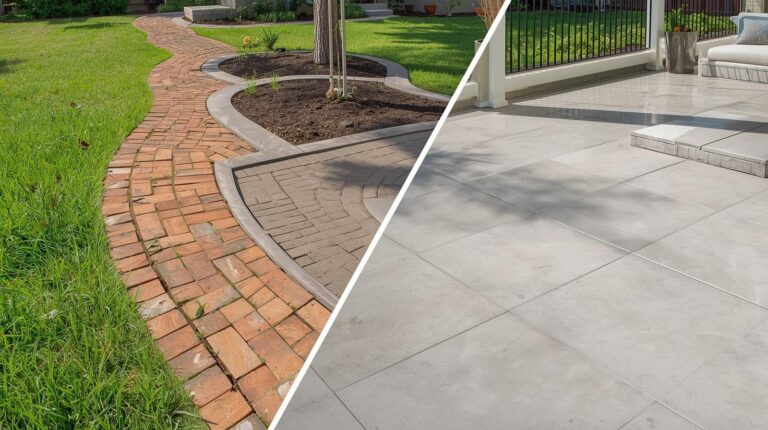
What Causes Pavers to Sink or Lift?
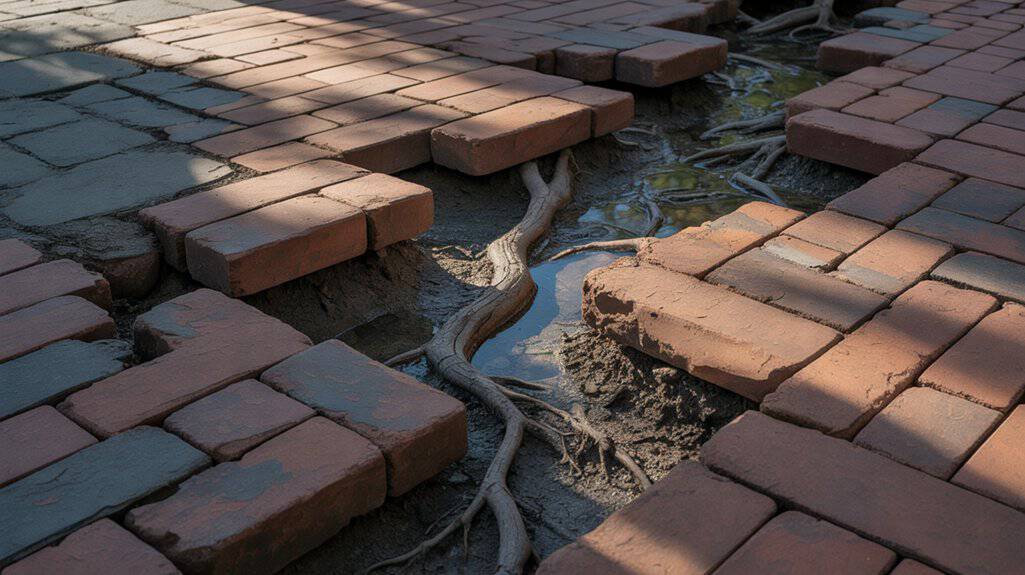
What Moving Pavers Are Telling You
Paver movement is a diagnostic signal: sinking or lifting units indicate a failure in one or more of the layers or conditions beneath the surface, not a defect in the pavers themselves. The specific pattern – isolated dish, perimeter tipping, seasonal heave, or whole-field undulation – reflects whether soil, water, frost, or installation practice is the governing condition. A paver patio is a flexible segmental pavement system, with units bedded on sand over compacted aggregate base, dependent on interlock and edge restraint for surface stability.
Settlement From Below
Settlement that originates below the paver surface almost always traces to one of two failures in the foundation layers. An under-compacted subgrade or fill – soil placed over a utility trench or former planting bed without reaching the 98-percent standard Proctor density required by CMHA guidelines – consolidates under repeated load and pulls the surface down with it, often in patterns that mirror whatever disturbance lies beneath. Bedding sand compounds the problem when it is screeded too thick or composed of limestone screenings or stone dust, materials that absorb moisture, lose structural integrity, and allow the pavers above to dish and rut.
Under-compacted base and fill that was never compacted
The Concrete Masonry and Hardscapes Association guideline PAV-TEC-002 requires both the subgrade and aggregate base to be compacted to at least 98 percent of standard Proctor density, as defined by ASTM D698. When base material is placed in lifts too thick for a compactor to reach the bottom of the layer, or when compaction occurs outside the ideal moisture window, the aggregate consolidates gradually under foot traffic and load cycles, producing surface depressions. Settlement that appears along a foundation wall, over a utility trench, or where a former planting bed once existed almost always points to fill that was placed but never compacted. CMHA PAV-TEC-002 sets the finished surface tolerance at plus or minus three-eighths inch under a ten-foot straightedge; depressions exceeding that threshold constitute a defect in the installation, not normal wear.
Bedding sand too thick or the wrong material
Bedding sand screeded beyond a nominal one-inch uncompacted thickness creeps laterally under repeated load, causing pavers to rut, rock, and lose the planar surface the installation requires. The Concrete Masonry and Hardscapes Association guideline PAV-TEC-017 further prohibits limestone screenings and stone dust as bedding materials, because their fine particles migrate toward paste when saturated, undermining uniform support across the entire field. Compliant bedding sand meets ASTM C33 gradation with no more than one percent of material passing the No. 200 sieve, a threshold that limits the fines responsible for moisture-driven instability. When either condition is present – excessive depth or a prohibited material – settlement is diffuse rather than localized, spreading across the patio field in a pattern that can be mistaken for base failure.
Water and the Edge
Water and inadequate edge restraint account for two of the most recognizable failure patterns in a segmental paver field. When slope falls below two percent, joint sand washes out, the base saturates, and fines pump upward through the joints – leaving sand on the surface after rain and a spongy feel underfoot that signals lost bearing capacity beneath. At the perimeter, a restraint that does not bear against the bottom inch of the paver side allows the field to spread laterally, joints to open, interlock to collapse, and edge units to tip inward under load.
Saturated base, washed joints and pumping fines
Water infiltrating a paver base destroys bearing capacity by saturating the aggregate and allowing fines to pump upward through open joints. IRC 2021 Section R401.3 requires finished grade within ten feet of a foundation to fall away from the structure at a minimum two-percent slope, a threshold directly applicable to patio surfaces adjacent to the house. When slope falls below that minimum – or when a downspout discharges onto the patio, joint sand washes out, or an edge drain becomes blocked – the base loses its ability to distribute load. The diagnostic signature is sand deposited on the paver surface after rainfall and a spongy underfoot feel, both indicating that fines are migrating rather than staying locked in the base profile.
Edge restraint failure and the spreading field
CMHA standard PAV-TEC-003 requires edge restraints to bear against the bottom inch of the paver side face, a dimensional minimum that keeps the field locked under lateral load. Without that bearing contact, pavers migrate outward incrementally, joints widen, and the interlock that gives segmental pavement its load-distributing capacity is lost. Once interlock fails, perimeter units carry load independently rather than collectively, and tipping or sinking at the field edge follows. Corroded or under-driven spike fasteners accelerate the process, allowing the restraint to creep outward each freeze-thaw cycle; soil and landscape edging, neither of which meets the structural requirement, are common substitutes that produce the same progressive failure pattern.
Lifting: Frost Heave
Frost heave is the one failure mode that lifts pavers rather than sinking them, and it will not occur unless three conditions are present simultaneously: frost-susceptible soil, a freezing front that reaches it, and a water source within range of that front. Remove any one condition and heave stops, which is why base depth, drainage, and geotextile separation matter as a system rather than individually. The pattern is diagnostic – humps that appear in late winter and partly recede by spring, concentrated where water collects, distinguish frost heave from settlement and direct the repair toward the base conditions rather than the surface units themselves.
The three conditions frost heave needs
Frost heave requires the simultaneous presence of three conditions: frost-susceptible soil, a freezing front that reaches the subgrade, and a water source within range of that front, as documented in U.S. Army Corps of Engineers Engineer Manual 1110-3-138. Silts, silty sands, and low-plasticity clays are the soil types most prone to ice lens formation; where these underlie a patio, the base is at material risk. As temperatures drop, ice lenses grow and push the pavement upward; on thaw, the softened soil fails to fully recover, leaving pavers settled in a different position than before. The signature pattern is surface humping in late winter that partially recedes in spring, concentrated where water accumulates.
Reading the pattern and deciding repair versus rebuild
Pavers that lift in late winter and settle imperfectly on thaw follow a pattern distinct enough to separate frost heave from base compaction failure without excavation. Where humping concentrates at low points or water-collection zones and partially recedes each spring, frost heave is the operative mechanism; where settlement is uniform across the field and shows no seasonal recovery, inadequate base compaction is the more probable cause. The Concrete Masonry and Hardscapes Association standard PAV-TEC-006 recognizes that segmental pavement allows localized lifting, base correction, and relay of the original units – an intervention appropriate when heave is confined. Whole-field base failure, by contrast, requires base reconstruction rather than targeted repair.
Frequently Asked Questions
Four questions surface consistently when paver surfaces begin to fail: why a single spot sinks, why units lift in winter, whether selective repair can substitute for a full rebuild, and how much surface variation is acceptable. Localized sinking almost always traces to a discrete subsurface event – uncompacted fill over a utility trench, for instance – while seasonal lifting points to frost acting on saturated, susceptible soil. The answers to all four hinge on the same diagnostic logic: the pavers are not the problem, and the base condition determines whether lifting affected units and correcting the substrate resolves the failure or whether the entire base must be addressed.
Why are my pavers sinking in one spot?
Localized sinking at a single point almost always indicates a base or subgrade failure confined to that area – most often fill that was never compacted beneath a utility trench or a former planting bed. Settlement along those boundaries is a diagnostic signature, not random deterioration. CMHA PAV-TEC-006 governs correction: the affected units are lifted, the base rebuilt, and the original pavers relaid.
Why do pavers lift in winter?
Frost heave lifts pavers when freezing temperatures, frost-susceptible soil, and a water source near the freezing front occur together. Removing any one of those three conditions prevents heave, which is why base drainage and a geotextile separator per AASHTO M288 matter. The Concrete Masonry and Hardscapes Association addresses frost heave under segmental pavement system design.
Can sunken pavers be fixed without redoing the patio?
Localized sinking can often be corrected without full reconstruction if the underlying cause is confined to a discrete area. Where whole-field settlement stems from an inadequately compacted base, the Concrete Masonry and Hardscapes Association (CMHA) classifies the condition as a base rebuild rather than a patch. The same pavers are typically salvaged and relaid once the base deficiency is corrected.
How much unevenness in pavers is normal?
The Concrete Masonry and Hardscapes Association sets the pedestrian tolerance at no more than one-eighth inch of lippage between adjacent paver units and no more than one-quarter inch at a slab edge. Surface variation beyond three-eighths inch under a ten-foot straightedge indicates a base defect rather than normal settling. Either threshold, when exceeded, constitutes a trip hazard.
Paver Patios Built on a Proper Base by Backyard Paradiso
Residential paver installations face compounding failure risk where frost-susceptible soils, shallow freezing fronts, poor surface drainage, and uncompacted fill over utility trenches interact beneath a system whose tolerance for base deficiency is measured in fractions of an inch. Backyard Paradiso works within these conditions on every paver patio project, applying the diagnostic framework that connects surface pattern – isolated settlement, perimeter tipping, seasonal heave – to the specific base failure driving it. Consultations are available by appointment for homeowners evaluating new installation or investigating existing movement. A correctly diagnosed and corrected base returns a patio to a safe, flat surface, where an unaddressed settlement pattern keeps moving until lippage passes the Concrete Masonry and Hardscapes Association’s one-eighth-inch pedestrian tolerance and becomes a trip hazard.