How Do Wood, Vinyl, and Aluminum Pergolas Compare?
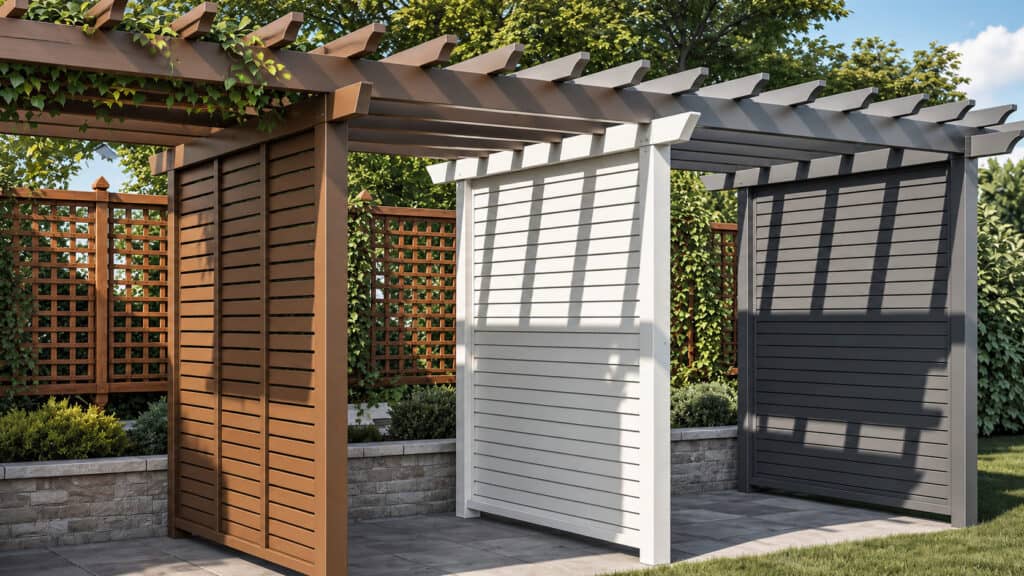
Wood, Vinyl and Aluminum Pergolas Compared
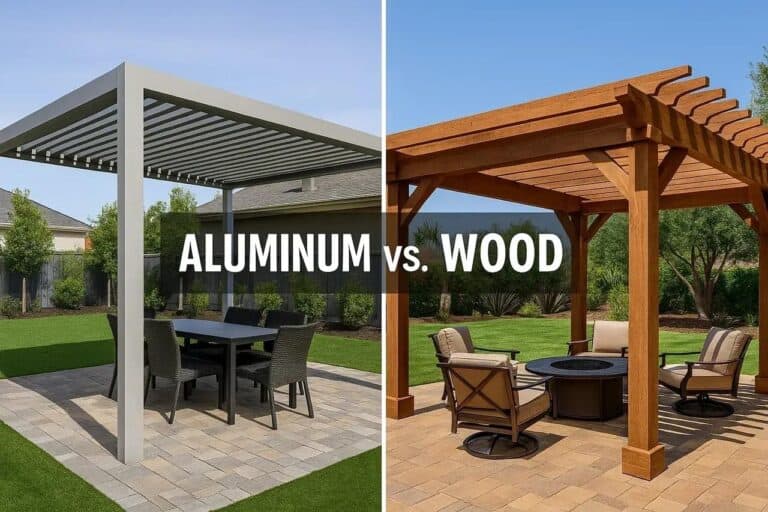
Aluminum, vinyl, and wood each serve residential pergola construction but differ substantially in structural capacity, maintenance demand, and long-term durability. Material performance is further conditioned by installation environment, since coastal salt air introduces filiform and galvanic corrosion risks for aluminum, while wood requires species selection or AWPA treatment to resist rot and insect attack. A pergola is a freestanding or attached overhead structure that provides shade and architectural definition to outdoor living spaces.
| Property | Aluminum (extruded, powder-coated) | Wood (cedar, redwood, PT pine) | Vinyl (PVC) |
|---|---|---|---|
| Design basis | Aluminum Design Manual (ADM 2020); ASTM B221 alloys | AWC NDS span tables by species and grade | Product data; reinforced inserts for span |
| Clear span at a given depth | Longest; closed hollow sections | Shorter; solid sawn members | Shortest unless reinforced |
| Rot, insects, warping | None | Yes unless durable species or AWPA treatment | No rot; UV embrittlement and heat distortion |
| Finish standard | AAMA 2603 / 2604 / 2605 tiers | Stain or sealer on a recurring cycle | Integral color; no refinishing possible |
| Louvered roof and in-post drainage | Available | Not available | Not available |
| Repair pattern | Component replacement | Board-by-board; refinishable | Section replacement |
| Corrosion or decay watch item | Galvanic contact with steel; filiform under damaged coating | Rot at post base and joints | Chalking and cracking under UV |
| Weight and anchorage | Light; uplift anchorage at every post (IBC 1604.9) | Heavy; gravity helps resist uplift | Light; uplift anchorage at every post |
Structure, Span and Weight
Each material’s structural behavior sets the ceiling on how far apart posts can stand and, by extension, how open a pergola’s interior can feel. Aluminum’s closed hollow extrusions, governed by the Aluminum Design Manual, carry loads efficiently enough to achieve long clear spans at a dead load typically between three and eight pounds per square foot, while wood members following NDS span tables demand shorter bays at greater self-weight for equivalent depth. Because aluminum and vinyl frames are comparatively light, IBC 2021 Section 1604.9 requires positive uplift anchorage at every post – a footing condition that heavier wood construction may satisfy through mass alone, depending on jurisdiction.
How each material carries a beam and what that means for post spacing
Extruded aluminum members designed under the Aluminum Design Manual (ADM 2020) achieve dead loads commonly between 3 and 8 pounds per square foot, enabling clear spans that wood members of equivalent depth cannot match. This structural efficiency stems from closed hollow section profiles, which concentrate material at the outer faces of the section and resist bending with less self-weight than solid or dimensional lumber. Wood framing follows the American Wood Council National Design Specification and species-grade span tables, and those tables consistently yield shorter allowable spans for a given member depth. Vinyl performs weakest in bending of the three materials; unreinforced hollow PVC extrusions require internal aluminum or wood inserts before they can carry any meaningful span, making post spacing a function of the reinforcement rather than the vinyl itself.
Dead load, uplift and the footing each one needs
IBC 2021 Section 1604.9 requires positive uplift anchorage at every post for lightweight structural frames, a provision directly applicable to aluminum and vinyl pergolas whose low self-weight offers minimal resistance to wind uplift forces. Where wood pergolas rely partly on dead load to counteract uplift, aluminum and vinyl structures – with dead loads in the 3 to 8 pounds per square foot range documented under ADM 2020 design practice – must transfer net uplift through positive mechanical connections into the footing. The footing itself must be sized for both compression under gravity loads and tension under uplift, with the governing load combination determined by the applicable provisions of IBC 2021. Wood, being the heaviest of the three materials, reduces net uplift demand but imposes greater compressive bearing loads on the footing and increases the tributary load carried by each post.
Weather, Finish and Maintenance
Each material’s service life is primarily decided not by its structure but by how it responds to the sustained pressure of UV radiation, moisture cycling, and – in coastal installations – airborne chlorides. Wood checks, cups, and greys under that pressure, and without a recurring stain or sealer cycle keyed to AWPA standards, rot and insect attack follow. Vinyl resists both but trades those vulnerabilities for a different set: without adequate UV stabilizer, it embrittles and chalks, and because it cannot be refinished, degradation is a replacement problem rather than a maintenance one.
What the sun, rain and salt do to each one
AAMA 2605 requires that a powder-coated aluminum finish retain color within a stated limit after a ten-year standard reference exposure, establishing the highest performance tier among the three coating classifications published by FGIA. That standard’s threshold matters for pergola frames because the finish, not the substrate, is aluminum’s primary vulnerability under prolonged sun and moisture. Where the coating is damaged, filiform corrosion can propagate beneath the surface, particularly in salt-laden air, and galvanic corrosion becomes a risk wherever aluminum contacts uninsulated steel fasteners. Wood, by contrast, checks, cups, and greys as a function of the substrate itself, requiring a recurring stain or sealer cycle, while vinyl cannot be refinished at all once UV exposure degrades its surface.
Finish standards and the recurring work each material asks for
AAMA 2604 requires that a qualifying coating retain color within a stated limit after a five-year standard reference exposure, while AAMA 2605 extends that threshold to ten years, establishing a performance hierarchy that directly determines how much recurring work an aluminum pergola frame will demand over its service life. A frame finished to the 2605 tier asks little of an owner beyond periodic washing to clear debris that can trap moisture against the coating. Wood imposes a fundamentally different obligation: checking, cupping, and graying are substrate-level processes that a stain or sealer cycle can slow but not eliminate, making maintenance a recurring condition of ownership rather than an occasional response to damage. Vinyl asks for no finish work but offers no remedy when UV exposure chalks or embrittles its surface, leaving replacement as the only corrective path.
Roofs, Integration and Repair
Roof architecture separates aluminum systems most sharply from wood and vinyl: motorized louvered panels, integrated beam gutters, and in-post drainage channels all depend on extruded aluminum profiles and are not available in the other two materials. Aluminum frames also accept integrated low-voltage lighting, fans, heaters, and zip-screen channels within the extrusion itself, though any structure carrying electrical equipment must be bonded and grounded per NEC 2023 Article 250. When components do fail, the repair calculus differs by material – wood is refinishable board by board, aluminum is addressed through component replacement with field touch-up falling short of a full coating restoration, and UV-embrittled vinyl offers no repair path and must be replaced by section.
Louvered roofs, drainage and built-in systems
Motorized louvered roofs, integrated beam gutters, and in-post drainage channels are design features exclusive to extruded aluminum pergola systems, made possible by the precision geometries that aluminum extrusion tooling produces. These elements depend on continuous extruded channels running through beams and posts; the same profiles that carry structural load also route water and conceal mechanical components within the frame envelope. Aluminum frames that incorporate electrical equipment – motorized louver drives, integrated lighting, or heaters – must be bonded and grounded in accordance with NEC 2023 Article 250. Wood and vinyl frames do not support these integrated systems; both material classes are limited to open-lattice construction or separate cover assemblies applied after the primary structure is complete.
Repairability, refinishing and end of life
Aluminum pergola frames are recyclable at end of life, and any recycled-content claims made in connection with that material are governed by the FTC Green Guides under 16 CFR 260. This regulatory framework establishes the standard against which environmental marketing representations must be evaluated, distinguishing aluminum’s end-of-life profile from that of the other two material classes. Wood is repairable board by board and can be refinished through recurring stain or sealer cycles, allowing incremental restoration without full replacement. Damaged powder coat on aluminum can be touched up in the field but cannot be restored to its original specification; repair is otherwise accomplished by component replacement. Vinyl embrittled by UV exposure is neither repairable nor refinishable, and degraded sections require full replacement, making the condition of the UV stabilizer in the original extrusion the primary determinant of service life.
Frequently Asked Questions
Several questions recur whenever homeowners compare these three materials, and most of them hinge on a single variable: what the material does under sustained environmental stress. Aluminum does not rot, warp, or require refinishing, but its surface temperature under direct sun depends entirely on coating color and thermal mass – a condition that affects comfort but not structural integrity. A louvered roof, whether motorized or fixed, is an aluminum-system feature by design, as it depends on extruded channels that wood and vinyl frames cannot replicate.
Which pergola material lasts the longest?
Aluminum outlasts both wood and vinyl in most residential pergola applications when the finish is specified at the AAMA 2604 or 2605 performance tier. Wood requires a recurring stain or sealer cycle to resist rot, checking, and insect attack, while UV-embrittled vinyl cannot be refinished or repaired. Damaged aluminum powder coat can be touched up but cannot be restored to specification in the field.
Is a vinyl pergola better than wood?
Vinyl outperforms wood on two specific fronts: it does not rot, host insects, or require a recurring stain and sealer cycle. However, vinyl cannot be refinished when UV degradation causes chalking or embrittlement, whereas a wood frame can be restored board by board. Neither material supports the integrated roofing and drainage features available in aluminum systems.
Do aluminum pergolas get hot?
Aluminum pergola members do absorb heat from solar radiation and can become warm to the touch on exposed surfaces. Powder-coated finishes in lighter colors reduce surface temperature gain compared with darker coatings, though no finish eliminates the effect entirely. Motorized louvered roof systems, an aluminum-exclusive feature, allow occupants to manage shade and airflow without direct contact with the frame.
Can a wood pergola have a louvered roof?
A wood pergola frame cannot accommodate a motorized louvered roof system. Those systems depend on extruded aluminum channels for the louver track, integrated beam gutters, and in-post drainage – features that wood construction cannot replicate structurally. Wood frames are limited to open-lattice designs or separately applied fabric and panel covers.
Aluminum Pergola Systems From Backyard Paradiso
Residential aluminum pergola installations must satisfy ADM 2020 structural design requirements, AAMA 2604 or 2605 coating performance standards, NEC 2023 Article 250 bonding and grounding provisions where electrical equipment is integrated, and IBC 2021 Section 1604.9 uplift anchorage at every post – a set of overlapping code obligations that few general contractors routinely coordinate. Backyard Paradiso works within this technical framework as a specialist in aluminum pergola systems, bringing the material knowledge and code familiarity that fixed-roof, open-lattice, and motorized louvered configurations each require. Consultations are available by appointment, allowing each project to be evaluated against site-specific loading conditions and jurisdiction-applicable thresholds before any structural or finish decisions are made. For residential installations generally, an aluminum pergola extends functional outdoor square footage in a form that supports long service life without the recurring finish work that wood demands or the replacement path that vinyl leaves as its only remedy.