Does a Louvered Pergola Keep the Area Underneath Dry When It Rains?
What a Closed Louvered Roof Does in Rain
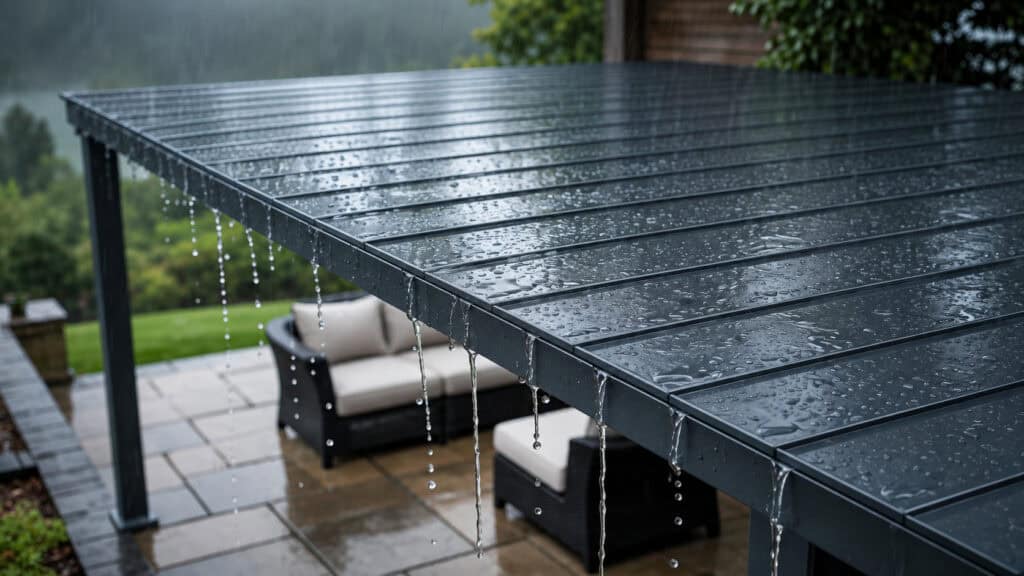
Closed louver blades form a near-continuous aluminum plane that sheds ordinary rainfall into an integrated perimeter gutter and routes water down through hollow structural posts to a grade-level outlet, keeping the area beneath substantially dry. Wind-driven rain enters freely from open sides, and blade seal quality, gutter slope, and drain sizing all condition how well the system performs in heavy precipitation. A motorized louvered pergola is a rain-shedding outdoor roof structure with adjustable aluminum blades driven by an electric actuator.
How the Water Is Collected and Routed
When a motorized louvered roof closes, the blades form a near-continuous plane that channels water laterally into a gutter machined into the perimeter beam, then downward through internal passages in the hollow aluminum posts – each post serving simultaneously as structural column and concealed downspout. Blade gaps caused by debris on the pivot, a drive out of adjustment, or differential thermal movement in the aluminum interrupt that sequence and produce drip points at the blade joints rather than controlled flow to the beam. At grade, the post base must include a drain tube or overflow port that directs discharge away from the footing, since water allowed to exit at the base plate and collect at the post base undermines both the footing and, where IRC 2021 R401.3 applies, the required drainage slope across the adjacent grade.
Blade seal, beam gutter and the hollow post as downspout
When a motorized louvered pergola‘s blades close, they overlap or seat against one another to form a near-continuous aluminum plane that functions as a rain-shedding roof. Water running across that plane travels along each blade toward a gutter channel machined directly into the perimeter beam, where it collects and flows by gravity toward the support posts. Each hollow post serves simultaneously as structural column and downspout, routing water through internal passages to a grade-level outlet. The post base must include a drain tube or overflow port so collected water exits at grade rather than pressurizing the assembly below the base plate – a condition that accelerates corrosion and can destabilize the footing.
Where the water has to go at grade
IRC 2021 Section R401.3 requires surface drainage to fall a minimum of six inches within the first ten feet measured away from the structure. Water discharging from a louvered pergola’s post outlets must consequently direct runoff away from both the post footings and any adjacent building foundation, and the grade beneath and around the pergola must be evaluated to confirm that positive slope is maintained. Where site conditions prevent adequate grade, options include a splash pad paired with positive slope away from the structure, a perforated pipe and French drain routed into the sub-base, or a connection to an underground storm drain system where local stormwater regulations permit. That last option brings the drainage assembly under IPC Chapter 11, which governs storm drainage sizing and secondary overflow provisions. What sits beneath the roof – a paver patio, an outdoor kitchen slab, an artificial turf sub-base – decides which of those routes is open, which is why outdoor living planning settles the discharge path before the posts are set.
Why a Louvered Roof Sometimes Leaks
A louvered roof’s performance degrades when debris accumulates in the beam gutter, blade adjustment drifts, or drainage sizing falls short of the tributary area’s demands during high-intensity rainfall. Blocked gutters overflow at the post-beam joint; blades that do not fully close – whether from pivot debris or drive misalignment – drip at every joint beneath them. Drain conductors sized without accounting for the full closed-louver roof area and the local 100-year hourly rainfall rate, as IPC 2021 Section 1106 requires, can be overwhelmed during a cloudburst even when every other component functions correctly.
Debris, slope and blade adjustment
Debris accumulation in the perimeter beam gutter is the most common cause of overflow in an otherwise correctly installed motorized louvered pergola, because a blocked channel forces collected rainwater to escape at the post-beam joint rather than through the designed internal drainage path. Leaves, pollen, and conifer needles gather at the gutter inlet and compress into a mat that resists flushing by light rain, leaving standing water that eventually overtops the beam face and stains the post. Slope compounds the problem: a beam set without positive fall toward the outlet, or one that has sagged over time due to footing settlement, holds water against the blocked section rather than draining it away. Blade adjustment failures – caused by debris on a pivot pin or a drive mechanism out of calibration – prevent full closure and introduce drip points at every blade joint during rainfall.
Drain sizing for roof area and rainfall intensity
IPC 2021 Section 1106 governs the sizing of conductors and leaders for roof drainage based on the horizontally projected roof area and the local 100-year hourly rainfall intensity drawn from IPC Figure 1106.1. Internal drainage passages within hollow pergola posts are typically small-bore channels, and a large louvered roof in a high-rainfall-intensity region can exceed that capacity during a cloudburst, producing brief overflow at the beam even when the gutter is otherwise clear. Sizing calculations must use the closed-louver tributary area, since the closed position is the condition under which the system captures its full rain load. Where a primary drain becomes blocked, IPC Sections 1107 and 1108 address secondary overflow provisions to prevent ponding and beam overload.
Living With a Louvered Roof in Wet Weather
A motorized louvered pergola performs as a rain-shedding roof only when its blades are closed; open blades render the structure fully permeable, and rain falls through without meaningful interception. Homeowners who reopen the blades immediately after a storm should expect residual water standing in the blade troughs and gutter channel to release as the blades rotate, producing a brief secondary drip across the area below. The closed position also cannot address wind-driven rain entering from the structure’s open sides, so lateral exposure remains a function of site orientation and prevailing storm direction rather than blade position.
Open, closed and the drip when blades reopen
Water standing in the blade troughs and the perimeter gutter channel discharges when motorized louvers rotate from the closed to the open position, releasing accumulated rain as a brief, concentrated drip along the blade edges. This release is a direct consequence of the closed-louver geometry: the overlapping aluminum blades form a near-continuous collecting plane that holds water until blade angle changes and gravity redistributes it. The practical implication is that reopening blades immediately after a rain event produces a secondary drip event beneath the pergola, distinct from the rain itself. Allowing drainage to complete before rotating the blades open eliminates the effect and prevents concentrated water release onto surfaces or occupants below.
Wind-driven rain and what the open sides admit
A motorized louvered aluminum pergola functions as a rain-shedding roof, not a sealed building enclosure, meaning wind-driven rain enters freely through the open sides regardless of blade position. This distinction defines the practical limits of wet-weather protection: closed blades intercept vertically falling precipitation and route it to the integrated gutter system, but lateral exposure remains unrestricted. The degree of intrusion depends on storm angle, wind speed, and the orientation of the open perimeters relative to prevailing weather. Occupants and furnishings positioned toward the windward edge of the structure receive the least protection during driven rain events, while the sheltered interior benefits most from the closed-louver roof plane above.
Frequently Asked Questions
Homeowners shopping for or already living with a motorized louvered pergola tend to arrive at the same four questions: whether the system is truly waterproof, where collected rain actually goes, why the structure drips after a storm has passed, and whether it holds up under heavy rainfall. Each answer connects to how the closed blades, integrated beam gutter, and hollow-post drainage path function as a system rather than as independent components. Understanding that relationship clarifies what the roof reliably does, where it has limits, and what maintenance keeps it performing as designed.
Is a louvered pergola waterproof?
A motorized louvered pergola with closed blades functions as a rain-shedding roof, keeping the space beneath substantially dry in ordinary rainfall. Wind-driven rain enters freely from open sides, and blade seal quality, gutter maintenance, and drainage sizing all affect performance. It is not a sealed building envelope.
Where does the rain go on a louvered pergola?
Closed louver blades channel rain into a perimeter gutter beam, which routes water through hollow structural posts and discharges it at grade. Blade seal quality, gutter slope, and internal passage sizing all determine how completely the system manages a given storm. Blocked gutter channels overflow at the post-beam joint, so periodic debris clearing is essential.
Why does my louvered pergola drip after it rains?
Water standing in the blade troughs and gutter channels releases when the blades rotate open after rain. Dripping continues until residual water fully drains from the perimeter beam gutters and internal post passages. Waiting for drainage to complete before reopening the blades eliminates most post-rain drip.
Can a louvered pergola handle heavy rain?
A motorized louvered pergola with closed blades handles ordinary rain effectively, routing water through integrated beam gutters and hollow posts to grade-level outlets. Drainage capacity is sized to the closed-louver roof area and local rainfall intensity per IPC 2021 Section 1106, meaning cloudburst conditions can briefly overwhelm undersized conductors. Blocked gutters or improper post-base drainage remain the most common failure points.
Louvered Pergola Installation by Backyard Paradiso
High-intensity rainfall events, expansive or settling soils, local stormwater discharge regulations, and jurisdiction-specific conductor sizing under IPC 2021 Section 1106 collectively determine whether a closed-blade louvered roof drains reliably over its service life. Backyard Paradiso works within these conditions on motorized louvered pergola systems and brings working familiarity with how post-drain sizing, beam slope, and grade-level discharge interact under the rainfall intensities and soil profiles common to the residential markets it serves. Consultations are available by appointment for homeowners evaluating louvered roof systems as covered outdoor living additions. A properly drained louvered roof turns a patio into covered, usable outdoor square footage for the full length of the season rather than the dry days alone.